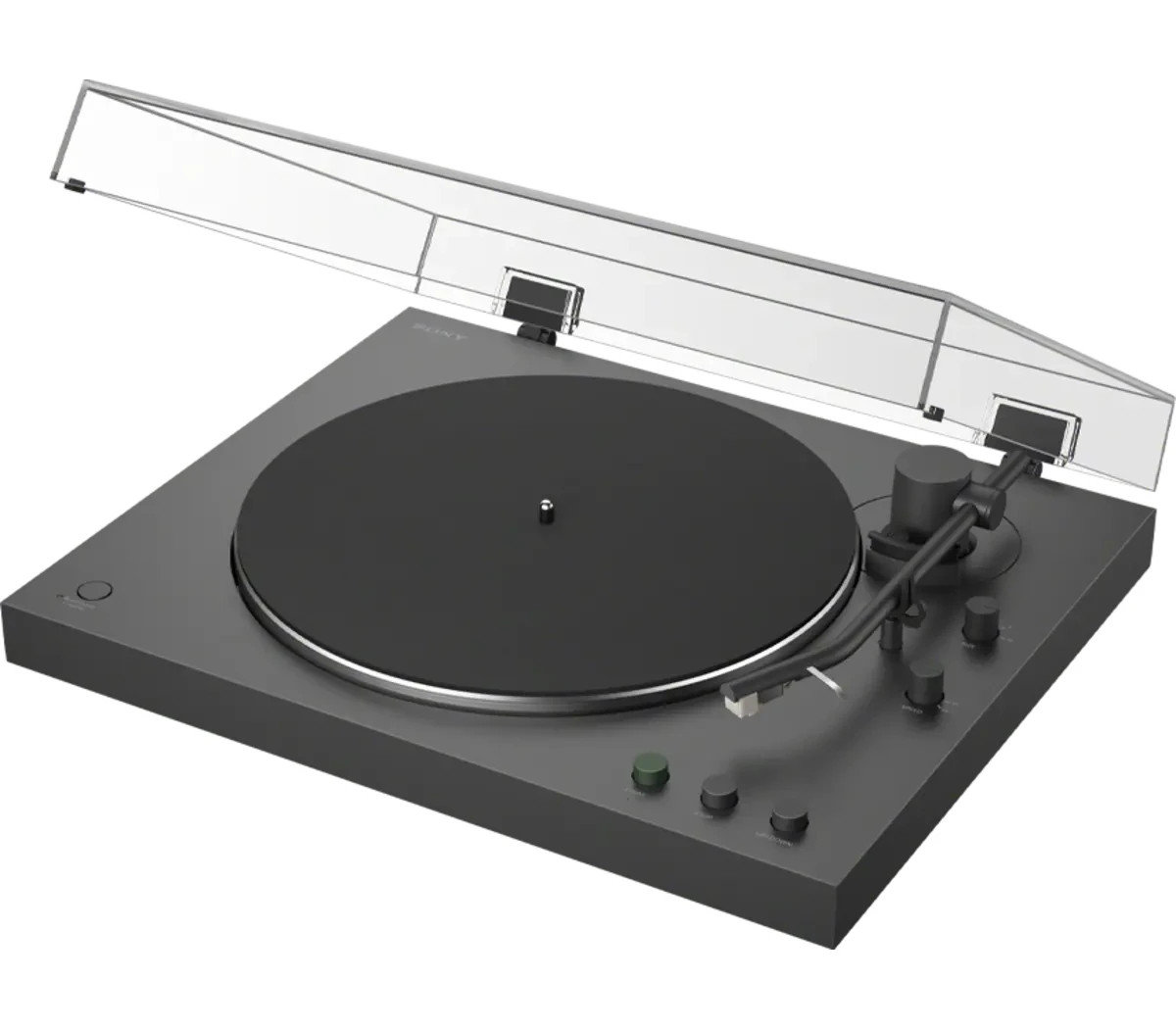

Photos from current listings. Actual item, color, and included accessories may vary.
Automatic Record Player Buying Guide
Automatic record players handle tonearm cueing and return (and often platter start/stop) at the push of a button or via auto-sensors, removing the risk of stylus drops that damage records and cartridges. The core trade-off is automation versus adjustability: fully automatic mechanisms add convenience but typically lock you into fixed tracking force and non-upgradeable cartridges, while semi-automatic and manual decks offer better arms and cartridges for the same money. The decision rule: buy fully automatic for low-friction family use and protected vinyl; buy semi-automatic or manual if you plan to upgrade the cartridge, adjust alignment, or pursue higher-fidelity playback.
Key takeaways
- Drive systems split into belt-drive (quieter, lower motor hum, needs belt replacement every few years) and direct-drive (instant start, higher torque, better for DJ use but requires motor isolation to avoid rumble).
- Fully automatic decks use optical or mechanical sensors to detect record size and end-of-side, then lift and return the arm; semi-automatic only auto-returns at the end, leaving manual cueing to the user.
- Bluetooth output on models like the Sony PS-LX3BT transmits the phono signal digitally, but you still need a moving-magnet phono stage or a built-in preamp to amplify before wireless transmission.
At a glance
- Category
- Turntables & Record Players
- Last updated
- Nov 25, 2026
Current offers
Highlights
- Drive systems split into belt-drive (quieter, lower motor hum, needs belt replacement every few years) and direct-drive (instant start, higher torque, better for DJ use but requires motor isolation to avoid rumble).
- Fully automatic decks use optical or mechanical sensors to detect record size and end-of-side, then lift and return the arm; semi-automatic only auto-returns at the end, leaving manual cueing to the user.
- Bluetooth output on models like the Sony PS-LX3BT transmits the phono signal digitally, but you still need a moving-magnet phono stage or a built-in preamp to amplify before wireless transmission.
- Built-in switchable preamps (MM) let you connect directly to powered speakers or Bluetooth; without one, you need an external phono stage or an amplifier/receiver with a PHONO input.
Best use cases
- Best fit: households with kids or guests where records may be played unattended — choose a fully automatic belt-drive with a hinged dust cover and built-in preamp for one-button start and auto-return.
- Best fit: casual listeners who want to stream vinyl to a Bluetooth speaker or soundbar — pick a model with Bluetooth output and a built-in phono preamp, skipping external receivers entirely.
- Wrong fit: buyers planning to upgrade cartridges, styli, or alignment — skip fixed-cartridge fully automatic decks and choose a semi-automatic or manual with a standard 1/2-inch headshell mount.
- Wrong fit: DJs or scratch performers — avoid automatic return mechanisms (they fight back-cueing) and choose a direct-drive manual turntable with high torque and a slipmat.
Buying tips
- Match the cartridge mount: fixed proprietary cartridges on automatic decks limit you to OEM styli; standard 1/2-inch headshell mounts accept any moving-magnet cartridge for future upgrades.
- Check the preamp: if your speakers are powered or you use Bluetooth, a built-in switchable MM preamp saves buying a separate phono stage; if you own a receiver with PHONO input, you can switch it off.
- Verify speed accuracy: quartz-locked or servo-controlled motors hold 33 1/3 and 45 RPM within ±0.5%; unregulated DC motors drift and cause pitch waver on sustained notes.
- Consider the tonearm mass: low-mass arms suit high-compliance cartridges; medium-mass arms (around 10-12 g effective mass) are the versatile default for most moving-magnet cartridges.
Specs
| Drive Type | Belt-drive vs Direct-drive |
|---|---|
| Automation | Fully auto / Semi-auto / Manual |
| Preamp | Built-in switchable MM vs None |
| Connectivity | Bluetooth / USB / RCA line-out |
Related searches
What to check before buying
- Measure your shelf or stand depth and clearance: most turntables need at least 14-16 inches of depth and 4-6 inches of height for the dust cover to open fully.
- Confirm your amplifier or speakers: count whether you have a PHONO input, line-level aux input, or only Bluetooth — this determines whether you need a built-in preamp.
- Check voltage and plug standard for your region (120V/60Hz North America vs 230V/50Hz Europe) and whether the motor is internally switchable or fixed.
- Account for the platter and dust cover: belt-drive decks often ship with a removable platter and hinged cover; direct-drive decks are heavier and may need a sturdier, level surface.
FAQ
Data sources: eBay / Amazon listings and product attribute feeds. Updated Nov 25, 2026.
Some links on this page are affiliate links. If you buy after clicking one, we may earn a commission at no extra cost to you. This does not change which products appear here or their order. Affiliate disclosure.