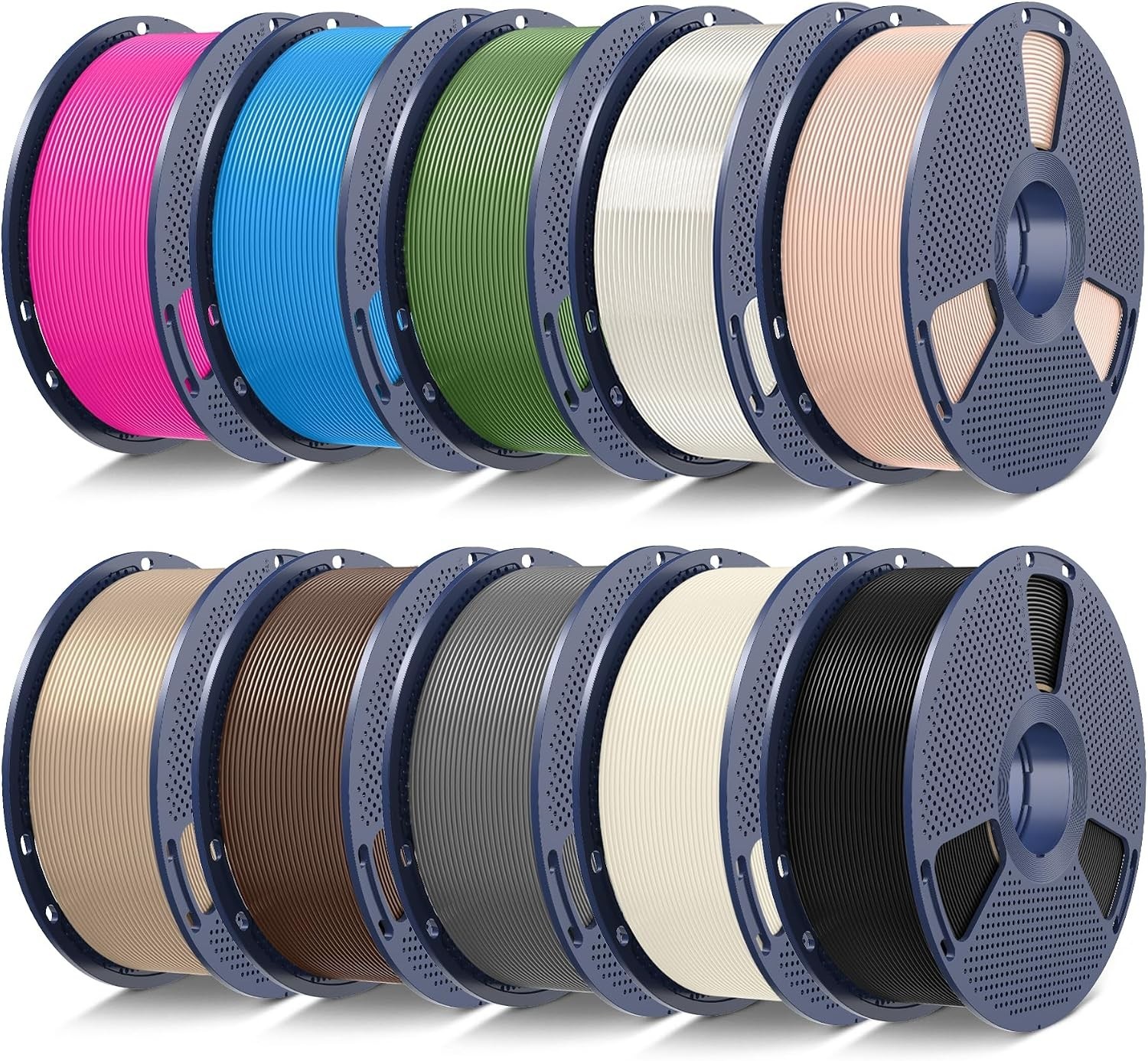

Photos from current listings. Actual item, color, and included accessories may vary.
Rainbow Filament Buying Guide
Rainbow filament is a multicolor FDM/FFF material whose hue shifts along the strand, producing color-changing prints without manual swaps. The core trade-off is gradient consistency and layer adhesion: cheap blended or surface-coated spools deliver dull transitions and weak bonds, while co-extruded PLA/PETG with tight diameter tolerance yields smooth, strong rainbows. Choose dual-color or multi-segment co-extrusion with ±0.02 mm tolerance for display parts; skip pastel-print PLA with loose tolerance for anything load-bearing.
Key takeaways
- Gradient architecture: co-extruded multi-segment strand (true rainbow) vs surface-painted or blended pellets that fade to muddy brown mid-spool.
- Diameter tolerance ±0.02 mm holds consistent flow and layer bonding; ±0.05 mm spools risk clogs and weak rainbow banding.
- PLA rainbow prints easily at 190-220°C but is brittle and UV-sensitive; rainbow PETG at 230-250°C adds ductility and outdoor durability.
At a glance
- Category
- 3D Printing Filament & Resin
- Last updated
- Nov 29, 2026
Current offers
Highlights
- Gradient architecture: co-extruded multi-segment strand (true rainbow) vs surface-painted or blended pellets that fade to muddy brown mid-spool.
- Diameter tolerance ±0.02 mm holds consistent flow and layer bonding; ±0.05 mm spools risk clogs and weak rainbow banding.
- PLA rainbow prints easily at 190-220°C but is brittle and UV-sensitive; rainbow PETG at 230-250°C adds ductility and outdoor durability.
- Spool color cycle length (e.g., 3-5 m per hue) determines band width: short cycles give rapid stripes, long cycles give slow, smooth transitions.
Best use cases
- Pick rainbow PLA for decorative vases, figurines, and low-stress display models where vivid banding matters more than impact strength.
- Pick rainbow PETG for functional outdoor parts, brackets, and toys needing UV and moisture resistance with still-visible color shifts.
- Skip surface-coated 'rainbow' spools for anything structural or post-processed—sanding and solvents expose the base color underneath.
Buying tips
- Verify co-extruded construction and ±0.02 mm tolerance before buying; blended-pellet spools cannot produce clean, repeating rainbow cycles.
- Match filament type to load: PLA for display only; PETG when parts face sunlight, heat, or flex; avoid rainbow TPU for high-speed prints.
- Check spool color-cycle length against model size—a 3-5 m cycle suits small prints, while 10 m+ cycles suit tall vases and lamps.
- Confirm 1.75 mm diameter and FDM compatibility; rainbow filament is rarely offered in 2.85 mm, so direct-drive and Bowden setups need a 1.75 mm path.
Specs
| Gradient Type | Co-extruded multi-segment vs blended |
|---|---|
| Material | PLA / PETG / TPU rainbow blends |
| Diameter Tolerance | ±0.02 mm (±0.05 mm budget) |
| Color Cycle Length | 3-5 m fast / 10 m+ slow shifts |
Related searches
What to check before buying
- Measure your printer's filament path: 1.75 mm hotend and extruder gearing are required; rainbow spools are almost exclusively 1.75 mm.
- Confirm spool outer diameter and hub width fit your holder—standard 200 mm spools need a holder rated for 1 kg rolls.
- Check hotend temperature capability: rainbow PETG needs 230-250°C, so all-metal hotends are required; PTFE-lined hotends cap near 240°C.
- Plan drying: rainbow PLA and PETG absorb moisture; a filament dryer keeps transitions crisp and prevents popping or weak layers.
FAQ
Data sources: eBay / Amazon listings and product attribute feeds. Updated Nov 29, 2026.
Some links on this page are affiliate links. If you buy after clicking one, we may earn a commission at no extra cost to you. This does not change which products appear here or their order. Affiliate disclosure.