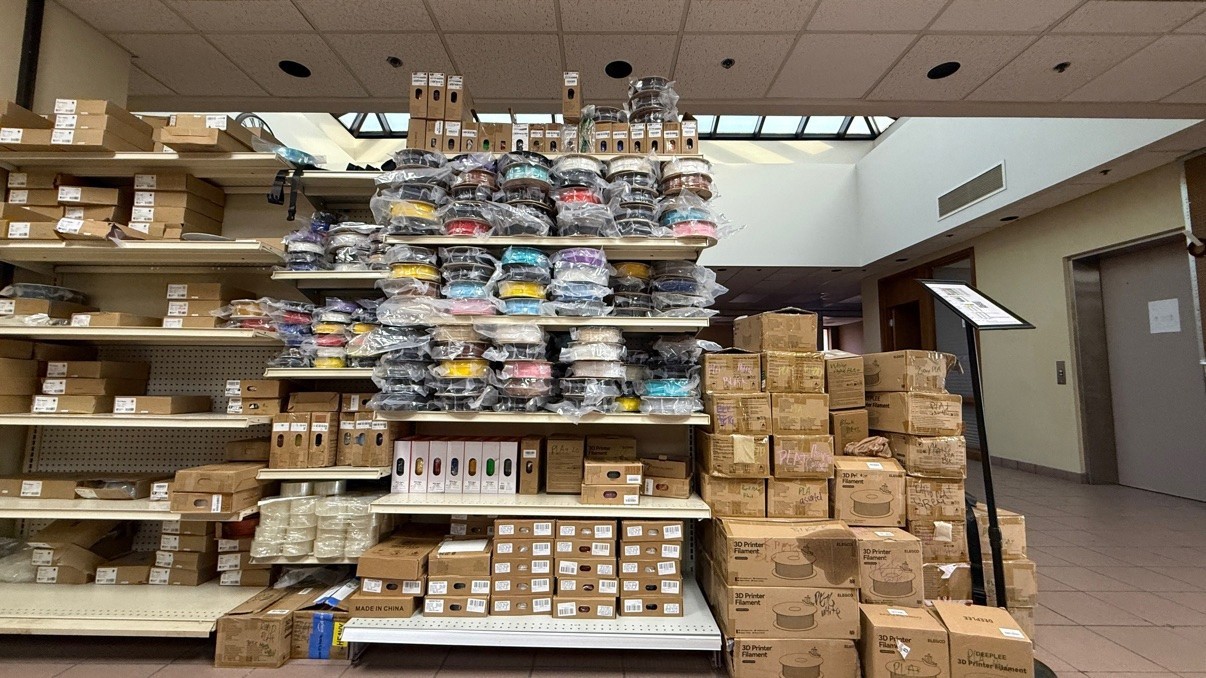

Photos from current listings. Actual item, color, and included accessories may vary.
3D Printing Filament Buying Guide
3D printing filament is the consumable feedstock for FDM printers, where polymer chemistry and diameter tolerance directly determine print success, part strength, and surface finish. The core trade-off is printability versus mechanical/thermal performance: PLA is easiest but brittle and heat-sensitive, while PETG, ABS/ASA, and TPU demand calibrated profiles but deliver toughness, heat resistance, or flexibility. The decision rule is simple: match filament to your printer's hotend/enclosure capabilities and the part's end-use environment—never buy specialty polymer without the hardware to print it.
Key takeaways
- 1.75mm is the industry-standard diameter for virtually all modern FDM printers; 2.85mm is a specialty format for select Ultimaker and older direct-drive systems and will not feed in 1.75mm hardware.
- Diameter tolerance of ±0.02mm ensures consistent extrusion and layer adhesion; ±0.05mm is acceptable for visual models but risks under/over-extrusion on precision parts.
- PLA prints at 190–220°C with no heated bed requirement and low warping, but softens near 60°C; PETG at 230–250°C offers higher toughness and moderate heat resistance with slightly more stringing.
At a glance
- Category
- 3D Printing Filament & Resin
- Last updated
- Nov 29, 2026
Current offers
Highlights
- 1.75mm is the industry-standard diameter for virtually all modern FDM printers; 2.85mm is a specialty format for select Ultimaker and older direct-drive systems and will not feed in 1.75mm hardware.
- Diameter tolerance of ±0.02mm ensures consistent extrusion and layer adhesion; ±0.05mm is acceptable for visual models but risks under/over-extrusion on precision parts.
- PLA prints at 190–220°C with no heated bed requirement and low warping, but softens near 60°C; PETG at 230–250°C offers higher toughness and moderate heat resistance with slightly more stringing.
- ABS/ASA require 240–260°C and an enclosed printer to prevent warping and layer splitting; TPU (shore 95A) needs direct-drive extrusion and slow speeds of 20–30mm/s for reliable feeding.
Best use cases
- Best fit: PLA for decorative models, prototypes, and low-stress household items on open-frame printers—buy 1kg spools or multi-color bundles for variety without committing to exotic polymer.
- Best fit: PETG for functional parts needing impact resistance and mild heat tolerance (brackets, enclosures, outdoor-adjacent items) on printers with part-cooling and a heated bed.
- Best fit: ABS/ASA only if you have an enclosed printer and need UV/heat resistance up to 90–100°C for automotive or outdoor functional parts.
- Wrong fit: buying TPU or ABS for an open-frame printer without direct-drive or enclosure—these will string, warp, or fail to feed; skip silk/rainbow gradients for structural parts since pigments can weaken layer bonding.
Buying tips
- Confirm your printer's filament diameter first: 1.75mm covers nearly all consumer FDM machines; 2.85mm is reserved for specific Ultimaker and industrial direct-drive platforms.
- Calculate spool economics by net weight, not gross: a 1kg spool yields roughly 330m of 1.75mm PLA; 250g sample spools suit testing colors, while 3kg spools reduce swap frequency for high-volume printing.
- Choose ±0.02mm tolerance for mechanical or multi-part assemblies; ±0.05mm is fine for large visual prints where minor extrusion variation is invisible.
- For multi-color work, buy 5- or 12-pack PLA bundles for consistent diameter and color matching; for engineering parts, buy single 1kg spools of PETG or ASA from a known polymer grade rather than assortments.
Specs
| Filament Diameter | 1.75mm standard / 2.85mm specialty |
|---|---|
| Diameter Tolerance | ±0.02mm tight / ±0.05mm acceptable |
| Polymer Options | PLA, PETG, ABS/ASA, TPU |
| Spool Net Weight | 1kg typical / 250g–3kg ranges |
Related searches
What to check before buying
- Verify your hotend's maximum temperature: PLA needs 220°C, PETG 250°C, ABS/ASA 260°C—an all-metal hotend is required above 240°C to avoid PTFE degradation.
- Check bed surface and enclosure: PLA works on bare glass or PEI at 50–60°C; PETG needs 70–80°C and a release agent; ABS/ASA requires an enclosure and 90–100°C bed.
- Confirm spool dimensions fit your holder: standard 1kg spools are 200mm diameter with 53–55mm hub, while 3kg spools exceed most stock holders and need an external rack.
- Match extrusion system to polymer: direct-drive is required for TPU below shore 98A; Bowden setups should stay with PLA or PETG to avoid flexible filament buckling.
FAQ
Data sources: eBay / Amazon listings and product attribute feeds. Updated Nov 29, 2026.
Some links on this page are affiliate links. If you buy after clicking one, we may earn a commission at no extra cost to you. This does not change which products appear here or their order. Affiliate disclosure.