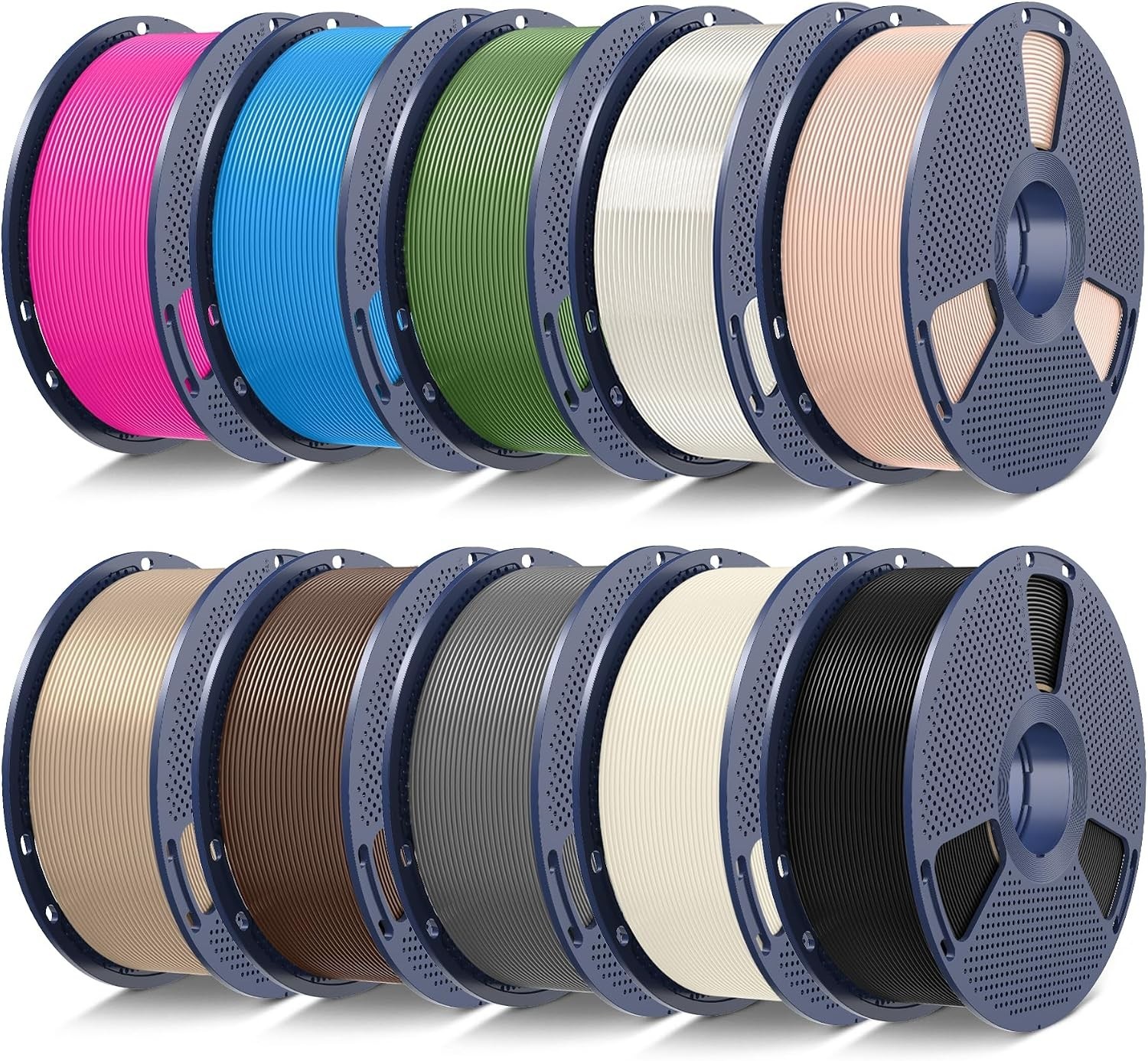

Photos from current listings. Actual item, color, and included accessories may vary.
Rainbow 3D Printer Filament Buying Guide
Rainbow 3D printer filament is a multi-color FDM material that transitions through a spectrum along a single spool, using either blended gradient segments or sharp color-change markers. The core trade-off is visual effect versus print consistency: gradient blends hide layer lines and Z-seams but make repeatable color placement impossible, while segmented rainbows deliver bold bands but require careful purge and waste planning. Choose a gradient spool when aesthetic one-off prints matter most; choose segmented or dual-extrusion setups when you need controlled, repeatable multi-color parts.
Key takeaways
- Gradient rainbow filament is co-extruded with continuously shifting pigment ratios, producing smooth hue transitions every few meters rather than abrupt color blocks.
- Segmented rainbow filament changes color at fixed meter intervals (commonly every 10–20 m), creating distinct bands whose placement depends on model volume and slicer flow.
- PETG rainbow variants print at 230–250 °C with bed temps of 70–80 °C, offering higher layer adhesion and UV resistance than standard PLA rainbow spools.
At a glance
- Category
- 3D Printing Filament & Resin
- Last updated
- Nov 29, 2026
Current offers
Highlights
- Gradient rainbow filament is co-extruded with continuously shifting pigment ratios, producing smooth hue transitions every few meters rather than abrupt color blocks.
- Segmented rainbow filament changes color at fixed meter intervals (commonly every 10–20 m), creating distinct bands whose placement depends on model volume and slicer flow.
- PETG rainbow variants print at 230–250 °C with bed temps of 70–80 °C, offering higher layer adhesion and UV resistance than standard PLA rainbow spools.
- PLA rainbow remains the most dimensionally stable for fine detail, but pigments can alter melt flow; expect ±0.02–0.03 mm diameter tolerance on quality gradient spools.
Best use cases
- Best fit: decorative vases, low-poly sculptures, and display models where a single gradient spool creates a continuous color sweep without multi-material hardware.
- Best fit: segmented rainbow spools for large flat prints or spiral vase mode, where color bands align predictably with Z-height and produce clean horizontal stripes.
- Wrong fit: functional mechanical parts or repeated identical production runs—gradient color shifts make batch color matching impossible and hide print defects.
- Skip if you need precise multi-color logos or text: rainbow filament cannot place specific colors on specific features; use a dual-extruder or AMS-style system instead.
Buying tips
- Match spool diameter to your printer: 1.75 mm is standard for most consumer FDM machines; 2.85 mm is reserved for Bowden-style ultimaker-class systems and will jam a 1.75 mm hotend.
- Check net filament weight, not gross spool weight: a 1 kg net spool yields roughly 330 m of 1.75 mm PLA, enough for one large gradient vase or several small models.
- For gradient consistency, buy spools from the same production batch; different batches can start and end on different hues, breaking color continuity across projects.
- Choose PETG rainbow for outdoor or heat-exposed prints (car interiors, garden markers); PLA rainbow will deform near 60 °C and is indoor-display only.
Specs
| Material Type | PLA / PETG / ABS rainbow blends |
|---|---|
| Color Style | Gradient blend vs segmented bands |
| Filament Diameter | 1.75 mm standard / 2.85 mm specialty |
| Net Spool Weight | 0.5 kg / 1 kg / 2 kg options |
Related searches
What to check before buying
- Confirm your printer's filament diameter (1.75 mm vs 2.85 mm) and hotend maximum temperature—PETG rainbow requires at least 250 °C capability.
- Measure spool hub bore and outer diameter against your holder: standard 200 mm outer diameter fits most printers, but oversized 250 mm spools need an external holder.
- Verify your build surface handles the material: PETG rainbow bonds aggressively to bare glass and can chip it; use textured PEI or a release agent.
- Plan purge waste for segmented spools: color changes mid-print between different rainbow spools require a purge block or wipe tower, adding 10–20% material consumption.
FAQ
Data sources: eBay / Amazon listings and product attribute feeds. Updated Nov 29, 2026.
Some links on this page are affiliate links. If you buy after clicking one, we may earn a commission at no extra cost to you. This does not change which products appear here or their order. Affiliate disclosure.