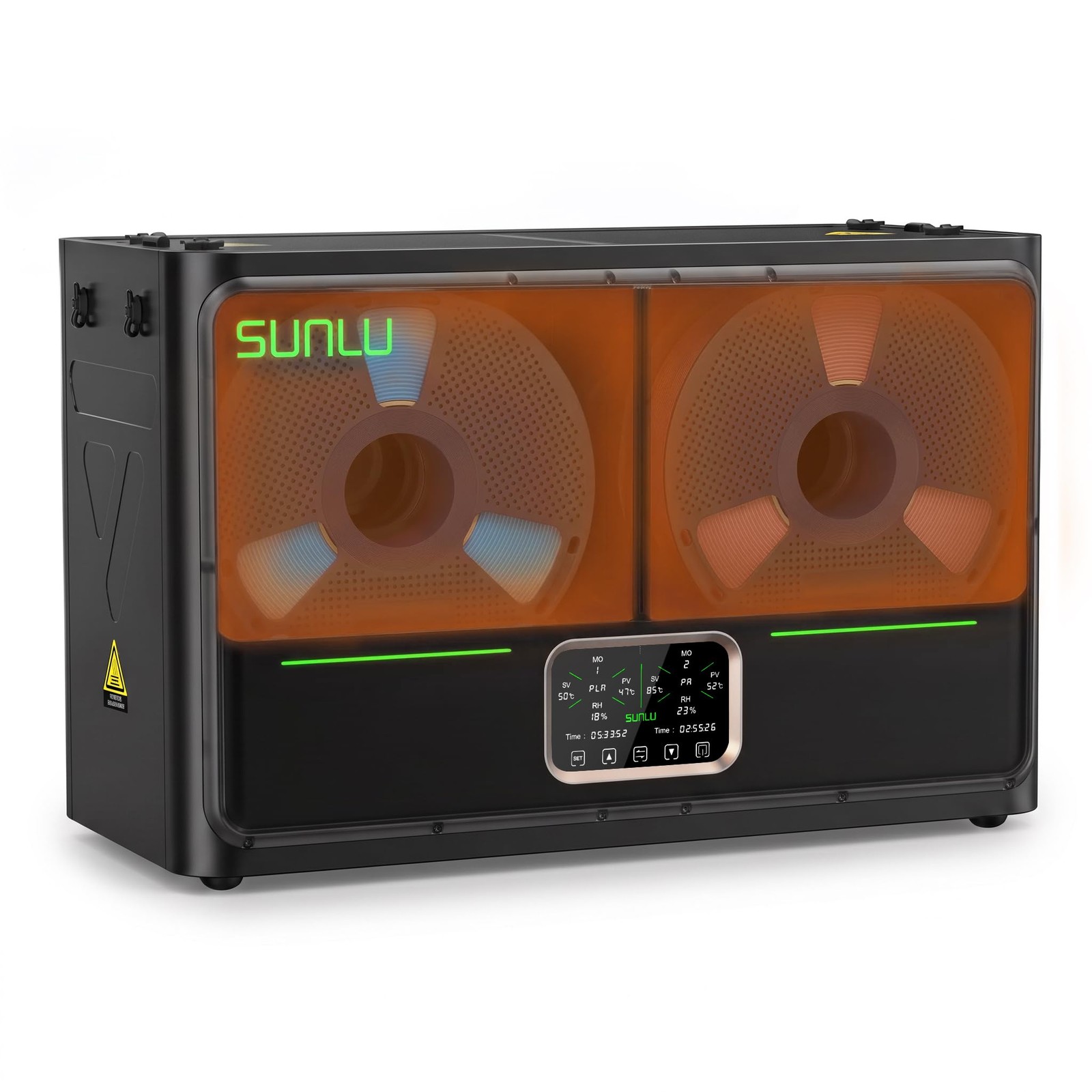

Photos from current listings. Actual item, color, and included accessories may vary.
Sunlu Dryer Box Buying Guide
A Sunlu dryer box is a dedicated heated filament dehydrator that removes absorbed moisture from FDM/FFF spools before printing, preventing stringing, bubbling, and weak layer adhesion. The core trade-off is single-spool compact drying versus multi-spool capacity and temperature uniformity, with the decision rule being: buy a unit whose max temperature covers your most hygroscopic filament and whose chamber fits your typical spool diameter and width.
Median $224.99 · New listings
Key takeaways
- Sunlu dryer boxes are single-spool units with a maximum drying temperature of 55°C to 70°C, suiting PLA, PETG, TPU, and some nylons but not high-temp engineering blends requiring 80°C+.
- Chamber clearance accommodates standard 200 mm (8 in) spool diameters and widths up to 70 mm, but oversized 250 mm or 1 kg wide-hub spools may not seat flush.
- Heating is resistive with a low-power fan for convective circulation; there is no active desiccant regeneration or sealed dry-air loop, so ambient humidity affects final dryness.
At a glance
- Category
- Filament Drying & Post-Processing
- Last updated
- Nov 28, 2026
Current offers
Highlights
- Sunlu dryer boxes are single-spool units with a maximum drying temperature of 55°C to 70°C, suiting PLA, PETG, TPU, and some nylons but not high-temp engineering blends requiring 80°C+.
- Chamber clearance accommodates standard 200 mm (8 in) spool diameters and widths up to 70 mm, but oversized 250 mm or 1 kg wide-hub spools may not seat flush.
- Heating is resistive with a low-power fan for convective circulation; there is no active desiccant regeneration or sealed dry-air loop, so ambient humidity affects final dryness.
- Controls are timer-based (typically 6–24 hours) with a fixed or selectable temperature setpoint; there is no onboard hygrometer or auto-hold humidity feedback on base models.
Best use cases
- Best fit: single-spool FDM printers running PLA, PETG, or TPU in humid climates where a compact 55–70°C dryer restores spools overnight and fits on a desk beside the printer.
- Best fit: print farms with one dryer per active spool, using timer-based drying cycles before each long print to eliminate moisture-driven stringing without a full filament-storage overhaul.
- Wrong fit: polycarbonate, PEI, or PPS spools needing 80–120°C drying—choose a dual-chamber or oven-style dryer rated above 80°C instead of a Sunlu box.
- Wrong fit: high-throughput operations drying multiple spools simultaneously—pick a multi-spool cabinet dryer with independent temperature zones rather than stacking single-spool boxes.
Buying tips
- Match max drying temperature to filament: 55–60°C covers PLA and TPU; 65–70°C covers PETG and most nylons; above 80°C you must step up to an engineering-grade dryer.
- Measure spool outer diameter and width before buying: standard 200 mm diameter and 60–70 mm width fits; 250 mm or 100 mm wide spools require a larger chamber.
- Prefer units with a visible temperature display and adjustable setpoint over fixed-temperature models, so you can dial down for PLA and up for PETG without guessing.
- Budget for a separate hygrometer or a dry-box storage system—the dryer removes moisture but does not keep filament dry after the cycle ends.
Specs
| Max Dry Temp | 55–70°C (PLA/PETG/TPU/nylon) |
|---|---|
| Spool Capacity | Single spool, ≤200 mm dia / 70 mm wide |
| Control Type | Timer 6–24 hr, adjustable setpoint |
| Heating Method | Resistive heater + convection fan |
Related searches
What to check before buying
- Confirm your spool diameter is ≤200 mm and width ≤70 mm; larger spools need a wider-chamber dryer or a spool adapter.
- Verify your filament's recommended drying temperature is at or below the dryer's maximum setpoint—PLA 45–55°C, PETG 65°C, nylon 70–80°C.
- Check that the unit's plug and voltage match your region (120V North America, 220–240V EU/UK) and that the power draw fits your bench outlet.
- Plan space for the dryer plus clearance for the spool to rotate freely, and keep a hygrometer nearby to confirm chamber humidity drops during the cycle.
FAQ
Data sources: eBay / Amazon listings and product attribute feeds. Updated Nov 28, 2026.
Some links on this page are affiliate links. If you buy after clicking one, we may earn a commission at no extra cost to you. This does not change which products appear here or their order. Affiliate disclosure.