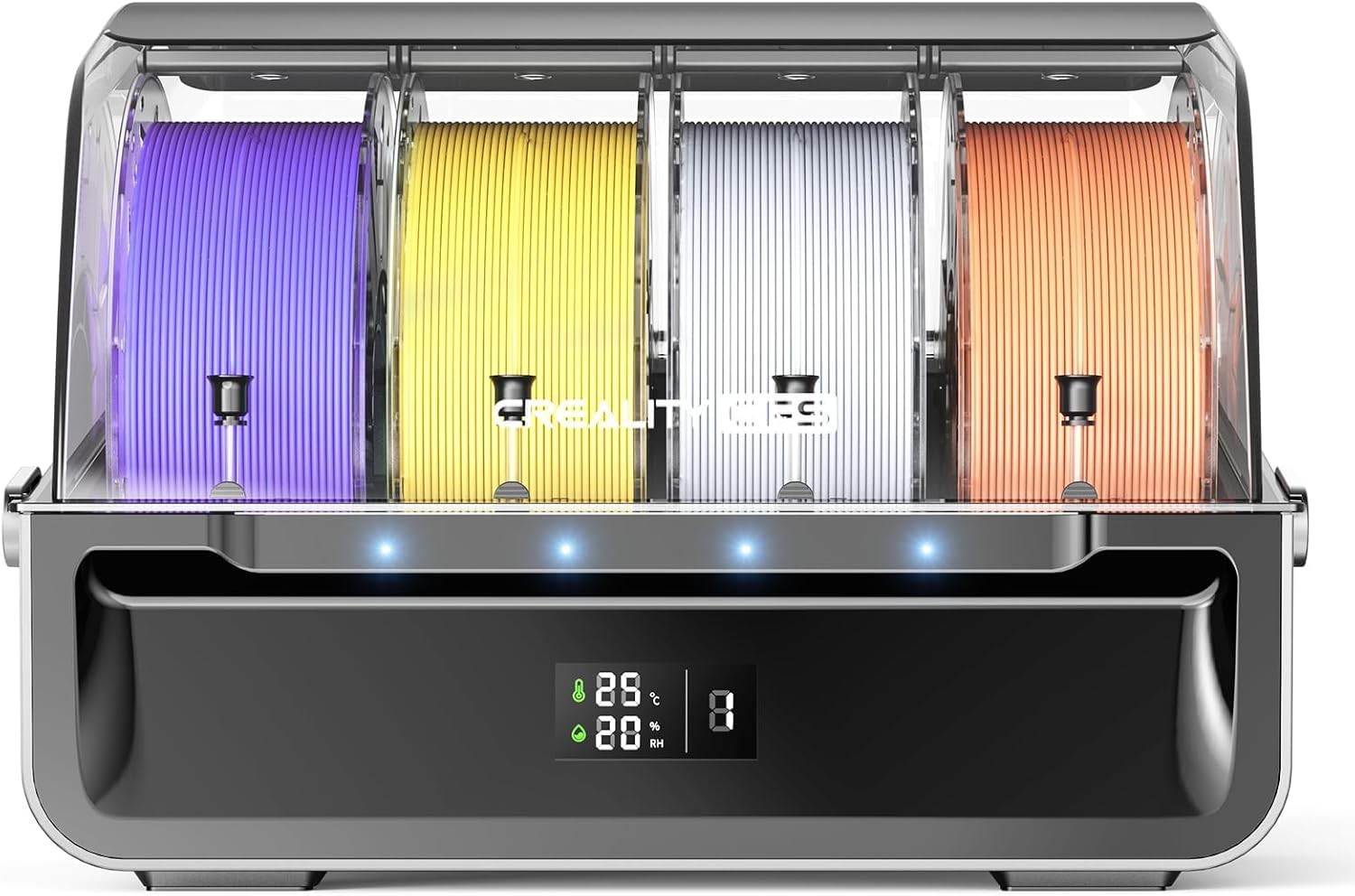

Photos from current listings. Actual item, color, and included accessories may vary.
3D Printer Filament Storage Buying Guide
Filament storage ranges from simple sealed boxes with desiccant to actively heated dryers that maintain low humidity. The key trade-off is passive moisture barrier versus active drying capability, with heated units adding temperature control and fan circulation. Buy passive sealed boxes only if you dry filament separately before storage; choose an active dryer-storage hybrid if you need to recover wet spools and keep them ready to print.
Key takeaways
- Passive storage boxes rely on desiccant packs and an airtight gasket; without a hygrometer you cannot confirm humidity stays below the 20% RH threshold that keeps PLA and PETG dry.
- Heated dryer boxes add a PTC heating element and fan, typically reaching 40–70°C, which can dry PLA, PETG, and TPU but not high-temp engineering plastics like PEEK or PEI.
- Spool capacity is fixed by internal rack geometry; 4-spool units like the SpacePi X4 fit standard 200mm-diameter spools but may not accept oversized 250mm or 1kg cardboard spools without wobble.
At a glance
- Category
- Filament Drying & Post-Processing
- Last updated
- Nov 28, 2026
Current offers
Highlights
- Passive storage boxes rely on desiccant packs and an airtight gasket; without a hygrometer you cannot confirm humidity stays below the 20% RH threshold that keeps PLA and PETG dry.
- Heated dryer boxes add a PTC heating element and fan, typically reaching 40–70°C, which can dry PLA, PETG, and TPU but not high-temp engineering plastics like PEEK or PEI.
- Spool capacity is fixed by internal rack geometry; 4-spool units like the SpacePi X4 fit standard 200mm-diameter spools but may not accept oversized 250mm or 1kg cardboard spools without wobble.
- Filament absorbs moisture within hours in humid air; sealed storage with fresh desiccant maintains dryness for weeks, while unsealed storage exposes spools to ambient humidity swings.
Best use cases
- Best fit for passive storage: you already own a separate filament dryer and need to keep 4–8 dried spools protected; pick a gasketed box with a hygrometer and rechargeable desiccant.
- Best fit for active dryer-storage: you print daily in a humid climate and want one unit that dries and stores; choose a heated box with fan circulation and adjustable temperature up to at least 70°C.
- Wrong fit: buying a passive box for wet filament expecting it to dry spools—desiccant only maintains dryness, it cannot remove moisture from an already saturated spool.
- Wrong fit: using a heated dryer box for nylon or polycarbonate—these need 80–90°C drying temperatures that most consumer dryer boxes cannot reach.
Buying tips
- Match internal rack diameter to your spool size: standard 1kg spools are 200mm diameter and 65–75mm wide; confirm the box accepts your widest spool before buying a 4-spool unit.
- Look for a silicone or rubber gasket plus a mechanical latch; clamp-style lids without gaskets leak humid air and defeat desiccant within days.
- For heated dryers, check the maximum temperature: 40–50°C suits PLA, 60–70°C suits PETG and TPU, and anything below 40°C is too slow for effective drying.
- Buy desiccant in rechargeable silica gel form with an indicator; 50–100g per sealed box is typical, and you recharge at 120°C for 2 hours when the indicator changes color.
Specs
| Storage Type | Passive sealed vs heated active |
|---|---|
| Spool Capacity | 2 / 4 / 6 spools per box |
| Max Dry Temp | 40–70°C (PLA/PETG/TPU) |
| Seal & Monitoring | Gasket latch + hygrometer |
Related searches
What to check before buying
- Measure your spool diameter and width—standard 1kg is 200mm × 68mm, but cardboard and 1.5kg spools run wider and may not fit 4-spool racks.
- Confirm your room humidity: above 60% RH year-round demands an active heated dryer, while below 40% RH makes passive sealed storage viable after initial drying.
- Check voltage and plug standard for heated units; most consumer dryer boxes are 100–240V with regional plugs, but some eBay imports ship with non-standard plugs.
- Verify you have a hygrometer (built-in or separate) to monitor internal RH; without it you cannot tell when desiccant is exhausted or when filament has reabsorbed moisture.
FAQ
Data sources: eBay / Amazon listings and product attribute feeds. Updated Nov 28, 2026.
Some links on this page are affiliate links. If you buy after clicking one, we may earn a commission at no extra cost to you. This does not change which products appear here or their order. Affiliate disclosure.