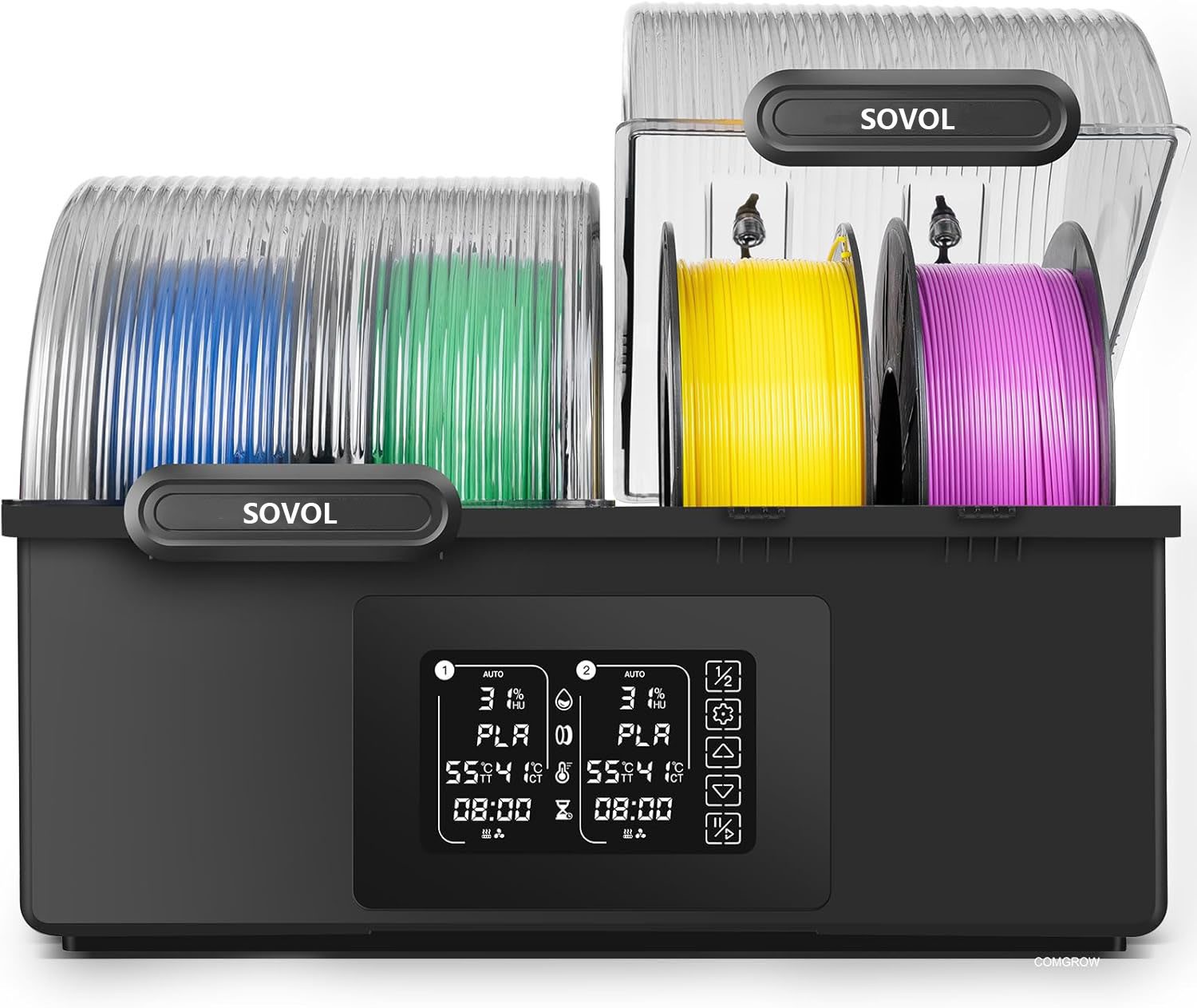

Photos from current listings. Actual item, color, and included accessories may vary.
Filament Dry Box Buying Guide
A filament dry box is a sealed, desiccant-equipped enclosure that keeps 3D printing filament below hygroscopic saturation between prints. The primary trade-off is passive desiccant storage versus active heated drying: passive boxes maintain dry filament but cannot rescue wet spools, while heated boxes add a heater and fan to actively dry. Choose a passive box if you print frequently and store spools short-term; choose an active heated dry box if you buy in bulk, live in a humid climate, or print hygroscopic polymers like PETG, TPU, or nylon.
Key takeaways
- Passive dry boxes rely on silica gel desiccant and a gasketed seal; performance is set by desiccant mass and seal quality, not by spool count.
- Active heated dry boxes add a PTC heater and convection fan; max temperature determines which polymers you can dry—85°C covers PLA, PETG, TPU, and most nylons, while 70°C limits you to PLA and PETG.
- Multi-spool capacity units (3-4 spools) trade bench space for bulk storage; stackable modular boxes let you scale capacity vertically without a larger footprint.
At a glance
- Category
- Filament Drying & Post-Processing
- Last updated
- Nov 28, 2026
Current offers
Highlights
- Passive dry boxes rely on silica gel desiccant and a gasketed seal; performance is set by desiccant mass and seal quality, not by spool count.
- Active heated dry boxes add a PTC heater and convection fan; max temperature determines which polymers you can dry—85°C covers PLA, PETG, TPU, and most nylons, while 70°C limits you to PLA and PETG.
- Multi-spool capacity units (3-4 spools) trade bench space for bulk storage; stackable modular boxes let you scale capacity vertically without a larger footprint.
- Filament diameter compatibility (1.75 mm vs 2.85 mm) is set by spool holder geometry and feed port size; confirm the box accepts your spool hub width and diameter before buying.
Best use cases
- Best fit: A passive sealed dry box with fresh silica gel for a PLA/PETG printer running daily in a dry climate—cheap, silent, and enough to prevent stringing and weak layer adhesion.
- Best fit: An active heated dry box rated to 85°C for PETG, TPU, or nylon spools that arrive wet or sit for weeks—the heater does the drying work that desiccant alone cannot.
- Wrong fit: Buying a passive box to rescue already-wet filament—desiccant maintains dryness but will not drive moisture out of a saturated spool at room temperature.
- Wrong fit: A 4-spool heated unit for a single-printer hobby setup with two spools—you pay for capacity and bench space you do not use; a 1-2 spool unit or stackable passive boxes fit better.
Buying tips
- Match max temperature to your polymer: 85°C covers PLA, PETG, TPU, and most nylon; 70°C is enough for PLA/PETG only; do not exceed a polymer's glass transition temperature while drying.
- Size desiccant mass to box volume—plan on roughly 50-100 g of fresh silica gel per spool of storage, and recharge indicator gel when it shifts color.
- For multi-spool storage, prefer stackable boxes with independent lids so opening one spool does not expose the whole inventory to room humidity.
- Check spool compatibility: standard 1.75 mm spools are 200 mm outer diameter with a 50-75 mm hub; wider 2.85 mm spools and large 3 kg reels need a box rated for that hub width and diameter.
Specs
| Drying Method | Passive desiccant vs active heated |
|---|---|
| Max Temp | 70°C vs 85°C PTC heater |
| Spool Capacity | 1-2 vs 3-4 spools / stackable |
| Filament Diameter | 1.75 mm vs 2.85 mm compatible |
Related searches
What to check before buying
- Measure your spool outer diameter and hub width—most boxes accept 200 mm spools, but 250 mm and 3 kg reels need a larger enclosure.
- Confirm filament diameter: 1.75 mm and 2.85 mm feed ports and holders differ; buy the box matching your printer's filament size.
- Check your room's average relative humidity—above 60% RH, passive desiccant saturates fast and an active heated box is the safer choice.
- Verify power requirements for heated boxes: most use a standard wall adapter, but confirm the plug type and voltage match your region (120V vs 230V).
FAQ
Data sources: eBay / Amazon listings and product attribute feeds. Updated Nov 28, 2026.
Some links on this page are affiliate links. If you buy after clicking one, we may earn a commission at no extra cost to you. This does not change which products appear here or their order. Affiliate disclosure.