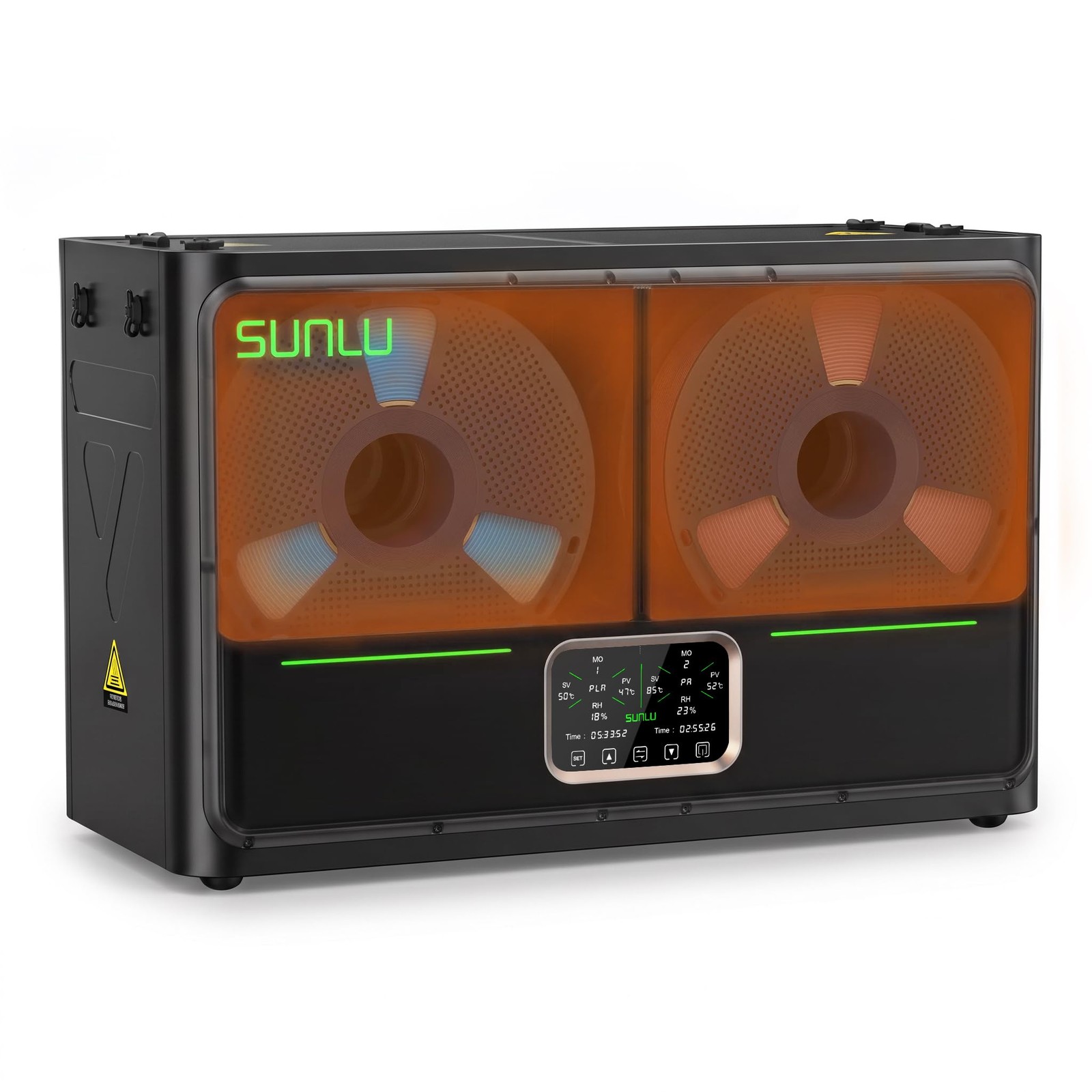

Photos from current listings. Actual item, color, and included accessories may vary.
Sunlu Filament Dryer Buying Guide
A Sunlu filament dryer is a dedicated heated chamber that removes moisture from 3D printing filament before extrusion, preventing bubbling, stringing, and weak layer adhesion. The primary trade-off is between single-spool desktop units and larger multi-spool or high-capacity chambers, which determines drying speed, spool compatibility, and whether you can dry engineering-grade polymers that demand sustained heat. Buyers should prioritize units with active airflow, a true temperature hold at or above 70°C for PETG/ABS/ASA, and sealed lids with desiccant compartments; pass on passive desiccant boxes or unheated dry boxes for any moisture-sensitive material.
Median $224.99 · New listings
Key takeaways
- Sunlu dryers use PTC heating elements with fan-forced convection; models like the S1 Plus reach 70°C, while the S2/S4 series adds higher wattage and dual-zone or four-spool capacity.
- Chamber temperature accuracy within ±2°C matters: PLA dries at 45–50°C, PETG at 65–70°C, ABS/ASA at 70–80°C, and TPU/nylon often need 70–80°C with longer dwell times.
- Sealed lid with silicone gasket and integrated desiccant holder maintains low humidity after the heat cycle; without it, filament reabsorbs moisture within hours in humid rooms.
At a glance
- Category
- Filament Drying & Post-Processing
- Last updated
- Nov 28, 2026
Current offers
Highlights
- Sunlu dryers use PTC heating elements with fan-forced convection; models like the S1 Plus reach 70°C, while the S2/S4 series adds higher wattage and dual-zone or four-spool capacity.
- Chamber temperature accuracy within ±2°C matters: PLA dries at 45–50°C, PETG at 65–70°C, ABS/ASA at 70–80°C, and TPU/nylon often need 70–80°C with longer dwell times.
- Sealed lid with silicone gasket and integrated desiccant holder maintains low humidity after the heat cycle; without it, filament reabsorbs moisture within hours in humid rooms.
- Spool size support typically caps at 1 kg with 200 mm diameter; larger 2–3 kg spools require the wider S2 or S4 chamber, and some units include adjustable roller bases to reduce friction during printing.
Best use cases
- Pick a single-spool Sunlu S1 Plus or S2 if you print mostly PLA and PETG on one printer and need a compact, countertop unit that doubles as a dry box during printing.
- Choose the four-spool Sunlu S4 if you run multiple printers, store several open spools, or regularly dry nylon and PC blends that need longer cycles and higher sustained heat.
- Skip any Sunlu dryer for engineering filaments like PEEK or PEI if the unit's maximum temperature is below 90°C—those polymers require dedicated high-temp ovens, not consumer filament dryers.
Buying tips
- Match the dryer’s max temperature to your filament: PLA/PETG need 45–70°C, ABS/ASA need 70–80°C, and nylon/TPU need 70–80°C with 6–12 hour cycles; a 70°C cap covers most hobby materials but not high-temp engineering plastics.
- Check spool diameter and width clearance: most Sunlu units accept 200 mm diameter, 70 mm wide spools; 2 kg and 3 kg spools need the wider S2/S4 chamber or an external roller stand.
- Prefer units with a digital thermostat and timer over dial-only controls, because precise temperature hold prevents PLA softening or PETG deformation during long drying cycles.
- Look for a removable desiccant compartment and a sealed lid gasket—these let the dryer function as a storage dry box between prints, extending filament shelf life in humid climates.
Specs
| Max Temperature | 70°C typical (PLA/PETG/ABS) |
|---|---|
| Spool Capacity | 1 spool (S1/S2) / 4 spools (S4) |
| Heating Method | PTC element + fan convection |
| Sealed Lid | Silicone gasket + desiccant slot |
Related searches
What to check before buying
- Measure your spool: diameter (typically 200 mm), width (67–70 mm), and weight (1 kg standard, 2–3 kg bulk) to confirm chamber fit before choosing a single- or multi-spool Sunlu model.
- Confirm your room’s ambient humidity and temperature: in basements or tropical climates, a sealed dryer with desiccant is mandatory; in dry climates, a simpler heated unit suffices.
- Check power compatibility: Sunlu dryers ship with region-specific plugs (US 120V, EU 220–240V); verify the unit’s voltage label matches your outlet to avoid needing a converter.
- Plan companion parts: a hygrometer to monitor chamber humidity, spare desiccant packs, and a PTFE tube guide if you print directly from the dryer to the extruder.
FAQ
Data sources: eBay / Amazon listings and product attribute feeds. Updated Nov 28, 2026.
Some links on this page are affiliate links. If you buy after clicking one, we may earn a commission at no extra cost to you. This does not change which products appear here or their order. Affiliate disclosure.