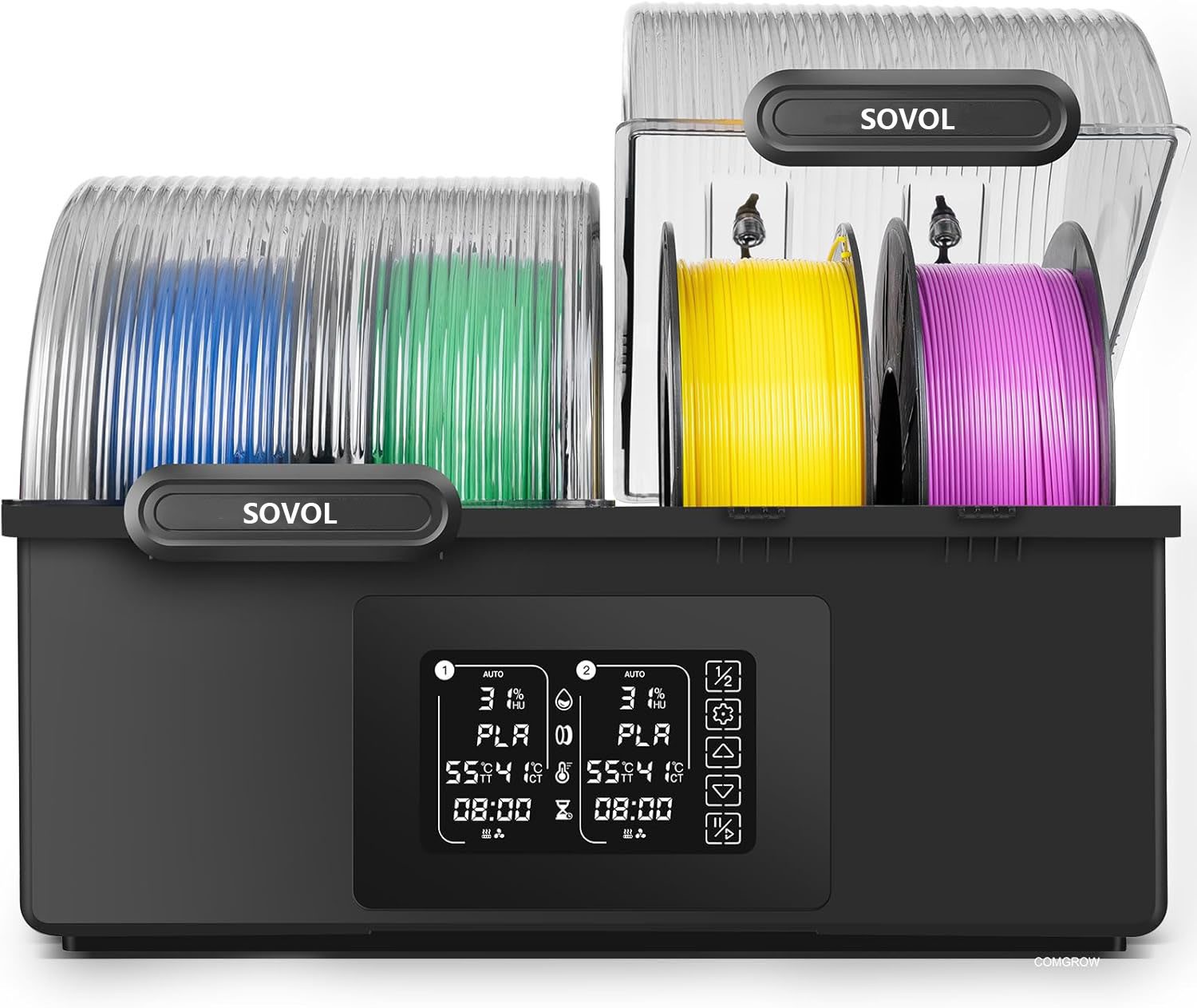

Photos from current listings. Actual item, color, and included accessories may vary.
Sovol Filament Dryer Buying Guide
A Sovol filament dryer is a dedicated heated chamber that removes moisture from 3D printing filament before use, preventing stringing, bubbling, and weak layer adhesion. The core trade-off is between single-spool compact units and multi-spool dry-boxes with higher temperature ceilings and sealed storage. Choose a dryer rated above the glass transition temperature of your most demanding filament and sized to your weekly spool throughput; skip unsealed single-temperature boxes that cannot hold a stable low-humidity environment.
Key takeaways
- Sovol SH03 is a 4-spool dry box with an 85°C maximum chamber temperature, covering PLA, PETG, TPU, ABS, ASA, and nylon-drying ranges above standard 55–70°C single-spool units.
- Dual-zone or multi-spool architectures let you dry and store several materials at once, but each zone's temperature must be independently settable to avoid heat-damaging low-temp filaments like PLA.
- Sealed dry boxes with gasketed lids and desiccant compartments maintain sub-20% relative humidity after drying, while open-tray dryers let moisture re-enter within hours.
At a glance
- Category
- Filament Drying & Post-Processing
- Last updated
- Nov 28, 2026
Current offers
Highlights
- Sovol SH03 is a 4-spool dry box with an 85°C maximum chamber temperature, covering PLA, PETG, TPU, ABS, ASA, and nylon-drying ranges above standard 55–70°C single-spool units.
- Dual-zone or multi-spool architectures let you dry and store several materials at once, but each zone's temperature must be independently settable to avoid heat-damaging low-temp filaments like PLA.
- Sealed dry boxes with gasketed lids and desiccant compartments maintain sub-20% relative humidity after drying, while open-tray dryers let moisture re-enter within hours.
- Temperature accuracy within ±5°C and a built-in hygrometer are the two build-quality metrics that separate effective drying from cosmetic warming.
Best use cases
- Best fit: Buy the 4-spool 85°C dry box if you print nylon, ABS, or ASA regularly and need to dry multiple spools simultaneously while storing them sealed against reabsorption.
- Wrong fit: Skip the multi-spool box if you only print PLA occasionally; a compact single-spool 55–65°C dryer with sealed storage handles that volume at lower cost and footprint.
- Best fit: Choose a Sovol dryer with independent zone control when you switch between high-temp engineering filaments and low-temp PLA in the same week.
- Wrong fit: Do not buy any dryer without a gasketed seal and desiccant bay if your workspace humidity exceeds 60% RH; drying without sealed storage reverses within a day.
Buying tips
- Match the dryer's max temperature to your filament: PLA needs 45–55°C, PETG 60–65°C, ABS/ASA 70–80°C, and nylon 80–90°C; an 85°C ceiling covers all common materials.
- Size the chamber to your spool diameter: standard 200mm spools fit most single-spool dryers, but 250mm+ jumbo spools require a wide-body or 4-spool box with adjustable racks.
- Prioritize a unit with a built-in hygrometer and adjustable timer; drying without humidity feedback risks over-drying TPU or under-drying nylon.
- Check the heater power and insulation: 50–100W chambers reach 70°C in 20–30 minutes, while underpowered units struggle to hold temperature in cool rooms.
Specs
| Max Temp | 55–85°C by model |
|---|---|
| Spool Capacity | 1-spool vs 4-spool box |
| Seal Type | Gasketed + desiccant vs open tray |
| Temp Control | Adjustable ±5°C, timed cycles |
Related searches
What to check before buying
- Measure your spool diameter and width (standard 200mm x 65mm vs jumbo 250mm+) to confirm the dryer's rack spacing and door clearance.
- Check your workspace ambient humidity and temperature; a dryer in a cold garage needs higher wattage and a sealed box to reach and hold target temperature.
- Confirm the plug and voltage standard for your region (US 120V vs EU 230V) and that the unit ships with the correct cord.
- Verify the dryer includes or accepts desiccant packs and has a gasketed lid, since sealed storage is required to keep filament dry after the cycle.
FAQ
Data sources: eBay / Amazon listings and product attribute feeds. Updated Nov 28, 2026.
Some links on this page are affiliate links. If you buy after clicking one, we may earn a commission at no extra cost to you. This does not change which products appear here or their order. Affiliate disclosure.