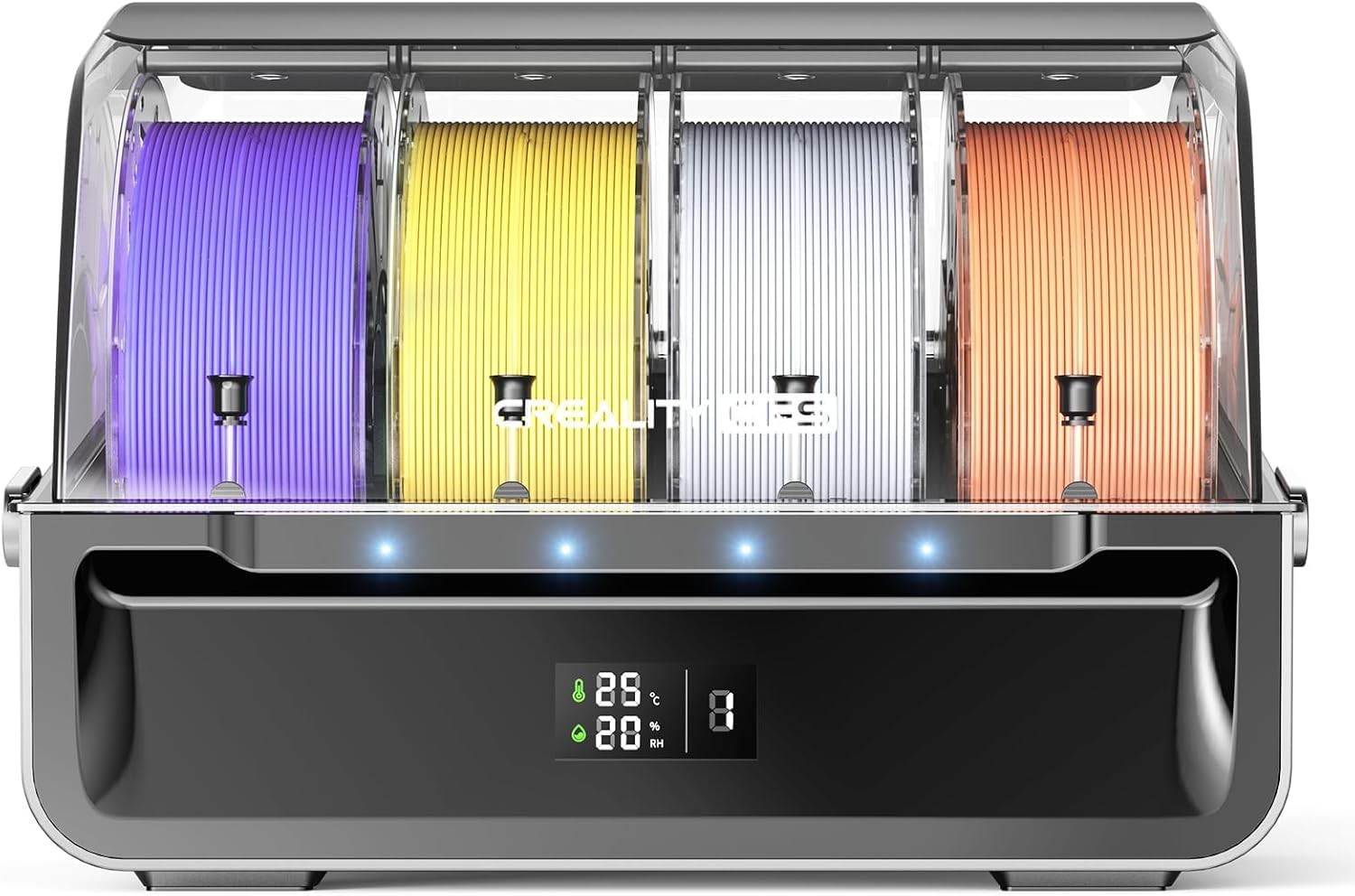

Photos from current listings. Actual item, color, and included accessories may vary.
Printer Filament Storage Buying Guide
Printer filament storage spans dry boxes that actively heat and circulate air, passive sealed containers with desiccant, and vacuum bags for long-term spool preservation. The core trade-off is active moisture removal (heat plus fan plus desiccant) versus passive barrier storage at lower cost. Buy active drying boxes if your filament sits in humid air during printing; buy passive sealed bins or vacuum kits only for already-dry spools going into long-term storage.
Key takeaways
- Active dry boxes hold 2-4 spools, use PTC heaters around 50-70°C, and pair a circulation fan with rechargeable silica desiccant.
- Passive storage bins rely on gasket seals at the lid and bulk desiccant packs; without a hygrometer you cannot confirm the interior stays below 20% RH.
- Filament moisture tolerance: PLA degrades visibly above ~0.5% moisture; PETG and TPU absorb faster and need active drying within days of opening.
At a glance
- Category
- Filament Drying & Post-Processing
- Last updated
- Nov 28, 2026
Current offers
Highlights
- Active dry boxes hold 2-4 spools, use PTC heaters around 50-70°C, and pair a circulation fan with rechargeable silica desiccant.
- Passive storage bins rely on gasket seals at the lid and bulk desiccant packs; without a hygrometer you cannot confirm the interior stays below 20% RH.
- Filament moisture tolerance: PLA degrades visibly above ~0.5% moisture; PETG and TPU absorb faster and need active drying within days of opening.
- Multi-spool dryers with independent chambers can run different temperatures per spool; single-chamber 4-spool units apply one temperature to all slots.
Best use cases
- Pick an active 4-spool dryer box if you print PETG, TPU, or nylon regularly in a humid room and need spools dried between sessions.
- Pick a sealed gasket bin with bulk desiccant and a hygrometer for storing already-dry PLA spools over weeks at ambient temperature.
- Skip active heaters entirely for long-term archival storage of dry spools; vacuum bags with desiccant preserve filament without continuous power.
- Skip oversized dryer boxes on a small desk—measure the footprint including lid clearance, because 4-spool units are roughly 40 cm wide and need rear fan clearance.
Buying tips
- Match dryer temperature range to your materials: PLA needs 45-55°C, PETG 60-65°C, and nylon/PC 70-80°C; verify the unit's maximum rated temperature before buying.
- Confirm spool fit by measuring spool outer diameter and width; standard 1 kg spools are 200 mm diameter and 65-72 mm wide, while some 2-3 kg spools exceed 250 mm and will not fit compact boxes.
- Choose units with a real hygrometer readout and a rechargeable or replaceable desiccant cartridge; thermometer-only boxes give no moisture feedback.
- For passive bins, specify a gasket seal (silicone or EPDM) and add bulk indicating desiccant; unsealed totes leak ambient humidity and defeat storage.
Specs
| Storage Type | Active heated dryer vs passive sealed |
|---|---|
| Spool Capacity | 1-2 spool compact / 4 spool multi |
| Dryer Temp Range | 45-80°C by material |
| Seal & Desiccant | Gasket seal + rechargeable silica |
Related searches
What to check before buying
- Measure your shelf or desk footprint including rear fan exhaust clearance and lid swing height before choosing a 4-spool dryer.
- Verify your spool outer diameter and width against the chamber dimensions; oversized 2-3 kg spools often do not fit compact boxes.
- Check your room's typical relative humidity and ambient temperature; active drying is needed above roughly 50% RH, passive sealed storage works below that.
- Confirm the power plug and voltage standard for your region (120V US vs 230V EU) and whether the unit needs a grounded outlet for the heater.
FAQ
Data sources: eBay / Amazon listings and product attribute feeds. Updated Nov 28, 2026.
Some links on this page are affiliate links. If you buy after clicking one, we may earn a commission at no extra cost to you. This does not change which products appear here or their order. Affiliate disclosure.