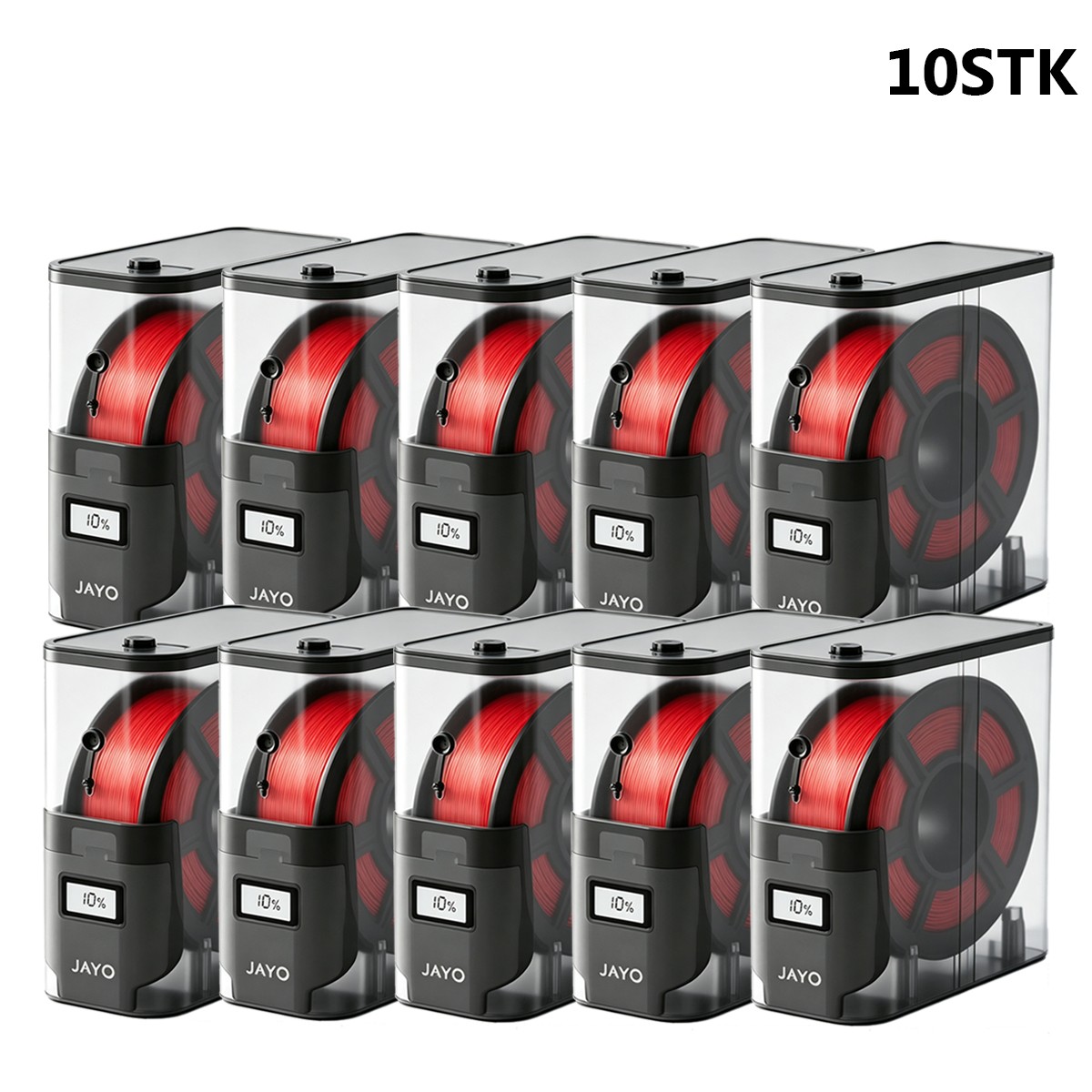

Photos from current listings. Actual item, color, and included accessories may vary.
Jayo Filament Dryer Buying Guide
A Jayo Filament Dryer is a dedicated heated chamber for removing moisture from 3D printing filament before extrusion, typically sold as a single-spool desktop unit with a fixed temperature range and a passive or low-power drying cycle. The primary trade-off is between a sealed, insulated chamber with accurate low-temperature control for PLA/PETG versus a larger single-wall box that heats fast but overshoots on heat-sensitive polymers. The clear decision rule: buy a dryer with independent temperature setpoint and a lid gasket if you print PLA, PETG, or TPU; skip any unit that only offers preset time with no thermostat or spool-clearance dimensions.
Key takeaways
- Most Jayo-style dryers use a PTC heating element rated 40-50W, reaching 45-55°C for PLA/PETG and up to 65-70°C for ABS/ASA; no active cooling or humidity sensor is standard.
- Chamber volume typically fits one 1kg spool up to 200mm diameter and 70mm width; larger 2-3kg spools and 250mm+ reels require a wider box or a filament-specific rack.
- Drying efficiency depends on air exchange: sealed units with a single vent hole dry slower but reach lower steady-state humidity, while open-lid or slotted designs dry faster but lose heat and risk warping low-Tg filaments.
At a glance
- Category
- Filament Drying & Post-Processing
- Last updated
- Nov 28, 2026
Current offers
Highlights
- Most Jayo-style dryers use a PTC heating element rated 40-50W, reaching 45-55°C for PLA/PETG and up to 65-70°C for ABS/ASA; no active cooling or humidity sensor is standard.
- Chamber volume typically fits one 1kg spool up to 200mm diameter and 70mm width; larger 2-3kg spools and 250mm+ reels require a wider box or a filament-specific rack.
- Drying efficiency depends on air exchange: sealed units with a single vent hole dry slower but reach lower steady-state humidity, while open-lid or slotted designs dry faster but lose heat and risk warping low-Tg filaments.
- Timer ranges are commonly 6-24 hours with no auto shutoff on entry-level models; units with digital thermostat and countdown timer are the practical minimum for repeatable drying.
Best use cases
- Best fit: single-spool PLA/PETG/TPU printing in humid climates — pick a 45-55°C thermostat unit with a gasketed lid and 6-12h timer; skip high-wattage 'fast dry' boxes that exceed 60°C for these polymers.
- Best fit: ABS/ASA/PC printing where moisture causes popping and poor layer adhesion — choose a dryer rated to at least 70°C with a metal or high-temp-rated chamber and a 12-24h timer; skip any unit capped at 55°C.
- Wrong fit: production farms running 5+ spools per day — a single-spool Jayo-style dryer is a bottleneck; use a multi-spool cabinet or dry-box storage with desiccant instead.
- Wrong fit: drying filament while printing from the same spool — most Jayo dryers are not designed as live feed-through dryers; use a separate dry box or a dryer with external PTFE pass-through if continuous printing is required.
Buying tips
- Measure your spool: the dryer must accept at least 200mm diameter and 70mm width for standard 1kg reels; 250mm+ reels and 2kg spools need a wider chamber or an adapter rack.
- Match temperature setpoint to polymer: PLA/PETG 45-55°C, TPU 50-60°C, ABS/ASA 65-70°C, PC 70-80°C; a unit with only fixed presets cannot cover all four tiers.
- Prefer a digital thermostat with ±5°C accuracy over a bimetallic dial; dial units commonly overshoot by 10-15°C and can soften PLA spools.
- Check the lid seal: a silicone gasket and a single small vent hole retain heat and lower chamber humidity faster than a loose-fitting or slotted lid; no gasket means longer dry times and higher energy use.
Specs
| Max Temperature | 45-80°C (polymer-dependent) |
|---|---|
| Spool Compatibility | 1kg / 200mm dia x 70mm width |
| Heating Element | PTC 40-50W, fan-assisted |
| Controls | Digital thermostat + timer |
Related searches
What to check before buying
- Confirm spool outer diameter and width fit inside the chamber with at least 5mm clearance on all sides; measure your largest reel before buying.
- Verify the unit's rated voltage and plug type match your wall outlet (120V US vs 230V EU) and that the power cord length reaches your shelf or printer enclosure.
- Check that the dryer's footprint fits your shelf or desk and that the lid opens fully without hitting a shelf above; most units need 30-40cm of vertical clearance.
- Decide whether you need a pass-through PTFE port for printing while drying; if yes, confirm the dryer has an external filament guide or you must add a separate dry box.
FAQ
Data sources: eBay / Amazon listings and product attribute feeds. Updated Nov 28, 2026.
Some links on this page are affiliate links. If you buy after clicking one, we may earn a commission at no extra cost to you. This does not change which products appear here or their order. Affiliate disclosure.