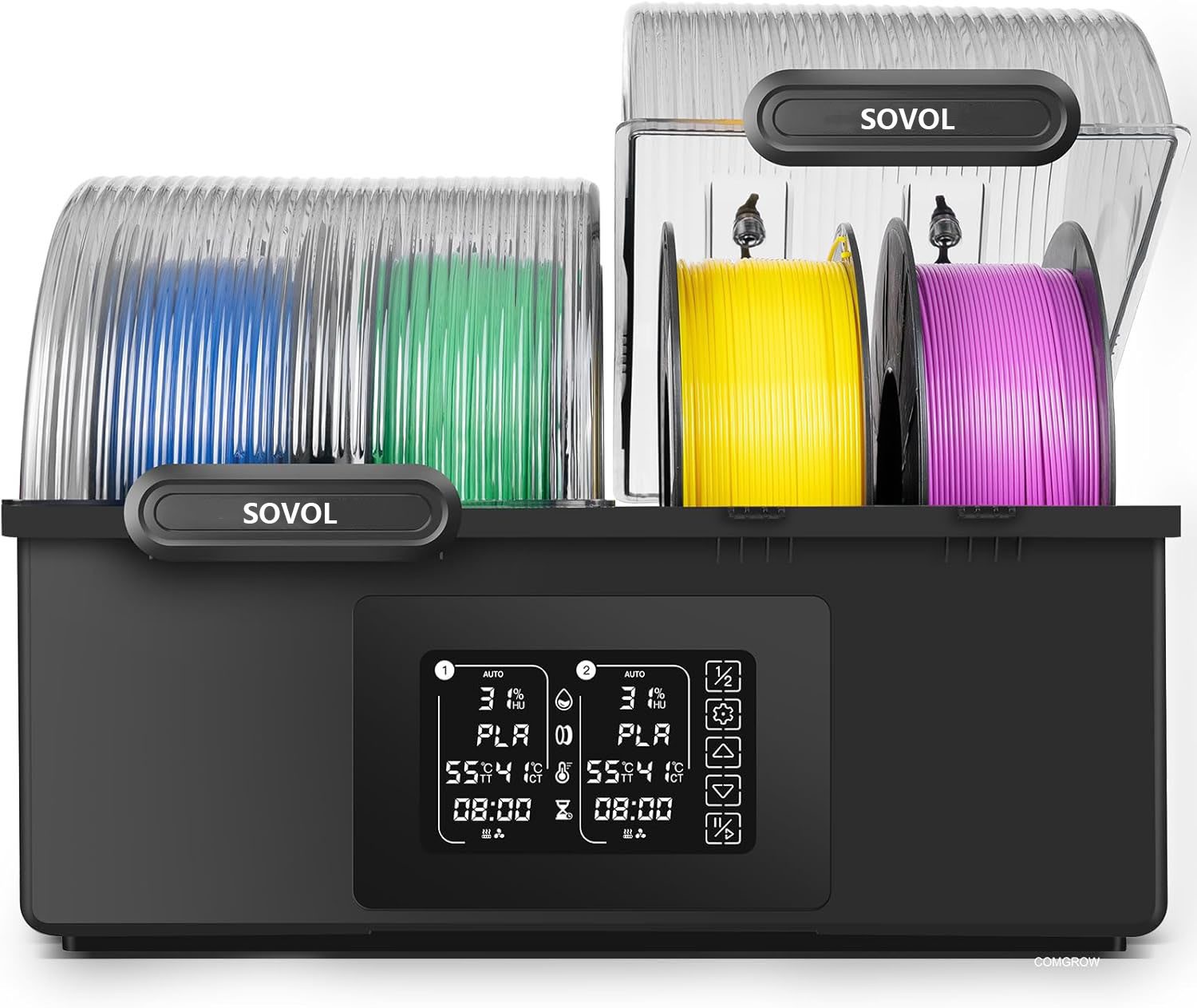

Photos from current listings. Actual item, color, and included accessories may vary.
High Temp Filament Dryer Buying Guide
A high-temp filament dryer is a heated chamber built to hold 70–90 °C+ for engineering filaments like PA, PC, PPS, and PEEK, where standard 40–55 °C dryers stall. The defining trade-off is heater power and chamber insulation versus price and footprint: weak PTC heaters topping out near 60 °C cannot dry nylon; dual-heater or PTC+fan designs with steel/PEI chambers hold stable high heat. The decision rule: buy only if the rated maximum is at least 80 °C, it has a real thermostat (not a timer-only relay), and the chamber fits your spool diameter plus desiccant capacity.
Key takeaways
- Most budget units use a single PTC element capped at 55–60 °C; high-temp models use dual PTC or cartridge heaters with a steel interior to reach 80–90 °C repeatedly.
- Chamber volume and insulation matter more than wattage claims: double-wall or aerogel-insulated boxes hold temperature across a full spool; uninsulated plastic shells sag 10–15 °C mid-cycle.
- A mechanical or PID thermostat with an over-temp cutoff is mandatory at 80 °C+; timer-only controllers can run away and warp or fuse filament to the spool.
At a glance
- Category
- Filament Drying & Post-Processing
- Last updated
- Nov 28, 2026
Current offers
Highlights
- Most budget units use a single PTC element capped at 55–60 °C; high-temp models use dual PTC or cartridge heaters with a steel interior to reach 80–90 °C repeatedly.
- Chamber volume and insulation matter more than wattage claims: double-wall or aerogel-insulated boxes hold temperature across a full spool; uninsulated plastic shells sag 10–15 °C mid-cycle.
- A mechanical or PID thermostat with an over-temp cutoff is mandatory at 80 °C+; timer-only controllers can run away and warp or fuse filament to the spool.
- Spool fit is a hard spec: most high-temp chambers accept 200 mm (1 kg) spools, while 250–300 mm (2–3 kg) spools need a wider bay or external rack; check internal depth, not exterior dimensions.
Best use cases
- Pick a 70–90 °C dual-heater unit for PA-CF, PC, PPS, and PEEK spools that absorb moisture fast; skip it for PLA/PETG where a 45–55 °C dryer is safer and cheaper.
- Choose a desiccant-assisted high-temp dryer if you dry intermittently in humid climates—the desiccant holds dry air between cycles so reheating is shorter; skip if you dry continuously and already have dry-room storage.
- Buy a wide-bay (250 mm+) high-temp model if you run 2–3 kg engineering spools; skip compact 200 mm bays unless you standardize on 1 kg spools.
- For print-farm use, pick a steel-chamber model with external probe port and PID control; skip plastic-shell timer-only units that cannot log or hold temperature across multiple spools.
Buying tips
- Match the dryer's rated max to your material: PLA/PETG 45–55 °C, PET-CF/PA 70–80 °C, PC/PPS/PEEK 80–100 °C. A 60 °C cap disqualifies nylon drying.
- Require a PID or bimetallic thermostat with an over-temp cutoff; timer-only heaters are the leading cause of spool deformation and chamber fires.
- Size the bay by internal depth and width: 200 mm covers 1 kg spools, 250–300 mm covers 2–3 kg; add 20 mm clearance for spool rotation and desiccant.
- Insulation beats wattage: double-wall steel or aerogel-lined chambers hold ±3 °C; single-wall plastic shells swing 10 °C+ and lengthen dry times.
Specs
| Max Temperature | 55 °C budget / 80–100 °C high-temp |
|---|---|
| Heater Type | Single PTC vs dual PTC/cartridge |
| Chamber Build | Plastic shell vs double-wall steel |
| Spool Bay | 200 mm (1 kg) / 250–300 mm (3 kg) |
Related searches
What to check before buying
- Measure your largest spool diameter and width (often 200×70 mm for 1 kg, 300×100 mm for 3 kg) and compare to the dryer's internal bay, not its exterior.
- Confirm your filament's recommended dry temperature and time (e.g., PA 80 °C for 4–8 h) against the dryer's rated max with at least 10 °C headroom.
- Check your workspace: 80–90 °C chambers need clearance for ventilation and a level, heat-safe surface; plastic shelves can soften under a high-temp unit.
- Verify plug/voltage standard (120 V or 230 V) and that the unit includes a desiccant basket or port if you dry in humid conditions.
FAQ
Data sources: eBay / Amazon listings and product attribute feeds. Updated Nov 28, 2026.
Some links on this page are affiliate links. If you buy after clicking one, we may earn a commission at no extra cost to you. This does not change which products appear here or their order. Affiliate disclosure.