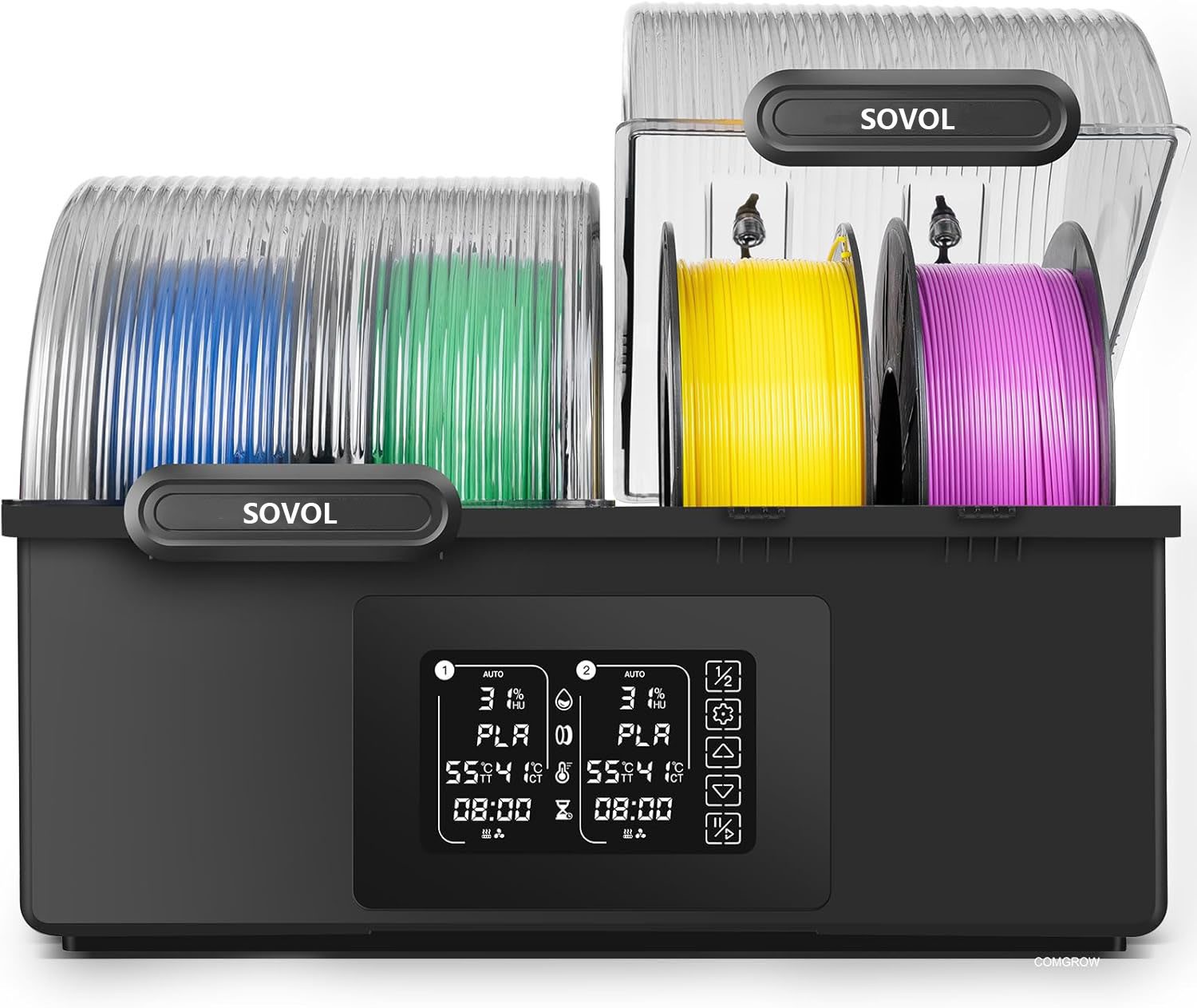

Photos from current listings. Actual item, color, and included accessories may vary.
Filament Storage Dry Box Buying Guide
Filament storage dry boxes are sealed, desiccant-equipped containers that keep hygroscopic filaments like PLA, PETG, and nylon below the ~20% RH threshold where hydrolysis degrades print quality. The core trade-off is passive desiccant capacity versus active heated drying: passive boxes maintain dryness but cannot reclaim wet spools, while heated dryers add temperature control at the cost of power and space. The decision rule is simple—buy a passive dry box for keeping already-dry spools stable, and a heated dryer for rescuing wet filament or running nylon/PC in humid climates.
Key takeaways
- Passive dry boxes rely on silica gel or molecular sieve desiccant; a 500g silica charge typically saturates in 2-4 weeks in a 30-50% RH room and must be regenerated at 120°C.
- Heated dryers like the Sovol SH03 reach 85°C max, which is sufficient for drying PETG, ASA, and PLA but below the 90-100°C needed for efficient nylon and PC drying.
- Seal quality is determined by gasket material (silicone > EVA foam > neoprene) and latch count; a single latch on a 4-spool box leaks 3-5x faster than dual-latch designs in humid rooms.
At a glance
- Category
- Filament Drying & Post-Processing
- Last updated
- Nov 28, 2026
Current offers
Highlights
- Passive dry boxes rely on silica gel or molecular sieve desiccant; a 500g silica charge typically saturates in 2-4 weeks in a 30-50% RH room and must be regenerated at 120°C.
- Heated dryers like the Sovol SH03 reach 85°C max, which is sufficient for drying PETG, ASA, and PLA but below the 90-100°C needed for efficient nylon and PC drying.
- Seal quality is determined by gasket material (silicone > EVA foam > neoprene) and latch count; a single latch on a 4-spool box leaks 3-5x faster than dual-latch designs in humid rooms.
- Spool capacity is nominal: a 4-spool box fits four 1kg 200mm spools, but 250mm+ spools or 3kg reels reduce real capacity to two or three.
Best use cases
- Best fit: passive dry box with 500g+ silica for PLA/PETG users in air-conditioned rooms who print weekly and need spools to stay under 20% RH between sessions.
- Best fit: heated dryer with 85°C+ and 4-spool capacity for PETG/ASA/nylon printers in humid climates who need to dry spools before each print.
- Wrong fit: a passive box alone for nylon or PC—these filaments absorb moisture fast and need active drying at 90-100°C before printing, not just storage.
- Wrong fit: a heated dryer with only 2-spool capacity for a print farm running 4+ materials—throughput bottleneck outweighs cost savings; buy a 4-spool unit or multiple 2-spool units.
Buying tips
- Match dryer max temperature to your filament: 70°C covers PLA/PETG, 85°C covers ASA/PETG, and 90-100°C is required for nylon and polycarbonate—buy accordingly, not just by spool count.
- Size desiccant to box volume: use at least 100g of silica gel per 10 liters of box volume; a 4-spool box is roughly 20-25 liters and needs 200-250g minimum for a 4-week recharge cycle.
- Check gasket and latch design: silicone gaskets with two or more latches hold <20% RH for weeks; single-latch EVA-foam boxes leak and need weekly desiccant changes.
- Verify spool diameter clearance: standard 200mm spools fit most boxes, but 250mm+ spools need a box with internal height ≥260mm—measure your largest spool before buying.
Specs
| Drying Method | Passive desiccant vs heated active |
|---|---|
| Max Dry Temp | 70°C / 85°C / 90-100°C tiers |
| Spool Capacity | 2 / 4 / 6 spools (1kg 200mm) |
| Seal & Desiccant | Silicone gasket + 100g silica/10L |
Related searches
What to check before buying
- Measure your largest spool diameter and width; confirm box internal dimensions exceed spool diameter by 10mm and width by 5mm per spool.
- Check room humidity: above 50% RH year-round, choose a heated dryer or budget for biweekly desiccant regeneration; below 30% RH, a passive box lasts 6-8 weeks per charge.
- Confirm power standard: heated dryers draw 50-150W and need a grounded outlet; verify the plug type matches your region (US NEMA 5-15 vs EU Schuko).
- Account for companion parts: passive boxes need a hygrometer (±5% RH accuracy) and spare desiccant; heated dryers need a spool holder that fits your spool hub diameter.
FAQ
Data sources: eBay / Amazon listings and product attribute feeds. Updated Nov 28, 2026.
Some links on this page are affiliate links. If you buy after clicking one, we may earn a commission at no extra cost to you. This does not change which products appear here or their order. Affiliate disclosure.