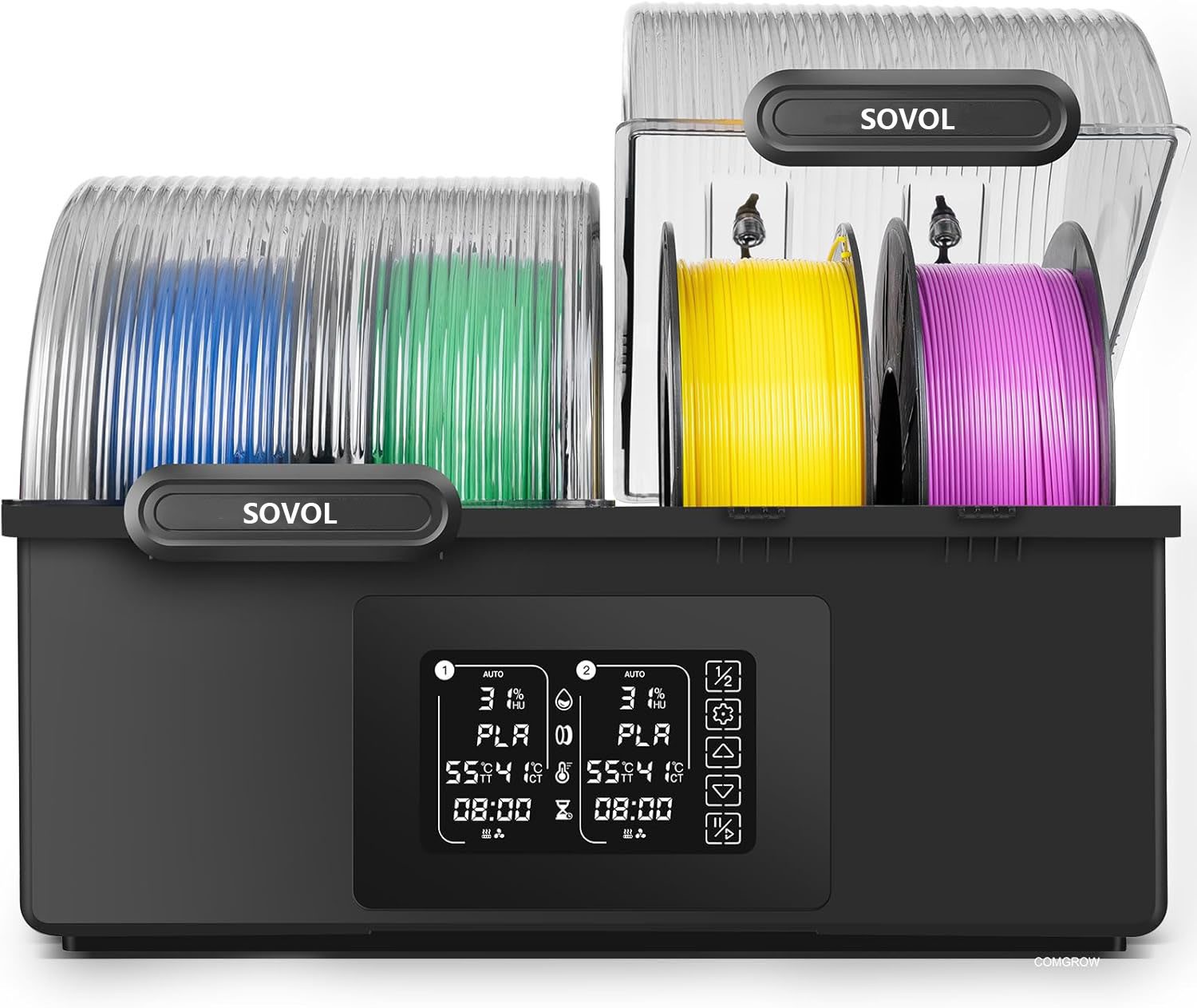

Photos from current listings. Actual item, color, and included accessories may vary.
Filament Dry Storage Buying Guide
Filament dry storage encompasses sealed containers, desiccant systems, and heated dry boxes that keep 3D-printing filament below the moisture threshold where hydrolysis degrades print quality. The primary trade-off is passive desiccant storage (cheap, no power, but no active drying) versus active heated dryers (restore wet spools but cost more and need power). The decision rule: buy active heated drying if your filament has already absorbed moisture or you print engineering polymers; buy passive sealed storage with fresh desiccant if you only need to keep dry spools dry.
Key takeaways
- Passive dry boxes rely on silica gel desiccant (indicating orange-to-green or blue-to-pink) and must be recharged by oven drying; they do not remove moisture from wet filament.
- Active filament dryers heat to 45–85°C; 85°C models support PA (nylon) and PC, while 45–55°C units are limited to PLA and PETG.
- Filament absorbs moisture over 0.2–0.5% by weight, causing steam bubbles, stringing, and weak layer adhesion; drying restores spools to <0.1% moisture.
At a glance
- Category
- Filament Drying & Post-Processing
- Last updated
- Nov 28, 2026
Current offers
Highlights
- Passive dry boxes rely on silica gel desiccant (indicating orange-to-green or blue-to-pink) and must be recharged by oven drying; they do not remove moisture from wet filament.
- Active filament dryers heat to 45–85°C; 85°C models support PA (nylon) and PC, while 45–55°C units are limited to PLA and PETG.
- Filament absorbs moisture over 0.2–0.5% by weight, causing steam bubbles, stringing, and weak layer adhesion; drying restores spools to <0.1% moisture.
- Stackable modular boxes (e.g., 3-spool JAYO-style units) let you scale storage per spool while maintaining a sealed gasket and desiccant compartment.
Best use cases
- Pick a heated dry box with 65–85°C max temp if you print PETG, TPU, PA, or PC and see popping/steam during extrusion; skip unheated sealed boxes for already-wet spools.
- Pick a sealed passive dry box with rechargeable desiccant if your spools are new and dry and you just need to prevent ambient humidity absorption between prints.
- Pick a stackable multi-spool modular system if you rotate many colors/materials and want per-spool desiccant control; skip single-spool heated units if you only need storage, not drying.
- Skip any heated dryer rated below 50°C if you print nylon or polycarbonate; those polymers need 70–85°C to release absorbed moisture.
Buying tips
- Match dryer max temperature to polymer: PLA/PETG need 45–55°C, TPU 50–60°C, PA/PC 70–85°C; a 55°C unit cannot dry nylon.
- Choose a dryer with a sealed gasket and desiccant compartment so it doubles as storage; open-vent dryers reabsorb moisture when powered off.
- Use indicating silica gel (rechargeable at 100–120°C) and replace or recharge when the indicator changes color; non-indicating gel gives no warning.
- For passive boxes, verify internal dimensions fit your spool diameter (200 mm standard, 250 mm for some 5 kg spools) and that the lid gasket is replaceable.
Specs
| Drying Type | Passive desiccant vs active heated |
|---|---|
| Max Dry Temp | 45–85°C (PLA 45–55, PA/PC 70–85) |
| Spool Capacity | 1–4 spools (200–250 mm dia) |
| Seal & Desiccant | Gasketed lid + rechargeable silica gel |
Related searches
What to check before buying
- Measure your spool diameter and width (standard 200 mm dia × 65–75 mm wide; 250 mm for 2.5–5 kg spools) and confirm the box interior clears them.
- Confirm your room’s ambient humidity: above 60% RH requires active heated drying or frequent desiccant recharge; below 40% RH passive storage suffices.
- Check that the dryer’s plug voltage (120 V US or 230 V EU) and wattage match your outlet; heated dryers draw 50–150 W.
- Verify desiccant capacity and recharge method: indicating gel needs a 100–120°C oven for 1–2 hours; some units use rechargeable cartridge systems.
FAQ
Data sources: eBay / Amazon listings and product attribute feeds. Updated Nov 28, 2026.
Some links on this page are affiliate links. If you buy after clicking one, we may earn a commission at no extra cost to you. This does not change which products appear here or their order. Affiliate disclosure.