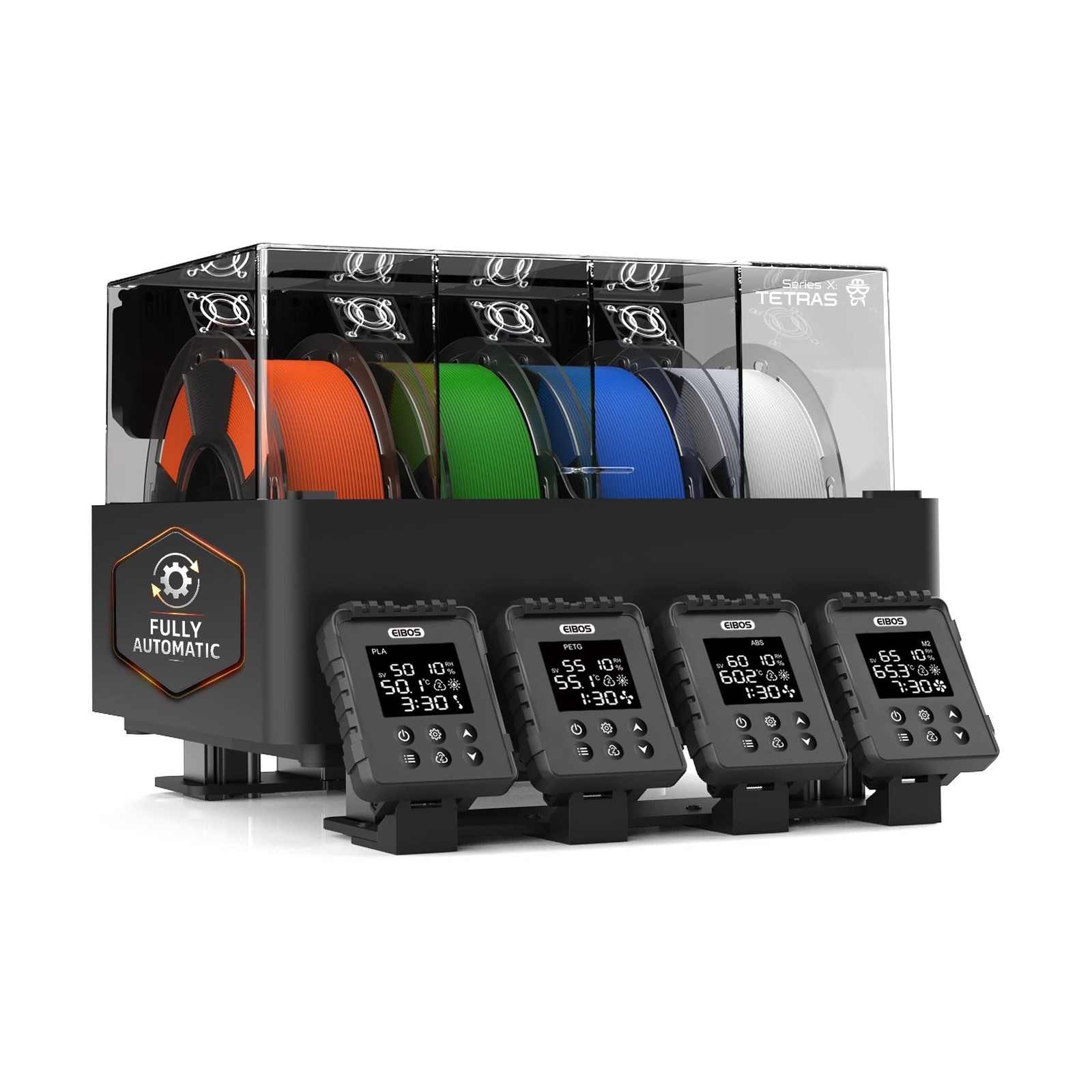

Photos from current listings. Actual item, color, and included accessories may vary.
Eibo Filament Dryer Buying Guide
An Eibo filament dryer is a dedicated heated chamber that removes moisture from 3D printing filament before extrusion, restoring layer adhesion and reducing stringing, bubbling, and weak parts. The core trade-off is between single-spool budget heaters with basic thermostats and dual-spool units with accurate PID temperature control and sealed lids. Choose a dryer rated at least 10°C above your highest printing temperature with active ventilation for moisture escape; skip any unit without a calibrated temperature readout or a sealed chamber.
Key takeaways
- Eibo dryers typically use PTC heating elements with PID control, holding ±1–2°C versus ±5–10°C on cheap bimetal thermostats, which prevents filament softening or uneven drying.
- Dual-spool Eibo models often include a filament feed-through port and removable spool racks, letting you print directly from the dryer to keep hygroscopic nylon and PC dry during long prints.
- Chamber capacity matters: single-spool units suit PLA/PETG, while dual-spool or tall-chamber versions fit 1 kg spools up to 200 mm diameter and accommodate 2.5 kg spools on some tiers.
At a glance
- Category
- Filament Drying & Post-Processing
- Last updated
- Nov 28, 2026
Current offers
Highlights
- Eibo dryers typically use PTC heating elements with PID control, holding ±1–2°C versus ±5–10°C on cheap bimetal thermostats, which prevents filament softening or uneven drying.
- Dual-spool Eibo models often include a filament feed-through port and removable spool racks, letting you print directly from the dryer to keep hygroscopic nylon and PC dry during long prints.
- Chamber capacity matters: single-spool units suit PLA/PETG, while dual-spool or tall-chamber versions fit 1 kg spools up to 200 mm diameter and accommodate 2.5 kg spools on some tiers.
- Sealed lids with silicone gaskets and a desiccant compartment slow moisture reabsorption after drying, while unsealed units lose effectiveness within hours in humid rooms.
Best use cases
- Best fit: Buy a dual-spool PID-controlled Eibo dryer if you regularly print PETG, TPU, or nylon and need to dry two spools simultaneously or print directly from the chamber.
- Best fit: Choose a single-spool basic Eibo unit if you print mostly PLA and occasionally PETG, have limited desk space, and dry one spool at a time.
- Wrong fit: Skip any dryer without a temperature display or adjustable thermostat if you print engineering filaments like PC or ASA, which require precise 70–80°C drying and risk deformation in uncontrolled heaters.
- Wrong fit: Do not buy a tall-chamber Eibo dryer if your spools exceed 200 mm diameter or weigh over 2.5 kg; check spool diameter and width against the chamber dimensions before ordering.
Buying tips
- Match dryer temperature range to your filament: PLA dries at 45–55°C, PETG at 60–65°C, TPU at 50–60°C, and nylon/PC at 70–80°C; a unit maxing at 55°C cannot properly dry engineering plastics.
- Verify the heater is PTC ceramic with PID control and a digital display; bimetal thermostat units swing widely and can soften filament on the spool.
- Check chamber dimensions against your largest spool: most 1 kg spools are 200 mm diameter and 65–70 mm wide; dual-spool units need at least 2× spool width plus clearance.
- Prefer models with a sealed lid, silicone gasket, and desiccant slot—unsealed dryers in 60%+ relative humidity rooms reabsorb moisture within a few hours of shutdown.
Specs
| Heater Control | PID ±1–2°C vs Thermostat ±5–10°C |
|---|---|
| Max Temperature | 70–80°C for Nylon/PC; 55°C PLA-only |
| Spool Capacity | Single vs Dual 1 kg; up to 2.5 kg |
| Chamber Seal | Silicone gasket + desiccant slot |
Related searches
What to check before buying
- Measure your spool diameter and width; confirm the dryer chamber accepts at least 210 mm diameter and 75 mm width for standard 1 kg spools, and larger for 2.5 kg spools.
- Check your room’s relative humidity; above 60% RH, only sealed dryers with desiccant compartments maintain dry filament after the heating cycle ends.
- Confirm the dryer’s plug and voltage match your region (120V North America, 220–240V Europe/Asia) and that the power supply meets the heater wattage.
- Verify whether you need a feed-through port for printing directly from the dryer; this requires a PTFE tube pass-through and a spool holder that rotates freely inside the chamber.
FAQ
Data sources: eBay / Amazon listings and product attribute feeds. Updated Nov 28, 2026.
Some links on this page are affiliate links. If you buy after clicking one, we may earn a commission at no extra cost to you. This does not change which products appear here or their order. Affiliate disclosure.