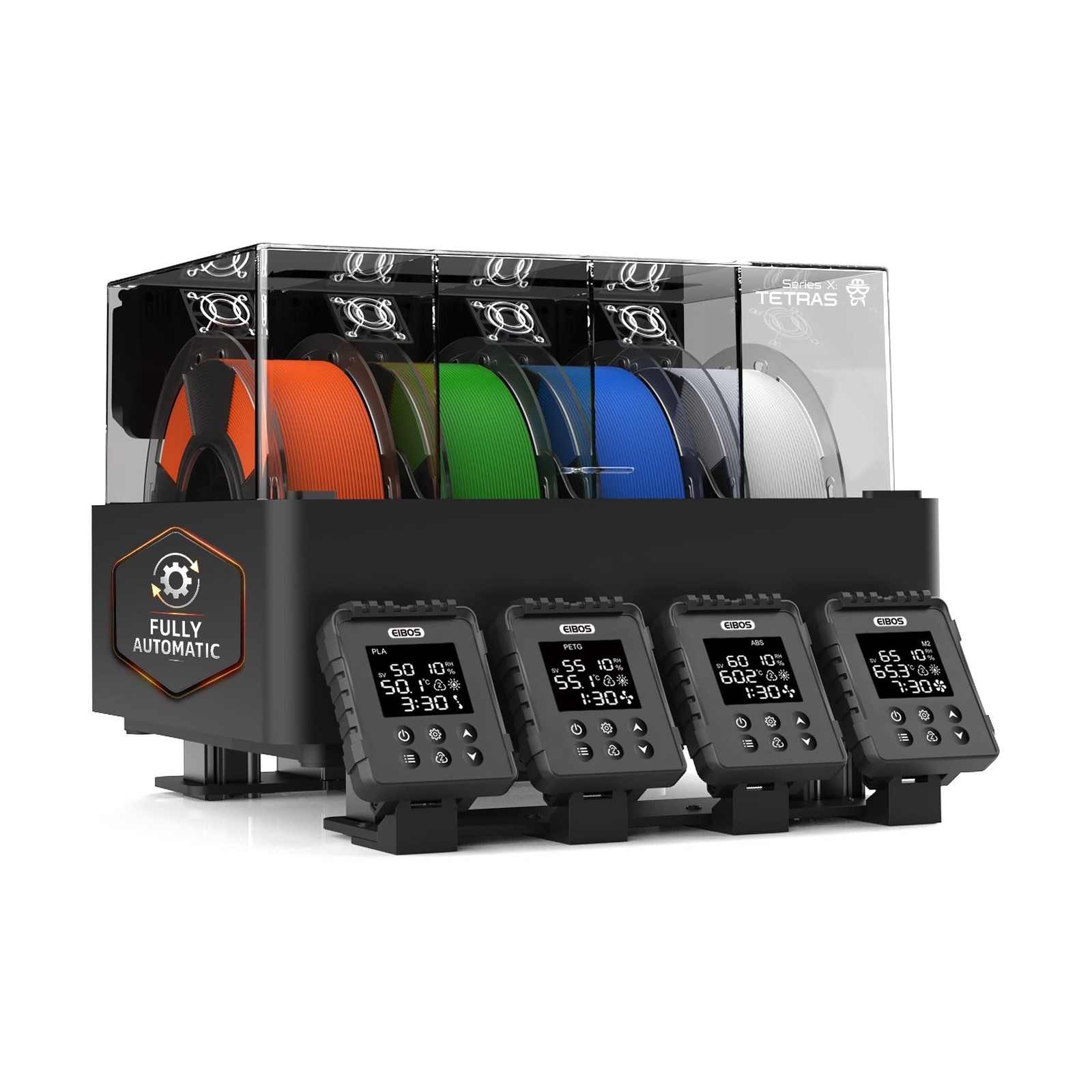

Photos from current listings. Actual item, color, and included accessories may vary.
Eibo Dryer Buying Guide
Eibos filament dryers are heated, fan-circulated chambers that remove moisture from 3D printing filament before use, preventing stringing, bubbling, and weak layer adhesion. The core trade-off is between single-spool desktop units with basic thermostat control and multi-spool or high-capacity dryers that add PID temperature stability, larger chambers, and feed-through printing. Choose a dryer with at least 70°C max temperature, active fan circulation, and a sealed chamber if you print hygroscopic engineering plastics; skip unvented, uninsulated boxes with only 40–50°C output.
Key takeaways
- Eibos-series dryers typically use PTC heating elements with 60–70°C max temperature, adequate for PLA, PETG, and TPU but marginal for drying PA (nylon) and PC which benefit from 80°C+ capability.
- Chamber capacity ranges from single 1 kg spool to dual-spool and 4-spool rack designs; multi-spool units require correspondingly higher wattage (100–200 W) to maintain uniform heat across the chamber.
- Temperature control accuracy of ±1–2°C with PID logic prevents filament softening or spool deformation; basic bimetallic thermostat units swing ±5°C or more and are less safe for low-Tg materials like PLA.
At a glance
- Category
- Filament Drying & Post-Processing
- Last updated
- Nov 28, 2026
Current offers
Highlights
- Eibos-series dryers typically use PTC heating elements with 60–70°C max temperature, adequate for PLA, PETG, and TPU but marginal for drying PA (nylon) and PC which benefit from 80°C+ capability.
- Chamber capacity ranges from single 1 kg spool to dual-spool and 4-spool rack designs; multi-spool units require correspondingly higher wattage (100–200 W) to maintain uniform heat across the chamber.
- Temperature control accuracy of ±1–2°C with PID logic prevents filament softening or spool deformation; basic bimetallic thermostat units swing ±5°C or more and are less safe for low-Tg materials like PLA.
- Feed-through designs let filament exit the dryer directly to the printer, maintaining dryness during long prints; passive box dryers require removing the spool and expose filament to ambient humidity during printing.
Best use cases
- Best fit: single-spool Eibos dryer for PLA/PETG hobbyists in humid climates — pick a unit with digital temperature setting and a closable feed port; skip if you regularly print nylon or polycarbonate.
- Best fit: dual-spool or rack-style Eibos dryer for small print farms running multiple materials — choose a model with independent chamber heating and a clear lid for spool monitoring; skip single-spool units that force sequential drying.
- Best fit: feed-through Eibos dryer for long ABS/ASA prints where filament reabsorbs moisture mid-print — select a unit with a PTFE-lined exit and internal spool roller; skip passive desiccant boxes for active drying needs.
- Wrong fit: unvented airtight containers with only silica gel — these absorb moisture slowly and cannot dry saturated filament; use only for storage of already-dry spools.
Buying tips
- Match dryer max temperature to your material: PLA/PETG need 45–55°C, TPU 50–60°C, PA/PC 70–80°C; a 70°C-capable Eibos unit covers most filaments but 80°C+ is required for reliable nylon drying.
- Check chamber dimensions against your spool diameter: standard 1 kg spools are 200 mm diameter and 60–70 mm wide; confirm internal height clears spool plus roller clearance before buying a compact unit.
- Prefer PID temperature control over bimetallic thermostats: PID holds ±2°C for safe PLA drying, while thermostat units can overshoot and soften or deform spools near the heater.
- For multi-spool drying, verify wattage scales with capacity: a 4-spool chamber needs roughly 150–200 W to reach and hold drying temperature uniformly; underpowered units dry unevenly.
Specs
| Max Temperature | 60-70°C typical; 80°C+ for nylon |
|---|---|
| Spool Capacity | 1-4 spools (200mm dia. standard) |
| Temperature Control | PID ±2°C vs thermostat ±5°C |
| Feed-Through | Yes (sealed port) / No (batch dry) |
Related searches
What to check before buying
- Measure your spool diameter and width — most Eibos chambers accept 200 mm spools; larger 2–3 kg spools may not fit and require a high-capacity dryer.
- Confirm your material's drying temperature and time: PLA 45–55°C for 4–6 h, PETG 55–65°C for 4–6 h, PA 70–80°C for 6–12 h; ensure the dryer reaches the top of that range.
- Check voltage and plug standard for your region — Eibos dryers are commonly 220–240 V or 110–120 V variants; verify the unit matches your mains before ordering.
- Plan for feed-through: if printing directly from the dryer, confirm the exit port accepts 1.75 mm filament and the unit is stable enough to sit beside the printer without tipping.
FAQ
Data sources: eBay / Amazon listings and product attribute feeds. Updated Nov 28, 2026.
Some links on this page are affiliate links. If you buy after clicking one, we may earn a commission at no extra cost to you. This does not change which products appear here or their order. Affiliate disclosure.