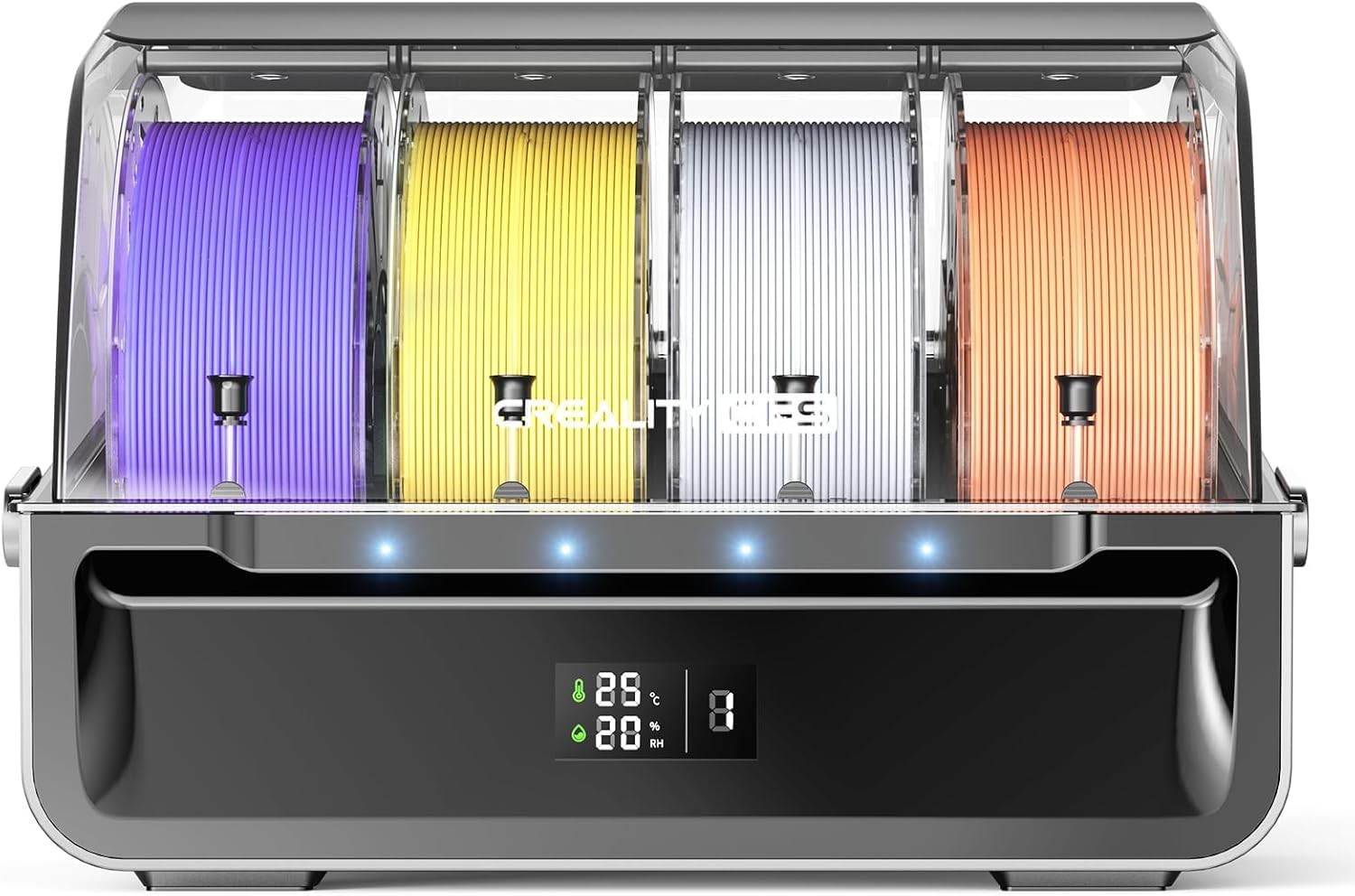

Photos from current listings. Actual item, color, and included accessories may vary.
3D Printer Filament Dehydrator Buying Guide
A filament dehydrator is a controlled low-temperature oven that removes absorbed moisture from 3D printing filament, restoring print quality and mechanical strength. The core trade-off is between food-dehydrator conversions (cheap, uneven, no filament-specific controls) and dedicated filament dryers (targeted temperature ranges, spool-friendly chambers, humidity feedback). Buy a unit rated for 70–90°C with a sealed chamber and active air circulation; skip anything that cannot hold a stable setpoint below 50°C or lacks a spool-sized interior.
Key takeaways
- Dedicated filament dryers typically reach 70–90°C; food dehydrators often top out at 70°C and lack precise low-temperature control for PLA (45–55°C).
- Chamber insulation and a gasketed lid determine moisture removal efficiency—thin uninsulated walls lose heat and extend dry times by hours.
- Active circulation (fan or convection) is required for even drying; passive heated chambers create hot spots that warp spools and leave wet cores.
At a glance
- Category
- Filament Drying & Post-Processing
- Last updated
- Nov 28, 2026
Current offers
Highlights
- Dedicated filament dryers typically reach 70–90°C; food dehydrators often top out at 70°C and lack precise low-temperature control for PLA (45–55°C).
- Chamber insulation and a gasketed lid determine moisture removal efficiency—thin uninsulated walls lose heat and extend dry times by hours.
- Active circulation (fan or convection) is required for even drying; passive heated chambers create hot spots that warp spools and leave wet cores.
- Integrated humidity/temperature sensors with automatic shutoff distinguish mid-tier dryers from basic timed-heat boxes that can over-dry nylon or anneal PETG.
Best use cases
- Best fit: single-spool desktop printing in humid climates—choose a compact 1-spool dryer with 40–70°C range and a sealed lid; skip multi-spool towers if you only run one material.
- Best fit: production or farm printing with frequent material changes—pick a 2-spool dryer with independent temperature zones and pass-through ports for printing while drying; skip single-zone units.
- Wrong fit: drying engineering nylons (PA6/PA12) that need 80–90°C—standard PLA-focused dryers often cap at 70°C; choose a high-temperature model rated to 90°C or a converted food dehydrator with verified thermostatic control.
- Wrong fit: annealing or stress-relieving printed parts—filament dryers are not kilns; use a dedicated annealing oven or toaster oven with PID control instead.
Buying tips
- Match temperature range to your materials: PLA 45–55°C, PETG 60–65°C, TPU 50–60°C, nylon 70–90°C; a dryer topping out at 70°C cannot properly dry PA6.
- Size the chamber to your largest spool: standard 1 kg spools are ~200 mm diameter and 65–75 mm wide; confirm interior dimensions exceed 210 × 80 mm per spool.
- Prefer units with digital PID or thermostat control and a readable setpoint; analog dial dehydrators drift ±10°C, which risks softening PLA.
- Look for gasketed lids, insulated walls, and a circulation fan—these three features cut dry times from 12+ hours to 4–6 hours for a 1 kg spool.
Specs
| Max Temperature | 70°C food-grade vs 90°C filament-grade |
|---|---|
| Spool Capacity | 1-spool compact vs 2-spool tower |
| Control Type | Analog dial vs digital PID/thermostat |
| Chamber Sealing | Vented vs gasketed insulated lid |
Related searches
What to check before buying
- Measure your spool diameter and width (commonly 200 mm × 67 mm); ensure the dryer interior accommodates your largest spool with clearance for airflow.
- Confirm your wall outlet voltage and plug type match the dryer's rating; most units are 120 V/60 Hz or 220–240 V/50 Hz and are not dual-voltage.
- Check ambient humidity in your print room—if RH exceeds 60%, choose a dryer with a sealed chamber and desiccant compartment rather than a vented food dehydrator.
- Verify the dryer includes or accepts a spool holder/roller; some compact models require the spool to rest directly on the chamber floor, reducing airflow.
FAQ
Data sources: eBay / Amazon listings and product attribute feeds. Updated Nov 28, 2026.
Some links on this page are affiliate links. If you buy after clicking one, we may earn a commission at no extra cost to you. This does not change which products appear here or their order. Affiliate disclosure.