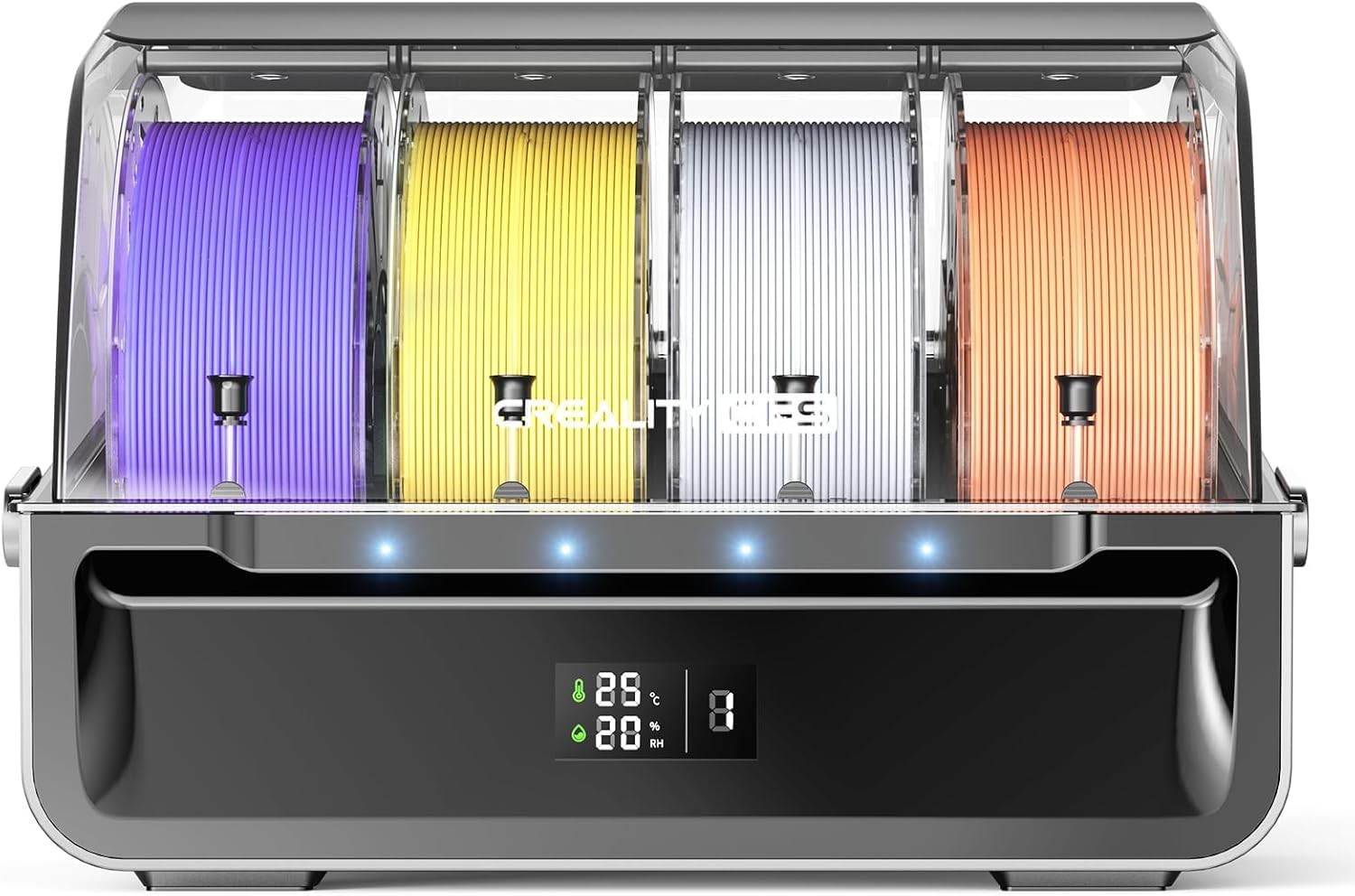

Photos from current listings. Actual item, color, and included accessories may vary.
3D Printer Dehydrator Buying Guide
A 3D printer dehydrator is a controlled low-temperature oven that removes moisture from filament before printing, preventing steam bubbles, poor layer adhesion, and brittle spools. The core trade-off is between dedicated single-spool dryers with built-in spool holders and repurposed food dehydrators that offer more capacity but lack precise temperature control. Buy a unit that holds 40–70°C within ±5°C and fits your spool diameter; skip any device that cannot sustain stable low heat or lacks a spool mount.
Key takeaways
- Filament absorbs moisture hygroscopically; PETG, TPU, and nylon degrade fastest, requiring drying at 65–70°C for 4–12 hours depending on saturation.
- Dedicated filament dryers typically hold one 1 kg spool on a rotating or static holder and cap at 70–75°C, while food dehydrators reach 70°C but need a printed spool adapter.
- Temperature accuracy matters more than maximum heat: a ±5°C swing can soften PLA (glass transition ~60°C) and warp spools, so choose digital PID or thermostat control.
At a glance
- Category
- Filament Drying & Post-Processing
- Last updated
- Nov 28, 2026
Current offers
Highlights
- Filament absorbs moisture hygroscopically; PETG, TPU, and nylon degrade fastest, requiring drying at 65–70°C for 4–12 hours depending on saturation.
- Dedicated filament dryers typically hold one 1 kg spool on a rotating or static holder and cap at 70–75°C, while food dehydrators reach 70°C but need a printed spool adapter.
- Temperature accuracy matters more than maximum heat: a ±5°C swing can soften PLA (glass transition ~60°C) and warp spools, so choose digital PID or thermostat control.
- Capacity is measured in spools: single-spool dryers suit one-printer owners, while dual-spool or stacked food-dehydrator trays fit farms running multiple materials.
Best use cases
- Best fit: one printer, one or two materials — pick a single-spool dedicated dryer with a built-in spool holder and 40–70°C digital control; skip large food dehydrators that waste counter space.
- Best fit: filament farm or multi-material shop — choose a multi-tray food dehydrator (5+ trays) plus printed spool adapters; skip single-spool dryers that bottleneck throughput.
- Best fit: nylon, PC, or TPU users — select a dryer rated to 70–80°C with a sealed chamber; skip units capped at 50°C that cannot drive off deep moisture.
- Wrong fit: drying resin prints or annealing — a filament dehydrator lacks the higher temperatures and ventilation for post-processing; use a dedicated UV cure or annealing oven instead.
Buying tips
- Match spool diameter: most dryers fit 200 mm (1 kg) spools; 250 mm (2–3 kg) spools need a wider unit or an external holder, so measure your largest spool before buying.
- Prioritize temperature range over wattage: 40–70°C covers PLA, PETG, and ABS; nylon and PC need 70–80°C, so check the upper limit, not just the element wattage.
- Choose digital thermostat or PID control over bimetallic dials; a ±5°C tolerance prevents PLA softening and ensures repeatable drying cycles.
- For food dehydrators, confirm adjustable thermostat down to 40°C and a rear or bottom fan; fixed 70°C models scorch PLA and lack the airflow to dry evenly.
Specs
| Temperature Range | 40–80°C (PLA to nylon) |
|---|---|
| Control Type | Digital PID vs bimetallic dial |
| Spool Capacity | 1–2 spools vs 5+ trays |
| Max Spool Diameter | 200 mm (1 kg) / 250 mm (2–3 kg) |
Related searches
What to check before buying
- Measure your largest spool diameter and width; confirm the dryer’s internal chamber and holder accept it without binding.
- Check your workshop ambient temperature and humidity: in humid climates, a sealed chamber with desiccant port dries faster than an open-tray dehydrator.
- Verify the unit’s plug and voltage match your regional standard (120V/60Hz or 230V/50Hz) and that the cord reaches your bench outlet.
- Confirm companion parts: some dryers need a printed spool adapter or external holder, and food dehydrators require printed risers for 1 kg spools.
FAQ
Data sources: eBay / Amazon listings and product attribute feeds. Updated Nov 28, 2026.
Some links on this page are affiliate links. If you buy after clicking one, we may earn a commission at no extra cost to you. This does not change which products appear here or their order. Affiliate disclosure.