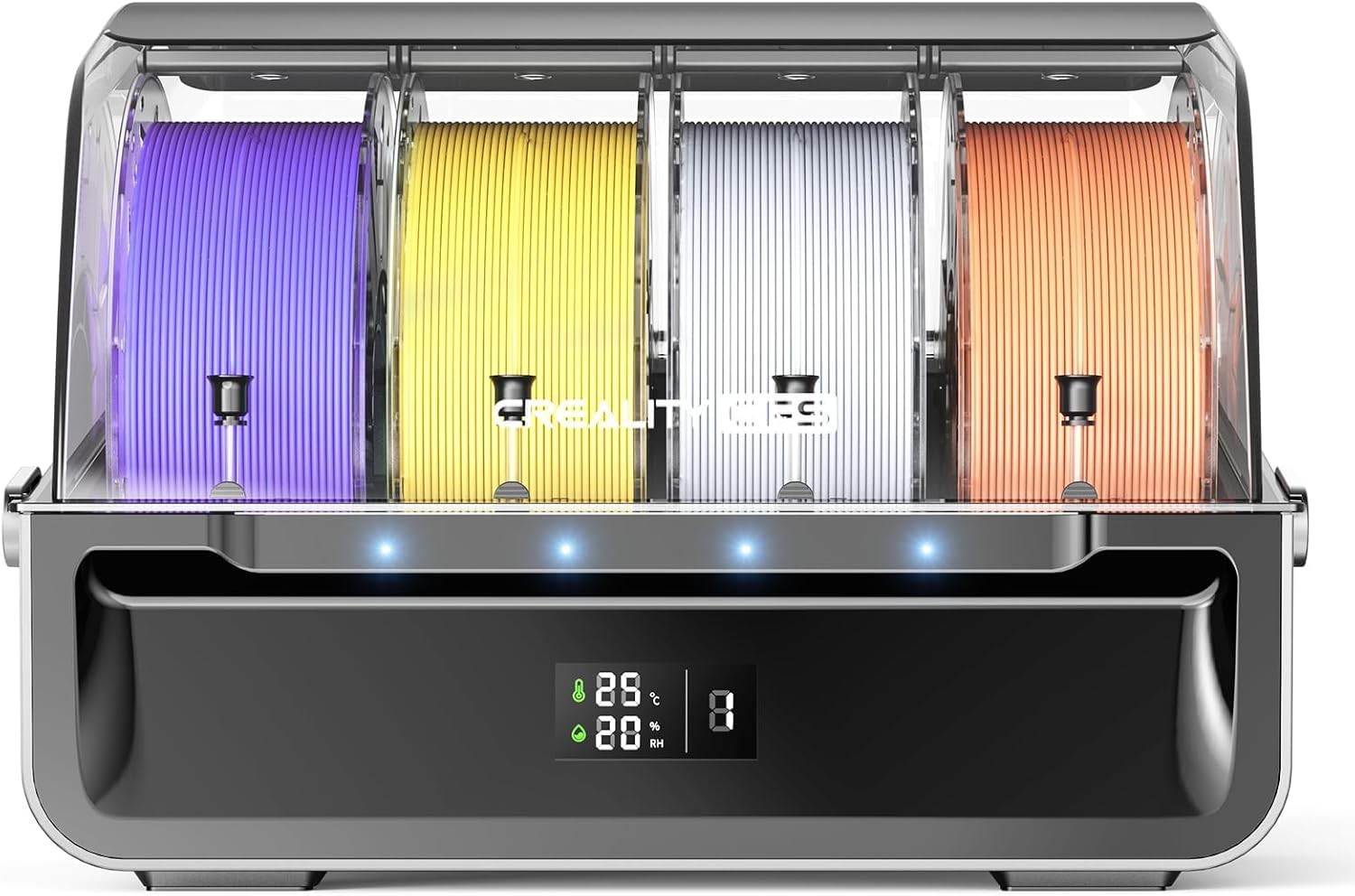

Photos from current listings. Actual item, color, and included accessories may vary.
3D Filament Storage Box Buying Guide
A 3D filament storage box is a sealed, often heated enclosure that protects spools from moisture-induced printing defects like stringing and poor layer adhesion. The key trade-off is passive desiccant storage versus active heated drying: passive boxes only maintain dryness, while active boxes with heaters and fans restore wet filament. Choose a heated unit with a sealed gasket and a true desiccant chamber if you print hygroscopic materials like PETG, TPU, or nylon; choose a simple sealed box only for short-term storage of PLA in dry climates.
Key takeaways
- Active dry boxes use PTC heaters (40–70°C) plus fans; passive boxes rely on silica gel and gaskets, so only active units can reverse moisture absorption.
- Sealing quality is set by the gasket material (silicone > EVA foam) and latch design; a box without a continuous gasket will exchange ambient humidity.
- Spool capacity and heater power must match: 4-spool boxes typically need 50–100W to reach drying temperature; single-spool units use 20–40W.
At a glance
- Category
- Filament Drying & Post-Processing
- Last updated
- Nov 28, 2026
Current offers
Highlights
- Active dry boxes use PTC heaters (40–70°C) plus fans; passive boxes rely on silica gel and gaskets, so only active units can reverse moisture absorption.
- Sealing quality is set by the gasket material (silicone > EVA foam) and latch design; a box without a continuous gasket will exchange ambient humidity.
- Spool capacity and heater power must match: 4-spool boxes typically need 50–100W to reach drying temperature; single-spool units use 20–40W.
- Desiccant rechargeability matters: reusable silica gel with color indicator beats single-use packs; some boxes include a dedicated desiccant compartment.
Best use cases
- Best fit: Print PETG, TPU, or nylon in a humid climate—pick a heated dry box with fan circulation and a sealed gasket; skip passive boxes that cannot dry filament.
- Best fit: Store many spools long-term in a dry room—a stackable passive box with replaceable desiccant and a clear window is sufficient; skip heated units if spools are already dry.
- Wrong fit: Printing abrasive filaments like carbon-fiber nylon—standard dry boxes scratch and fog; choose a unit with a hardened inner liner or use dedicated dry cabinets.
- Wrong fit: Drying large 2.85mm spools—confirm internal height and spindle diameter; many compact boxes fit only 1.75mm spools up to 200mm diameter.
Buying tips
- Match heater power to capacity: under 40W struggles to dry 4 spools; look for 60W+ for multi-spool heated boxes with active fan.
- Check spool fit: measure your largest spool diameter (often 200–250mm) and width (50–70mm); box interior must exceed these by 10mm for airflow.
- Prefer boxes with a real gasket (silicone or EPDM) and metal latches; foam seals compress and leak over time.
- For passive storage, choose a box with a dedicated desiccant tray and a hygrometer port; rechargeable silica gel with indicator beads is a must.
Specs
| Drying Method | Passive desiccant vs active PTC heated |
|---|---|
| Spool Capacity | 1 / 2 / 4 spools |
| Seal Type | Silicone gasket + latch vs foam |
| Max Temp | 40–70°C (heated models) |
Related searches
What to check before buying
- Measure your spool: diameter, width, and bore (22mm, 32mm, or 50mm) must fit the box’s spindle or cradle.
- Check your room’s humidity: above 50% RH year-round demands an active heated box; below 30% RH a passive sealed box suffices.
- Confirm power: heated boxes need a nearby outlet; check plug type (US/EU/UK) and cord length for your setup.
- Verify compatibility: some dry boxes are designed to feed directly to a printer—confirm the filament exit port matches your printer’s input and that the box fits your spool holder.
FAQ
Data sources: eBay / Amazon listings and product attribute feeds. Updated Nov 28, 2026.
Some links on this page are affiliate links. If you buy after clicking one, we may earn a commission at no extra cost to you. This does not change which products appear here or their order. Affiliate disclosure.