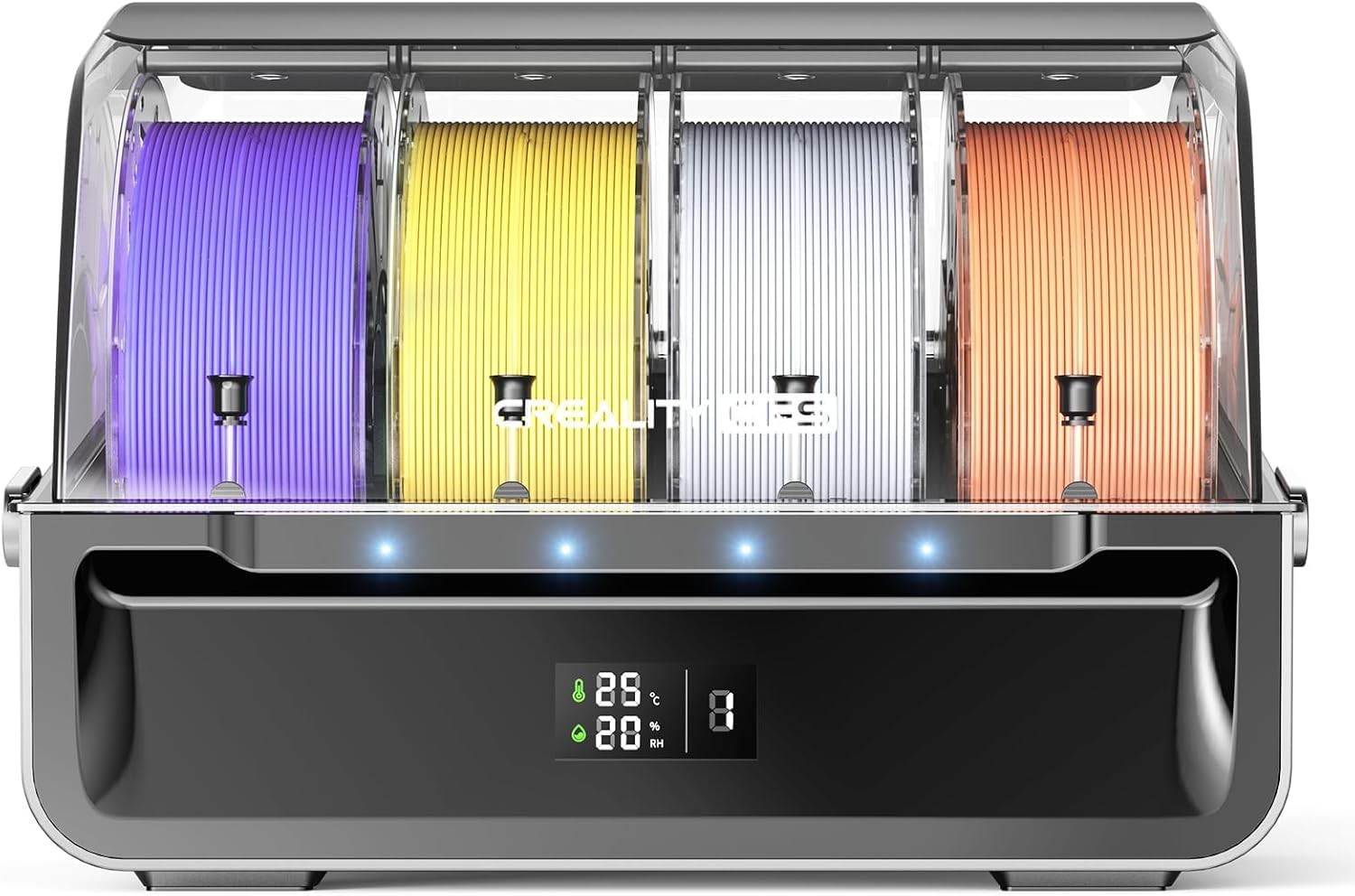

Photos from current listings. Actual item, color, and included accessories may vary.
3D Filament Dehydrator Buying Guide
A 3D filament dehydrator is a heated, fan-circulated chamber that removes absorbed moisture from PLA, PETG, TPU, nylon, and other hygroscopic filaments before printing. The core trade-off is between simple fixed-temperature food-dehydrator conversions and purpose-built dryers with precise thermostatic control, sealed chambers, and filament feed-through ports. Choose a purpose-built unit with adjustable heat and a sealed lid for consistent results; skip open-tray food dehydrators unless you add a thermometer and accept slower, uneven drying.
Key takeaways
- Purpose-built filament dryers typically hold one to two spools and offer adjustable heat from 40–70 °C, while food dehydrators often lack fine low-temperature control below 50 °C.
- Sealed chamber design with a gasketed lid and feed-through ports lets you print directly from the dryer, preventing re-absorption during long prints.
- Desiccant-assisted drying (silica gel packs) speeds moisture removal and maintains low humidity after the heat cycle ends; some units include a built-in hygrometer.
At a glance
- Category
- Filament Drying & Post-Processing
- Last updated
- Nov 28, 2026
Current offers
Highlights
- Purpose-built filament dryers typically hold one to two spools and offer adjustable heat from 40–70 °C, while food dehydrators often lack fine low-temperature control below 50 °C.
- Sealed chamber design with a gasketed lid and feed-through ports lets you print directly from the dryer, preventing re-absorption during long prints.
- Desiccant-assisted drying (silica gel packs) speeds moisture removal and maintains low humidity after the heat cycle ends; some units include a built-in hygrometer.
- Higher-wattage heating elements (100–150 W) and a circulation fan reduce drying time to 2–6 hours depending on filament type and ambient humidity.
Best use cases
- Best fit: Printing engineering filaments like nylon, PC, or TPU in humid climates — choose a sealed, adjustable-temperature dryer with feed-through ports and a hygrometer.
- Best fit: Occasional PLA/PETG printing — a single-spool fixed-temperature unit or a food dehydrator with a thermometer works, but expect longer cycles and monitor for over-softening.
- Wrong fit: Drying large quantities (3+ spools) in one batch — most consumer dryers hold 1–2 spools; use a larger cabinet-style oven or multiple units instead.
- Wrong fit: Using a kitchen oven — household ovens overshoot temperature and can fuse or deform filament; dedicated dryers maintain ±5 °C control.
Buying tips
- Match temperature range to your filament: PLA 45–50 °C, PETG 55–60 °C, TPU 50–55 °C, nylon 65–70 °C; ensure the dryer's maximum exceeds your highest requirement by at least 5 °C.
- Prefer units with a sealed lid and feed-through PTFE ports if you plan to print directly from the dryer; open-tray designs lose heat and re-absorb moisture quickly.
- Check spool compatibility: most dryers fit 200 mm (1 kg) spools; larger 2–3 kg spools require a wider chamber or an external spool holder.
- Look for a built-in hygrometer or include a separate digital hygrometer to verify chamber humidity drops below 20% RH during drying.
Specs
| Temperature Range | 40–70 °C adjustable |
|---|---|
| Spool Capacity | 1–2 spools (200 mm) |
| Chamber Seal | Gasketed lid vs open tray |
| Feed-Through Ports | PTFE ports for direct printing |
Related searches
What to check before buying
- Measure your spool diameter and width; confirm the dryer's internal chamber dimensions exceed the largest spool you use.
- Verify your workspace voltage and plug standard match the dryer's rating (120 V US vs 230 V EU) and that the cord reaches your outlet.
- Check ambient humidity in your print room; in high-humidity environments, prioritize sealed chambers and desiccant capacity.
- Confirm you have a stable, heat-resistant surface and adequate clearance around the dryer's vents for safe operation.
FAQ
Data sources: eBay / Amazon listings and product attribute feeds. Updated Nov 28, 2026.
Some links on this page are affiliate links. If you buy after clicking one, we may earn a commission at no extra cost to you. This does not change which products appear here or their order. Affiliate disclosure.