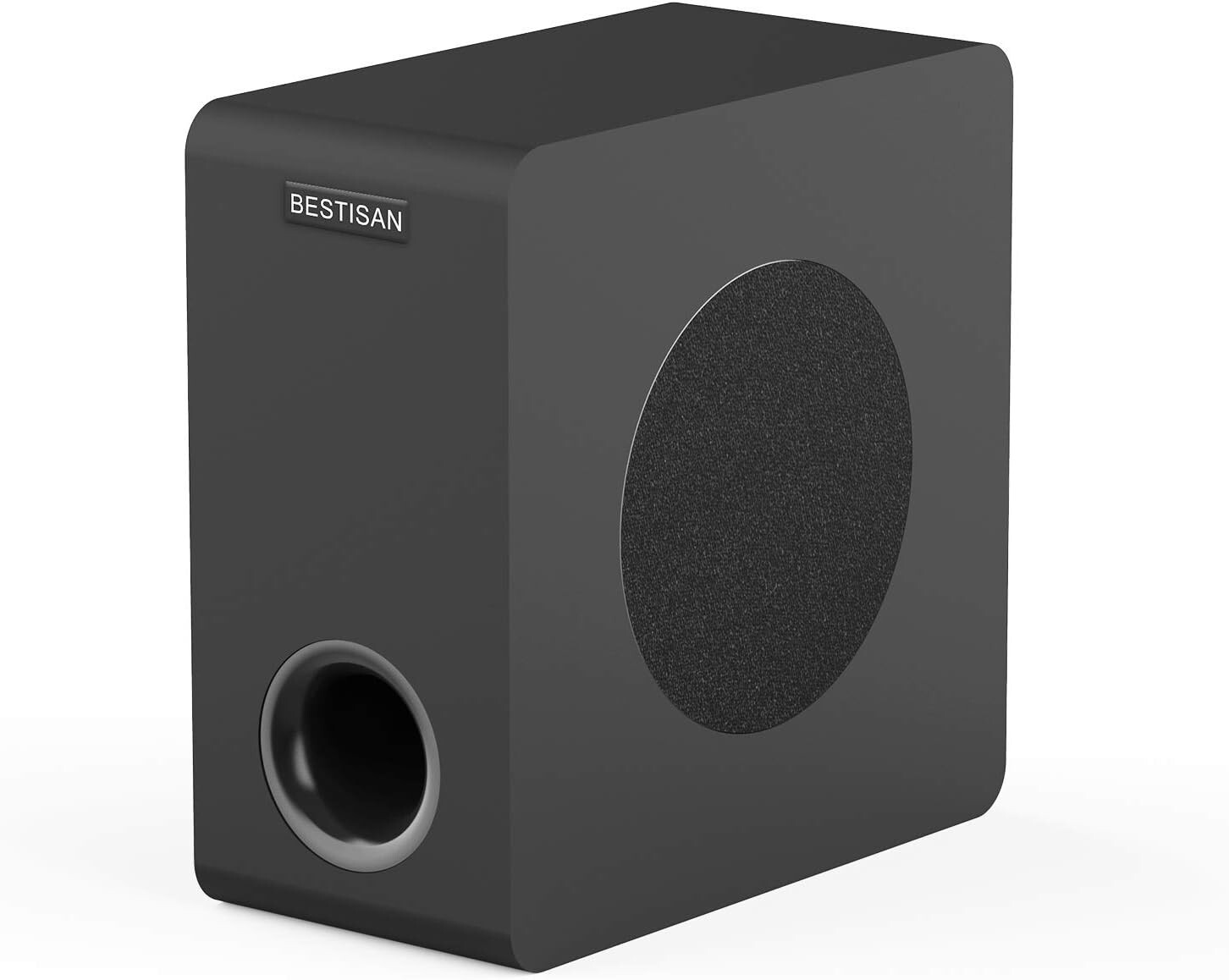

Photos from current listings. Actual item, color, and included accessories may vary.
Powered Subwoofer Buying Guide
A powered subwoofer is a self-amplified bass speaker that adds the low-frequency effects (LFE) channel your main speakers cannot reproduce, and the core trade-off is driver size plus amplifier power versus room volume and budget. The decision rule: match woofer diameter and RMS wattage to your room's cubic footage, insist on a crossover and phase control, and skip any unit that lacks line-level RCA/LFE inputs.
Median $129.99
Key takeaways
- Woofer size drives output capability: 6.5-inch drivers suit small rooms under 100 sq ft, 8-10 inch suit 100-200 sq ft, and 12-inch drivers are required for 200+ sq ft or high-SPL theater use.
- Class D amplification is standard in modern powered subs for efficiency and compact size; RMS wattage (not peak) determines clean output, and a 70W RMS unit is entry-level while 300-500W RMS serves medium-to-large rooms.
- Crossover and phase controls are mandatory: variable low-pass (typically 40-160 Hz) lets you blend with mains, and a 0/180-degree phase switch fixes nulls at the listening position.
At a glance
- Category
- Home Theater Speakers & Subwoofers
- Last updated
- Nov 27, 2026
Current offers
Highlights
- Woofer size drives output capability: 6.5-inch drivers suit small rooms under 100 sq ft, 8-10 inch suit 100-200 sq ft, and 12-inch drivers are required for 200+ sq ft or high-SPL theater use.
- Class D amplification is standard in modern powered subs for efficiency and compact size; RMS wattage (not peak) determines clean output, and a 70W RMS unit is entry-level while 300-500W RMS serves medium-to-large rooms.
- Crossover and phase controls are mandatory: variable low-pass (typically 40-160 Hz) lets you blend with mains, and a 0/180-degree phase switch fixes nulls at the listening position.
- LFE RCA input (or speaker-level inputs) is the compatibility baseline; sealed cabinets favor music accuracy and ported cabinets deliver deeper output per watt for home theater.
Best use cases
- Small apartment or bedroom music setup: pick a sealed 6.5-8 inch sub with 50-100W RMS and RCA input; skip 12-inch ported models that overwhelm the space.
- Dedicated home theater in a medium room (150-250 sq ft): choose a 10-12 inch ported sub with 200-300W RMS and LFE input; skip compact 6.5-inch units that bottom out on movie LFE peaks.
- Large open-plan or basement theater over 300 sq ft: use a 12-inch or dual-sub configuration with 300W+ RMS and room-correction EQ; skip single small subs that cannot pressurize the volume.
- Stereo-only audiophile system: pick a sealed servo or high-excursion sub with speaker-level inputs and a 24 dB/octave crossover; skip budget ported models with high port noise.
Buying tips
- Size the sub to room volume, not just floor area: multiply length x width x height in feet and aim for at least 1W RMS per cubic foot as a starting rule.
- Prioritize RMS wattage over peak: a 70W RMS unit delivers roughly half the clean output of a 150W RMS unit, so compare RMS figures only.
- Check crossover range: a variable low-pass that reaches at least 120-160 Hz blends with small satellite speakers; a fixed 80 Hz crossover limits pairing options.
- Prefer subs with both LFE RCA and speaker-level inputs for AV receiver and stereo amp compatibility, and confirm 0/180 phase plus auto-on signal sensing.
Specs
| Woofer Size | 6.5 / 8 / 10 / 12 inch |
|---|---|
| Amplifier Power | 50-500W RMS Class D |
| Crossover Range | 40-160 Hz variable low-pass |
| Inputs | LFE RCA + speaker-level |
Related searches
What to check before buying
- Measure the available floor footprint and leave 2-4 inches clearance from walls for ported models; sealed subs tolerate tighter placement.
- Confirm your AV receiver or amp has a subwoofer pre-out (RCA) or that the sub offers speaker-level inputs for stereo setups.
- Verify room volume in cubic feet and match driver size and RMS wattage to that figure before choosing a tier.
- Check voltage and plug standard for your region, and confirm the sub includes a power cable and feet for floor decoupling.
FAQ
Data sources: eBay / Amazon listings and product attribute feeds. Updated Nov 27, 2026.
Some links on this page are affiliate links. If you buy after clicking one, we may earn a commission at no extra cost to you. This does not change which products appear here or their order. Affiliate disclosure.