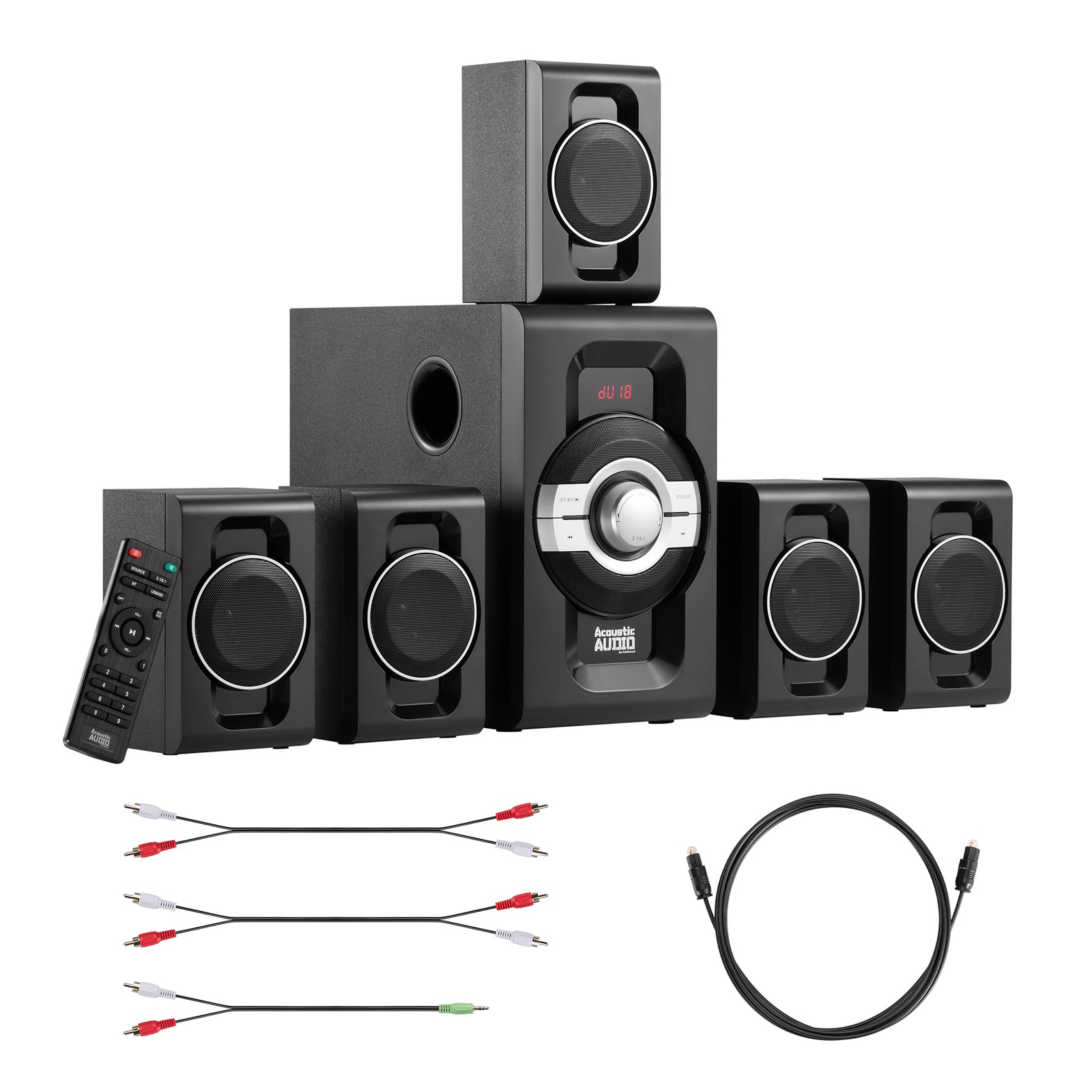

Photos from current listings. Actual item, color, and included accessories may vary.
Surround Sound Speaker Buying Guide
Surround sound speakers for TV split into two buyer paths: a true discrete multichannel system (5.1/7.1 with an AVR and wired satellites) or a soundbar-based virtual/real surround package with wireless rear speakers. The core trade-off is acoustic honesty and channel separation versus room-friendly wiring and setup simplicity; discrete speakers with a real AVR deliver the best imaging, while soundbar-plus-rears packages trade absolute fidelity for wireless placement and one-cable install.
Key takeaways
- True 5.1 uses six discrete amplification channels: three front (L/C/R), two surrounds, one LFE subwoofer channel; 5.1.2 adds two height/elevation channels for Dolby Atmos object rendering.
- Soundbar systems labeled 5.1.2 typically use virtualized or up-firing drivers plus wireless rear satellites; discrete AVR systems require speaker-level wiring and an HDMI eARC connection for lossless formats.
- Impedance and sensitivity govern amplifier matching: 8-ohm speakers are universally safe, 4-ohm loads demand AVRs rated for low-impedance drive; 85 dB+ sensitivity reduces power needs.
At a glance
- Category
- Home Theater Speakers & Subwoofers
- Last updated
- Nov 28, 2026
Current offers
Highlights
- True 5.1 uses six discrete amplification channels: three front (L/C/R), two surrounds, one LFE subwoofer channel; 5.1.2 adds two height/elevation channels for Dolby Atmos object rendering.
- Soundbar systems labeled 5.1.2 typically use virtualized or up-firing drivers plus wireless rear satellites; discrete AVR systems require speaker-level wiring and an HDMI eARC connection for lossless formats.
- Impedance and sensitivity govern amplifier matching: 8-ohm speakers are universally safe, 4-ohm loads demand AVRs rated for low-impedance drive; 85 dB+ sensitivity reduces power needs.
- Wireless surrounds still need AC power at the rear positions; only the signal path is wireless, so plan outlets behind or beside the seating area.
Best use cases
- Best fit for a dedicated movie room with in-wall/ceiling access: discrete 5.1.2 with an AVR and 8-ohm satellites for true channel separation and Atmos.
- Best fit for an apartment or rental with no rear wiring: a soundbar package with wireless rear speakers and a subwoofer, accepting virtualized height channels.
- Skip large floorstanding surrounds in small rooms under ~120 sq ft; use compact sealed satellites or bipole/dipole rears mounted 1.5-2 m high for diffuse ambience.
- Wrong fit: pairing a 5.1 speaker set with a stereo-only amplifier or TV's analog output; you need a multichannel AVR or a soundbar system with its own processing.
Buying tips
- For a 5.1 layout, surround speakers go 90-110 degrees beside or slightly behind the listener, 60-90 cm above ear height; ceiling Atmos modules want 30-45 degree elevation angles.
- Match subwoofer to room volume: sealed 10-inch subs suit rooms under ~1500 cu ft, ported 12-inch subs suit larger spaces; smaller subs in big rooms produce boomy, uneven bass.
- Confirm HDMI eARC on both TV and AVR/soundbar for Dolby Atmos and lossless TrueHD; optical/Toslink is limited to compressed 5.1 and cannot carry Atmos.
- Choose satellite sensitivity of 85 dB or higher and 8-ohm nominal impedance for broad AVR compatibility; low-sensitivity 4-ohm satellites need robust amplification.
Specs
| Channel Layout | 5.1 / 5.1.2 / 7.1 discrete |
|---|---|
| Wireless Rear | Signal wireless; AC power required |
| Impedance Match | 8 ohm nominal / 4 ohm AVR-rated |
| TV Connection | HDMI eARC / optical fallback |
Related searches
What to check before buying
- Measure the TV wall and seating distance; surrounds need 60-90 cm behind or beside the main seat and a clear line to the listening position.
- Verify power outlets near rear speaker positions for wireless surrounds and near the subwoofer location, plus surge protection for the AVR.
- Check TV HDMI ports for eARC and CEC; older TVs may need an AVR with dual HDMI outputs or an optical fallback for compressed 5.1.
- Measure ceiling height and stud locations for wall/ceiling mounts; satellites over 2 kg need anchored mounts, not drywall plugs alone.
FAQ
Data sources: eBay / Amazon listings and product attribute feeds. Updated Nov 28, 2026.
Some links on this page are affiliate links. If you buy after clicking one, we may earn a commission at no extra cost to you. This does not change which products appear here or their order. Affiliate disclosure.