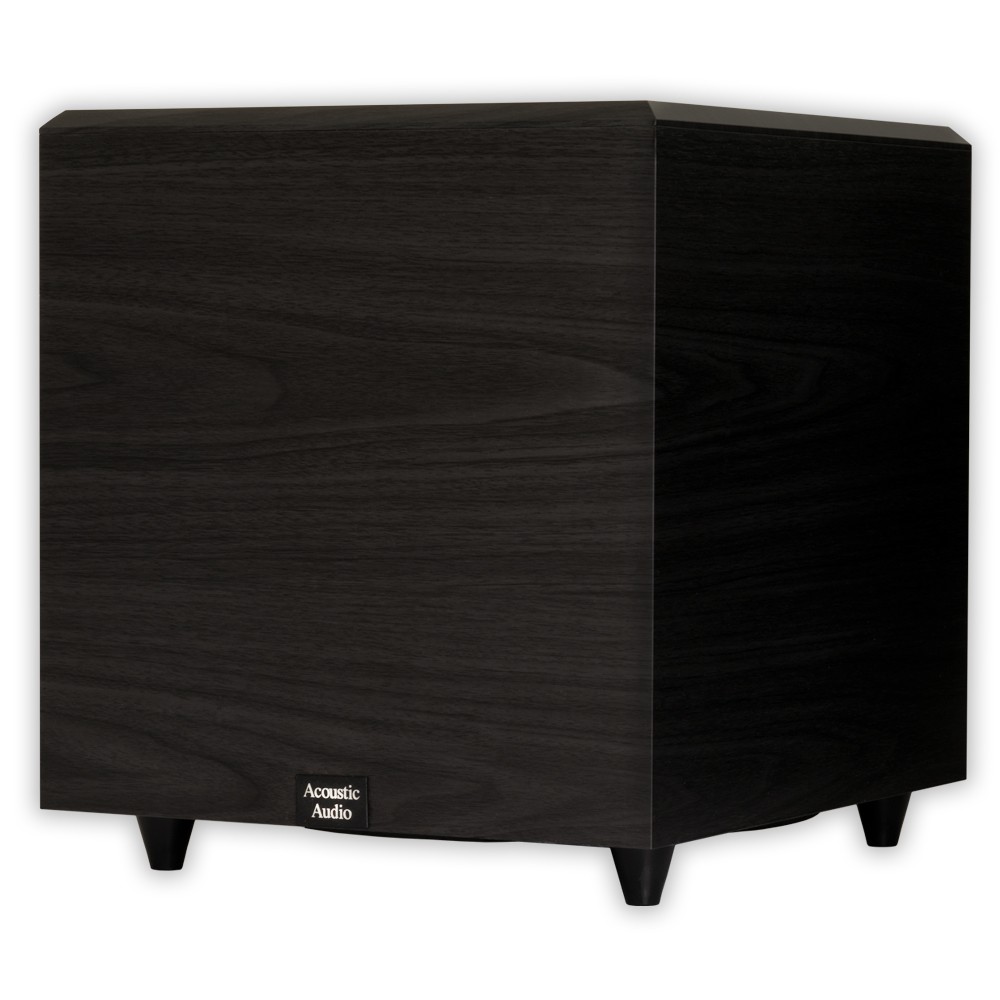

Photos from current listings. Actual item, color, and included accessories may vary.
Home Theater Subwoofer Buying Guide
A home theater subwoofer is the dedicated low-frequency channel that reproduces the LFE track and bass-managed content below roughly 80–120 Hz, and the primary trade-off is driver/enclosure engineering versus amplifier quality at a given cabinet size. Durable, clean options use a rigid braced MDF cabinet, a high-excursion driver, and a real power supply rated for continuous RMS output. The decision rule: buy a powered sub whose -3 dB point and RMS amplifier match your room volume and main speakers, and skip any bar-style 'subwoofer' bundle that lacks crossover control and line/LFE input.
Key takeaways
- Powered subs are classified by amplifier topology: Class AB linear amps run hotter but clip gracefully, while Class D switch-mode amps deliver 80–95% efficiency and higher RMS per pound.
- Driver diameter sets displacement: 8-inch subs suit rooms under 1,500 cu ft, 10-inch suit 1,500–3,000 cu ft, and 12-inch suit 3,000+ cu ft or bass-heavy action mixes.
- The LFE input bypasses the internal low-pass crossover; the line-in RCA path uses the adjustable 40–120 Hz crossover, which is mandatory for pairing with small satellite speakers.
At a glance
- Category
- Home Theater Speakers & Subwoofers
- Last updated
- Nov 28, 2026
Current offers
Highlights
- Powered subs are classified by amplifier topology: Class AB linear amps run hotter but clip gracefully, while Class D switch-mode amps deliver 80–95% efficiency and higher RMS per pound.
- Driver diameter sets displacement: 8-inch subs suit rooms under 1,500 cu ft, 10-inch suit 1,500–3,000 cu ft, and 12-inch suit 3,000+ cu ft or bass-heavy action mixes.
- The LFE input bypasses the internal low-pass crossover; the line-in RCA path uses the adjustable 40–120 Hz crossover, which is mandatory for pairing with small satellite speakers.
- A ported (bass-reflex) cabinet extends deeper output per watt but needs room boundary placement, while sealed cabinets roll off gently and integrate more easily with main speakers.
Best use cases
- Pick a sealed 10- or 12-inch powered sub with LFE input for a 5.1/7.1 receiver setup in a 1,500–2,500 cu ft room where accurate mid-bass and easy blending matter more than maximum SPL.
- Choose a ported 12-inch sub rated near 500 W RMS for a dedicated media room over 3,000 cu ft or for action/gaming content where deep 25–30 Hz output is the priority.
- Skip soundbar-plus-sub bundles for true home theater: they rarely expose a discrete LFE input, fixed crossovers, or phase control, so they cannot be calibrated to an AV receiver.
- For apartments or shared walls, pick a smaller sealed 8–10-inch sub with room-correction EQ rather than a large ported box, since boundary gain and rattles dominate before output does.
Buying tips
- Match sub RMS to room volume: roughly 100–150 W RMS per 1,000 cu ft for typical listening, doubling for high-SPL action or inefficient sealed designs.
- Confirm the receiver has a subwoofer pre-out (LFE) and set the sub's crossover to 'LFE/bypass' or the highest setting; the AV receiver's bass management should own the 80 Hz crossover.
- Budget for room correction: a sub with an app-based parametric EQ or an AVR with Audyssey/Dirac/YPAO will outperform a bigger driver that is placed badly.
- Check phase control (0–180° continuous is better than a two-position switch) and auto-on sensitivity, since these determine clean integration and standby behavior.
Specs
| Amplifier Class | Class D (efficient) vs Class AB |
|---|---|
| Driver Size Tier | 8 in / 10 in / 12 in / 15 in |
| Enclosure Type | Sealed vs Ported (bass-reflex) |
| Input / Crossover | RCA LFE + line-in, 40-120 Hz low-pass |
Related searches
What to check before buying
- Measure the available floor footprint and leave at least 6 inches of clearance from the driver and port to walls; ported subs need 1–2 feet of breathing room for rated output.
- Verify the AV receiver or processor has a powered subwoofer output (RCA LFE) and that the sub accepts line-level LFE, not just speaker-level inputs.
- Confirm wall voltage and plug type for your region (120 V 60 Hz NEMA 5-15 in North America, 230 V 50 Hz elsewhere) before ordering an imported amp.
- Check the sub's low-pass crossover range reaches at least 120 Hz so it can cover small satellites, and that it has a phase control and auto-on/off.
FAQ
Data sources: eBay / Amazon listings and product attribute feeds. Updated Nov 28, 2026.
Some links on this page are affiliate links. If you buy after clicking one, we may earn a commission at no extra cost to you. This does not change which products appear here or their order. Affiliate disclosure.