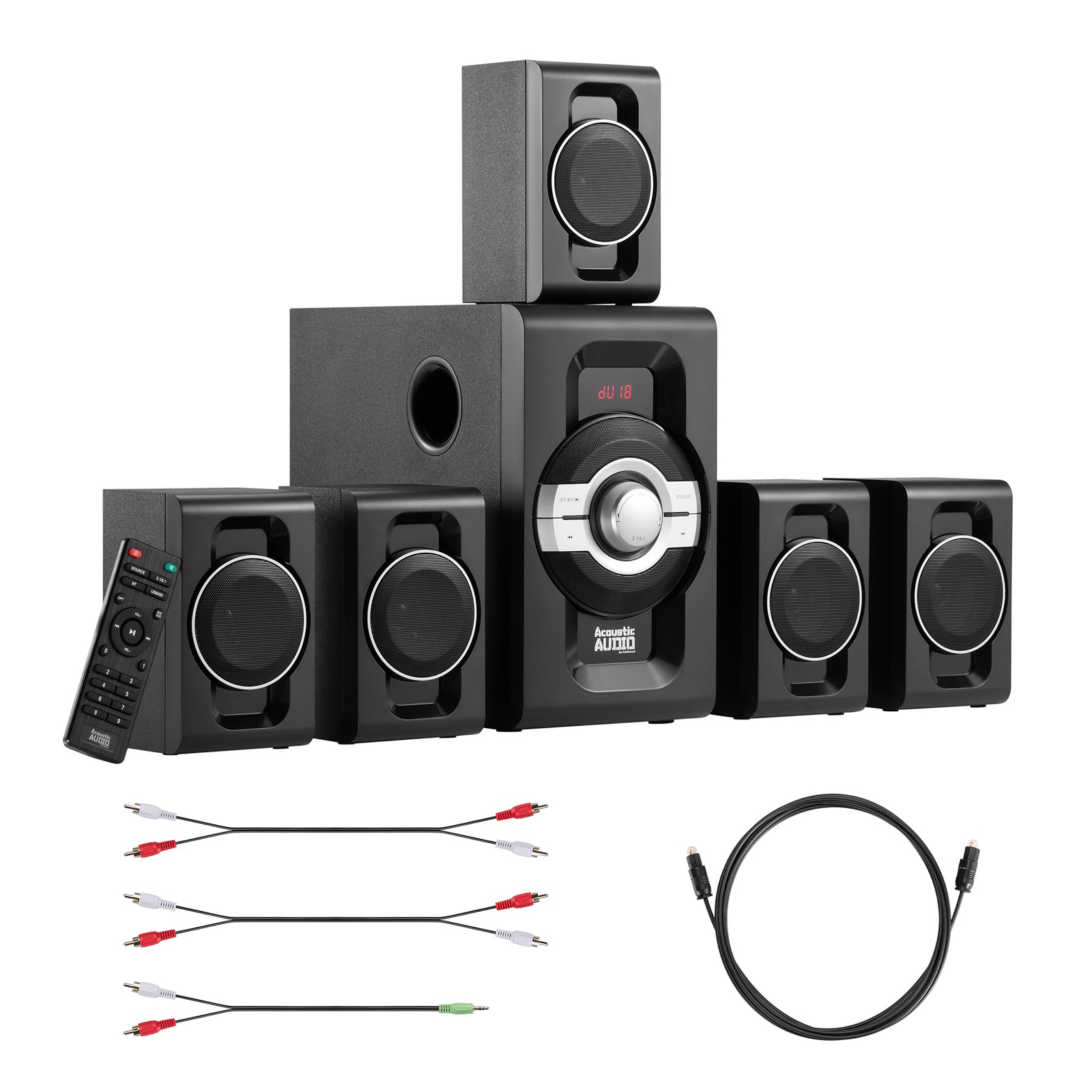

Photos from current listings. Actual item, color, and included accessories may vary.
Home Theater Sound System Buying Guide
A home theater sound system is the speaker and subwoofer chain that replaces TV-downmixed audio with discrete channels and real low-frequency output. The core trade-off is passive speaker quality plus amplifier headroom versus all-in-one soundbar convenience. Buy separate AV receiver plus passive speakers for durability and upgradeability; choose a soundbar only when space and wiring make a receiver impossible.
Key takeaways
- Channel count defines immersion: 2.0/2.1 is stereo plus bass; 5.1 adds center and surrounds; 5.1.2 or 7.1.4 adds height channels for Dolby Atmos and DTS:X object audio.
- Passive systems need an AV receiver rated at the speakers' nominal impedance (4 or 8 ohm) and sensitivity (85-90 dB); low-sensitivity 4-ohm speakers demand receiver power roughly double an 8-ohm load.
- Subwoofer output is set by driver diameter and cabinet volume: 8-inch ported models reach about 35-40 Hz, 10-inch about 30 Hz, 12-inch about 25 Hz, with room gain adding 3-6 dB below 40 Hz.
At a glance
- Category
- Home Theater Speakers & Subwoofers
- Last updated
- Nov 28, 2026
Current offers
Highlights
- Channel count defines immersion: 2.0/2.1 is stereo plus bass; 5.1 adds center and surrounds; 5.1.2 or 7.1.4 adds height channels for Dolby Atmos and DTS:X object audio.
- Passive systems need an AV receiver rated at the speakers' nominal impedance (4 or 8 ohm) and sensitivity (85-90 dB); low-sensitivity 4-ohm speakers demand receiver power roughly double an 8-ohm load.
- Subwoofer output is set by driver diameter and cabinet volume: 8-inch ported models reach about 35-40 Hz, 10-inch about 30 Hz, 12-inch about 25 Hz, with room gain adding 3-6 dB below 40 Hz.
- Soundbars use compact full-range or 2-way drivers with 2-3 inch woofers; a separate wireless subwoofer with a 6.5-8 inch driver is required for any output below roughly 60 Hz.
Best use cases
- Dedicated media room with 10+ ft viewing distance: choose a 5.1 or 5.1.2 passive system with an AV receiver and 10-12 inch subwoofer; skip soundbars, which cannot produce discrete rear channels.
- Living room with sofa against the wall and no rear wiring: choose a 3.1 soundbar plus wireless subwoofer or a passive 3.1 setup with surround speakers placed at 110-120 degrees; skip 5.1 systems that require rear cable runs.
- Apartment or bedroom under 150 sq ft: choose a 2.0 or 2.1 soundbar with an 80W amp and compact subwoofer; skip 12-inch ported subwoofers that overload small rooms with boomy 40-60 Hz peaks.
- PC or projector gaming desk: choose a 2.0 compact soundbar or powered bookshelf pair with optical or HDMI ARC; skip full AV receiver stacks unless you need 4K/120Hz HDMI passthrough.
Buying tips
- Match receiver power to speaker sensitivity: a 85 dB speaker needs about 2x the amplifier watts of a 88 dB speaker to hit the same loudness; aim for 50-100W per channel into 8 ohms for medium rooms.
- For a room 12x15 ft or smaller, a 10-inch subwoofer is sufficient; step to 12-inch only for rooms over 250 sq ft or for pipe-organ and explosion-heavy content below 30 Hz.
- Confirm HDMI ARC/eARC on both TV and soundbar or receiver; eARC is required for uncompressed Dolby TrueHD and DTS-HD Master Audio passthrough from the TV.
- Place the center channel directly below or above the TV screen at ear height and the front left/right speakers 22-30 degrees off-center for a coherent front stage.
Specs
| Channel Layout | 2.0 / 3.1 / 5.1 / 5.1.2 / 7.1.4 |
|---|---|
| Amplification | Passive AV receiver vs active soundbar |
| Subwoofer Driver | 8 / 10 / 12 in ported or sealed |
| TV Connection | HDMI eARC / optical / Bluetooth |
Related searches
What to check before buying
- Measure the TV stand width and shelf depth: soundbars are typically 24-48 inches wide, and a 32-inch bar fits under 43-55 inch TVs without blocking the IR receiver.
- Check wall construction and outlets: wireless surround speakers still need AC power at the rear, and in-wall cable runs require stud-safe routing or surface raceway.
- Verify TV audio output: optical (TOSLINK) is universal, HDMI ARC needs a compatible port, and Bluetooth introduces 100-200 ms latency unsuitable for lip-sync-critical viewing.
- Confirm receiver clearance: AV receivers need 3-6 inches of open space above and around vents; enclosed cabinets overheat Class AB amplifiers.
FAQ
Data sources: eBay / Amazon listings and product attribute feeds. Updated Nov 28, 2026.
Some links on this page are affiliate links. If you buy after clicking one, we may earn a commission at no extra cost to you. This does not change which products appear here or their order. Affiliate disclosure.