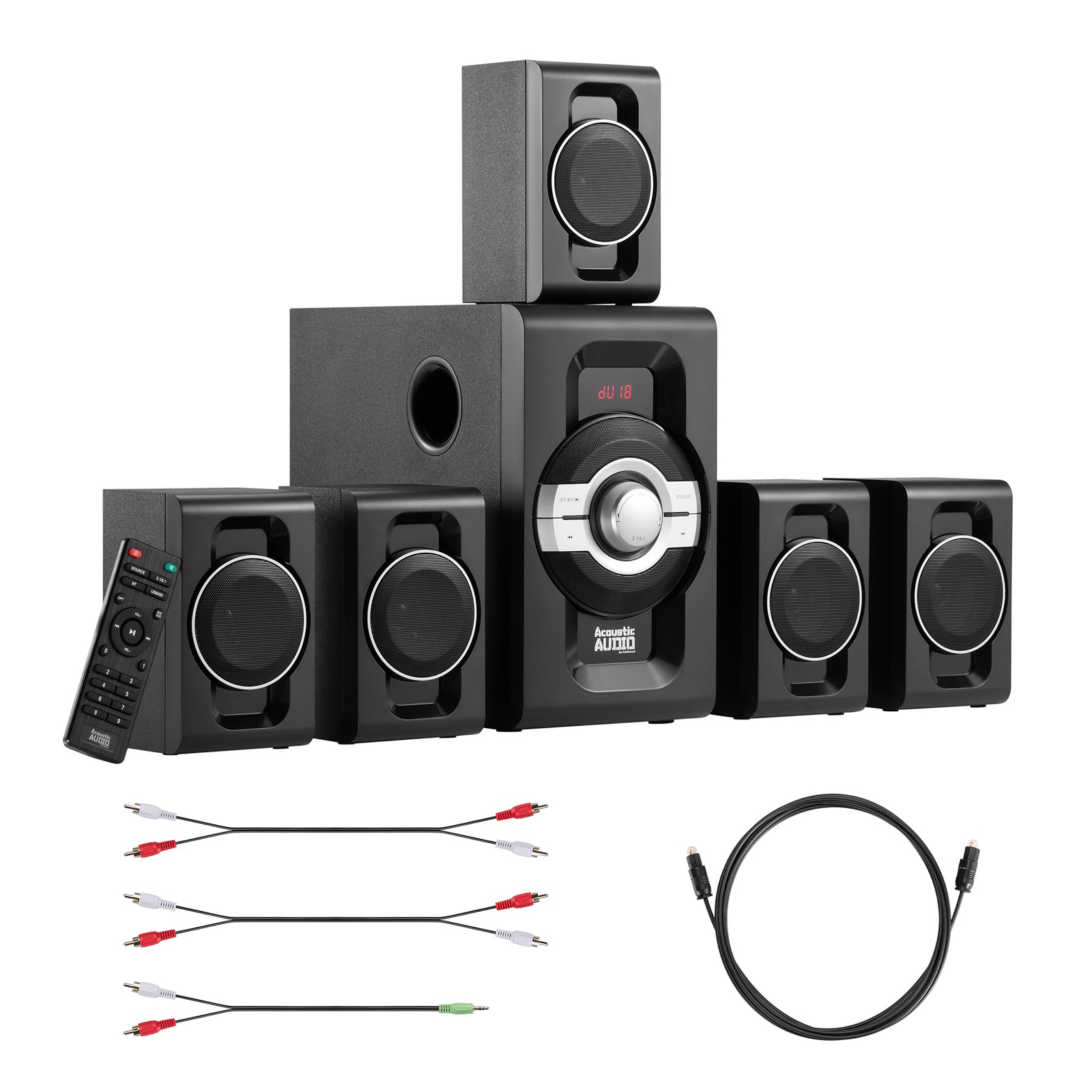

Photos from current listings. Actual item, color, and included accessories may vary.
Home Sound System Buying Guide
A home sound system spans soundbars, component 5.1/2.1 speaker kits, and architectural in-ceiling/in-wall speakers, each defined by channel count, amplifier power, and cabinet construction. The core trade-off is compact convenience versus true acoustic output: plastic soundbars simplify wiring but limit bass and soundstage, while separate AV receivers and MDF cabinets deliver real dynamics at the cost of space and setup. The decision rule is to buy by room size and source chain — a soundbar with a wireless subwoofer for bedrooms under 200 sq ft, a discrete 5.1 kit with an AVR for living rooms over 250 sq ft, and in-ceiling pairs only where flush mounting and ceiling access are confirmed.
Key takeaways
- Channel count drives immersion: 2.0/2.1 soundbars virtualize surround with two or three drivers, while true 5.1 systems use five discrete speakers plus a subwoofer for real rear-channel separation.
- Amplifier power is quoted as peak versus RMS; 80W peak soundbars typically deliver 15-25W RMS per channel, while 150W peak in-ceiling pairs handle 40-75W RMS continuously.
- Cabinet material separates tiers: plastic housings resonate below 100 Hz and suit compact soundbars, while MDF-wood enclosures on component speakers reduce vibration and extend clean low-frequency response.
At a glance
- Category
- Home Theater Speakers & Subwoofers
- Last updated
- Nov 28, 2026
Current offers
Highlights
- Channel count drives immersion: 2.0/2.1 soundbars virtualize surround with two or three drivers, while true 5.1 systems use five discrete speakers plus a subwoofer for real rear-channel separation.
- Amplifier power is quoted as peak versus RMS; 80W peak soundbars typically deliver 15-25W RMS per channel, while 150W peak in-ceiling pairs handle 40-75W RMS continuously.
- Cabinet material separates tiers: plastic housings resonate below 100 Hz and suit compact soundbars, while MDF-wood enclosures on component speakers reduce vibration and extend clean low-frequency response.
- In-ceiling and in-wall models use 2-way driver arrays (woofer plus tweeter) with 8-ohm impedance to match standard AV receivers; damp/humid-rated pairs add sealed backcans for bathrooms and covered patios.
Best use cases
- Bedroom or small apartment under 200 sq ft — pick a 2.0 or 2.1 soundbar with Bluetooth and optical/HDMI ARC; skip 5.1 kits whose rear speakers need mounting space you do not have.
- Living room 250-400 sq ft with a TV and movie priority — pick a 5.1 channel kit (six speakers) paired with an AV receiver rated at 80-100W per channel; skip single soundbars that cannot produce discrete rear effects.
- Renovation or new-build with ceiling access — pick an 8-inch 2-way in-ceiling pair rated 150W peak and damp/humid placement for kitchens and covered patios; skip them in rented rooms or ceilings without crawl space.
- Music-first listening with a turntable or streamer — pick a 2.1 system with a powered subwoofer and bookshelf speakers on stands; skip plastic soundbars whose small drivers muddy midbass.
Buying tips
- Match amplifier power to room volume: 50-80W RMS per channel covers up to 300 sq ft, while rooms above 400 sq ft need 100W+ RMS and a 10-12 inch subwoofer.
- Confirm impedance compatibility: 8-ohm speakers pair safely with any AV receiver, while 4-ohm models demand a receiver rated for low-impedance loads or they will overheat.
- Measure ceiling joist spacing before buying in-ceiling pairs: 8-inch cutouts need 9.5-10.5 inch holes and at least 4 inches of depth clearance above drywall.
- Prioritize HDMI ARC or optical inputs over Bluetooth-only soundbars for TV use; Bluetooth introduces 100-200ms lip-sync delay that no remote setting fully corrects.
Specs
| Channel Config | 2.0 / 2.1 / 5.1 discrete |
|---|---|
| Power Rating | 50-150W RMS per channel |
| Cabinet Material | Plastic vs MDF wood |
| Inputs | HDMI ARC / Optical / Bluetooth |
Related searches
What to check before buying
- Measure the TV stand width and wall space: soundbars run 24-48 inches wide, and 5.1 rear speakers need stands or wall mounts within cable reach of the receiver.
- Check ceiling construction for in-ceiling models: confirm drywall thickness, joist direction, and at least 4 inches of clearance above the ceiling plane.
- Verify room acoustics and floor type: hard floors and glass walls reflect high frequencies, so budget for a rug or curtains before blaming the speakers.
- Confirm voltage and plug standard for your region (120V/60Hz North America vs 230V/50Hz Europe) and that the receiver or soundbar includes the correct power cable.
FAQ
Data sources: eBay / Amazon listings and product attribute feeds. Updated Nov 28, 2026.
Some links on this page are affiliate links. If you buy after clicking one, we may earn a commission at no extra cost to you. This does not change which products appear here or their order. Affiliate disclosure.