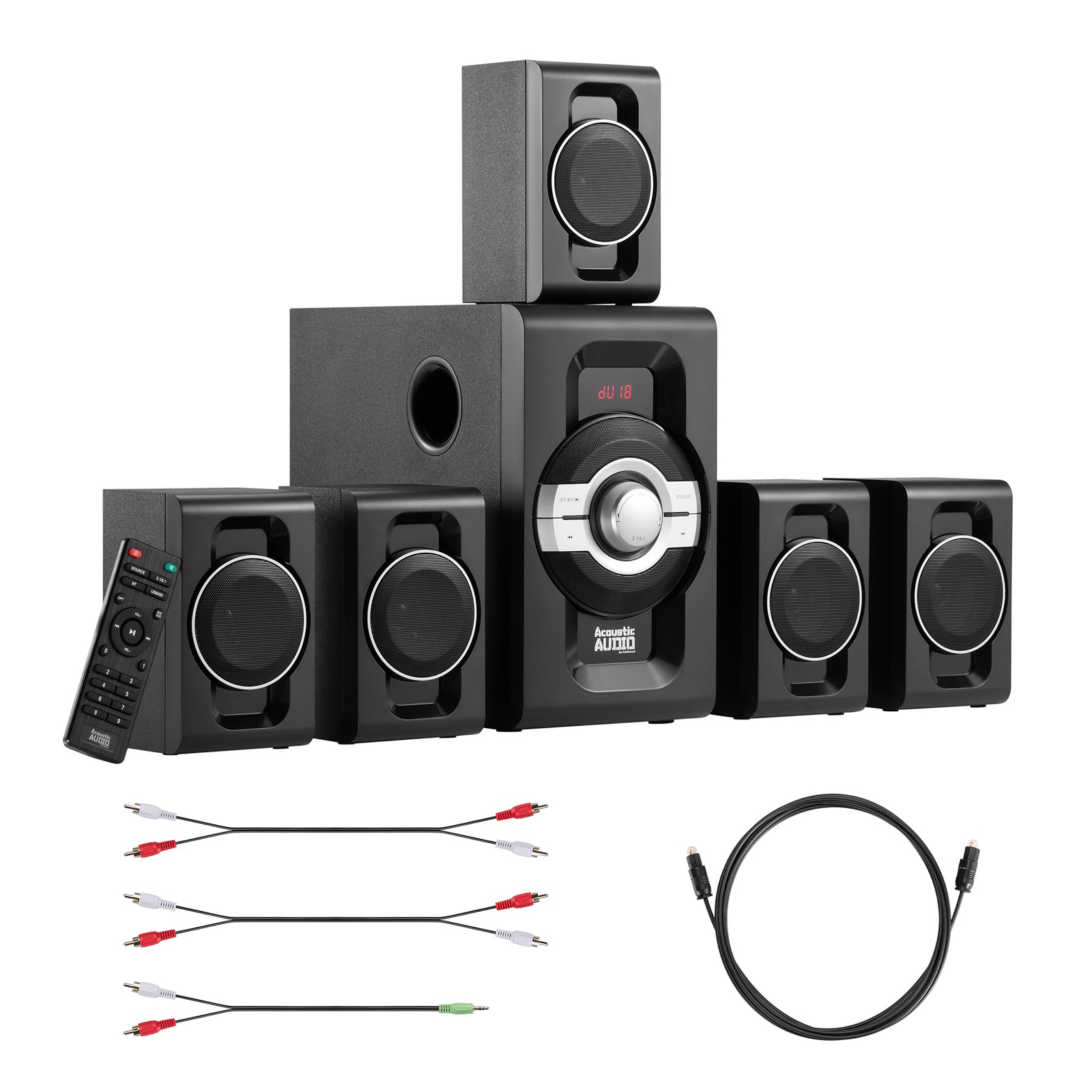

Photos from current listings. Actual item, color, and included accessories may vary.
Bluetooth Home Theater Speaker Buying Guide
Bluetooth home theater speakers split into two clear architectures: self-powered soundbars with integrated amplification and passive speaker systems that require an AV receiver or standalone amplifier. The primary trade-off is convenience versus true surround decoding and upgrade path—soundbars simplify wiring but rarely deliver discrete rear channels, while passive 5.1 systems need an AVR yet offer real multichannel separation and replaceable components. The decision rule: buy a soundbar only if you want a one-box 2.0/2.1 solution in a small room; buy a passive speaker system plus AVR if you want genuine 5.1 surround and long-term expandability.
Key takeaways
- Soundbar Bluetooth home theater systems are self-amplified 2.0 or 2.1 designs—30–80W total—with optical, AUX, and Bluetooth inputs but no discrete surround decoding.
- Passive 5.1 Bluetooth speaker kits ship with five satellite speakers and a subwoofer; they require an AV receiver or the included compact amplifier to power all channels.
- In-ceiling and in-wall Bluetooth speaker pairs use 2-way flush-mount drivers (typically 6.5" or 8") and must be paired with an amplifier that supports Bluetooth or a separate streaming module.
At a glance
- Category
- Home Theater Speakers & Subwoofers
- Last updated
- Nov 28, 2026
Current offers
Highlights
- Soundbar Bluetooth home theater systems are self-amplified 2.0 or 2.1 designs—30–80W total—with optical, AUX, and Bluetooth inputs but no discrete surround decoding.
- Passive 5.1 Bluetooth speaker kits ship with five satellite speakers and a subwoofer; they require an AV receiver or the included compact amplifier to power all channels.
- In-ceiling and in-wall Bluetooth speaker pairs use 2-way flush-mount drivers (typically 6.5" or 8") and must be paired with an amplifier that supports Bluetooth or a separate streaming module.
- True home theater surround depends on Dolby Digital/DTS decoding in the receiver or soundbar—Bluetooth itself carries only stereo audio, so rear-channel wireless systems use proprietary transmitters, not standard Bluetooth.
Best use cases
- Best fit: a 24–32 inch 2.0 soundbar for a bedroom or small apartment TV where space is tight and you want one-cable optical or Bluetooth setup—skip if you expect rear-channel surround.
- Best fit: a passive 5.1 speaker kit plus a 5-channel AV receiver for a dedicated living-room theater where discrete surround and future speaker upgrades matter—skip if you refuse to run speaker wire.
- Best fit: an 8-inch in-ceiling Bluetooth speaker pair with a compact stereo amplifier for covered patios or damp rooms where flush mounting and humidity resistance are required—skip for rental walls you cannot cut.
- Wrong fit: buying a Bluetooth soundbar for a large open-plan room with vaulted ceilings—2.0 bars lack the output and dispersion to fill that volume; choose a passive 5.1 system with a dedicated subwoofer instead.
Buying tips
- Match soundbar width to TV screen size: a 24-inch bar suits 32-inch and smaller TVs; a 32-inch bar suits 40–50-inch TVs—wider bars look disproportionate on small stands.
- For passive 5.1 kits, confirm the receiver delivers at least 50W per channel into 8 ohms and supports Dolby Digital/DTS via HDMI or optical—Bluetooth alone cannot carry surround.
- In-ceiling speakers need 3–5 inches of mounting depth behind drywall and a cutout matching the driver size; 8-inch drivers require roughly a 9.5-inch cutout and produce deeper bass than 6.5-inch units.
- Bluetooth range and stability depend on version: Bluetooth 5.0 and later offer lower latency and longer range than 4.2—choose 5.0+ for lip-sync accuracy with video.
Specs
| System Type | Soundbar 2.0 / Passive 5.1 / In-Ceiling |
|---|---|
| Amplification | Self-powered vs AV receiver required |
| Bluetooth Version | 5.0+ preferred; 4.2 minimum |
| Surround Decoding | Dolby Digital / DTS via AVR only |
Related searches
What to check before buying
- Measure your TV stand or wall width and the space below the screen—soundbars are 24–32 inches wide and 2–4 inches tall; confirm no obstruction to the TV IR sensor.
- For in-ceiling or in-wall speakers, verify ceiling joist spacing, cutout diameter, and mounting depth before ordering; also confirm the room's humidity level matches the speaker's damp-rated construction.
- Confirm your TV has an optical, HDMI ARC, or 3.5mm AUX output—Bluetooth-only TVs introduce audio latency and are not ideal for primary home theater use.
- For passive 5.1 systems, budget for speaker wire, a 5-channel AV receiver, and stands or mounts for the rear satellites—these are not included in most speaker-only kits.
FAQ
Data sources: eBay / Amazon listings and product attribute feeds. Updated Nov 28, 2026.
Some links on this page are affiliate links. If you buy after clicking one, we may earn a commission at no extra cost to you. This does not change which products appear here or their order. Affiliate disclosure.