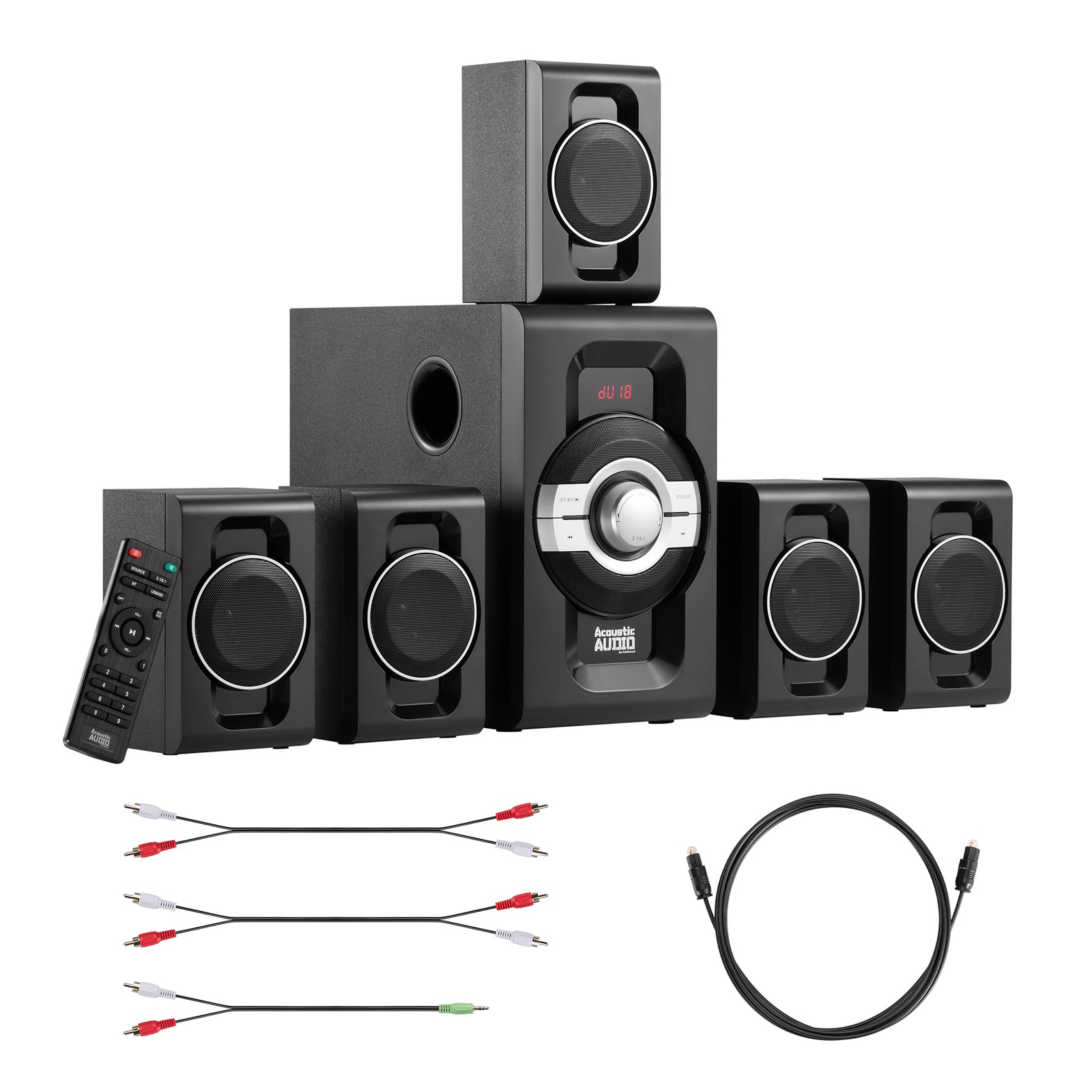

Photos from current listings. Actual item, color, and included accessories may vary.
Bluetooth Home Theater Buying Guide
A Bluetooth home theater system combines wireless source connectivity with multi-channel speaker and subwoofer setups, where the key trade-off is between convenience and true surround performance. The decisive rule: choose systems with discrete amplification and wired speaker runs for core channels, using Bluetooth only as a source input rather than a substitute for surround processing.
Key takeaways
- True 5.1 systems require a powered subwoofer and at least five separate satellite speakers with discrete channel amplification, not shared full-range drivers.
- Bluetooth codecs like SBC and AAC introduce 100-200ms latency; low-latency modes (aptX LL, LC3) are needed for lip-sync with video.
- In-wall and in-ceiling speakers use 2-way designs with aimable tweeters and moisture-resistant cones (polypropylene or treated paper) for damp locations.
At a glance
- Category
- Home Theater Speakers & Subwoofers
- Last updated
- Nov 28, 2026
Current offers
Highlights
- True 5.1 systems require a powered subwoofer and at least five separate satellite speakers with discrete channel amplification, not shared full-range drivers.
- Bluetooth codecs like SBC and AAC introduce 100-200ms latency; low-latency modes (aptX LL, LC3) are needed for lip-sync with video.
- In-wall and in-ceiling speakers use 2-way designs with aimable tweeters and moisture-resistant cones (polypropylene or treated paper) for damp locations.
- Amplifier power per channel should be 50-100W RMS at 8 ohms to cleanly drive satellite speakers without clipping.
Best use cases
- Best fit: a 5.1 Bluetooth system with a powered subwoofer and five satellites for movie surround in a dedicated room; skip soundbar-only setups if true rear-channel immersion matters.
- Best fit: in-ceiling/in-wall pairs with a stereo amplifier for damp spaces like covered patios or bathrooms; skip these if you need discrete surround channels.
- Best fit: compact 2.1 Bluetooth systems for apartments where rear speaker placement is impractical; skip 5.1 if room width is under 10 feet.
- Wrong fit: using a single Bluetooth receiver to feed existing passive speakers without checking amplifier impedance matching; this risks underpowering or distortion.
Buying tips
- Match speaker impedance to amplifier rating: 8-ohm speakers with 8-ohm-rated amps; 4-ohm speakers require amps rated for 4-ohm loads to avoid overheating.
- For surround placement, rear speakers should be 2-3 feet above ear level and angled inward; ceiling speakers need aimable tweeters for proper dispersion.
- Verify Bluetooth version: 5.0 or higher for stable range up to 30 feet; older 4.2 versions may drop in rooms with obstacles.
- Check subwoofer crossover range: adjustable 40-160Hz lets you blend with satellite speakers that roll off around 80-100Hz.
Specs
| Channel Config | 2.0 / 2.1 / 5.1 discrete |
|---|---|
| Bluetooth Codec | SBC / AAC / aptX LL / LC3 |
| Amplifier Power | 50-100W RMS per ch @ 8 ohms |
| Speaker Impedance | 4 / 6 / 8 ohms |
Related searches
What to check before buying
- Measure room dimensions and seating distance: rear speakers need at least 3 feet behind the listener for 5.1; skip 5.1 if impossible.
- Confirm ceiling joist spacing (16 or 24 inches on center) for in-ceiling speakers and check clearance depth for the speaker basket.
- Verify amplifier power output at 8 ohms and total harmonic distortion (THD) under 0.1% for clean audio.
- Ensure Bluetooth source device supports the same codec as the system (e.g., aptX for low latency) and check for optical or HDMI ARC inputs for TV connectivity.
FAQ
Data sources: eBay / Amazon listings and product attribute feeds. Updated Nov 28, 2026.
Some links on this page are affiliate links. If you buy after clicking one, we may earn a commission at no extra cost to you. This does not change which products appear here or their order. Affiliate disclosure.