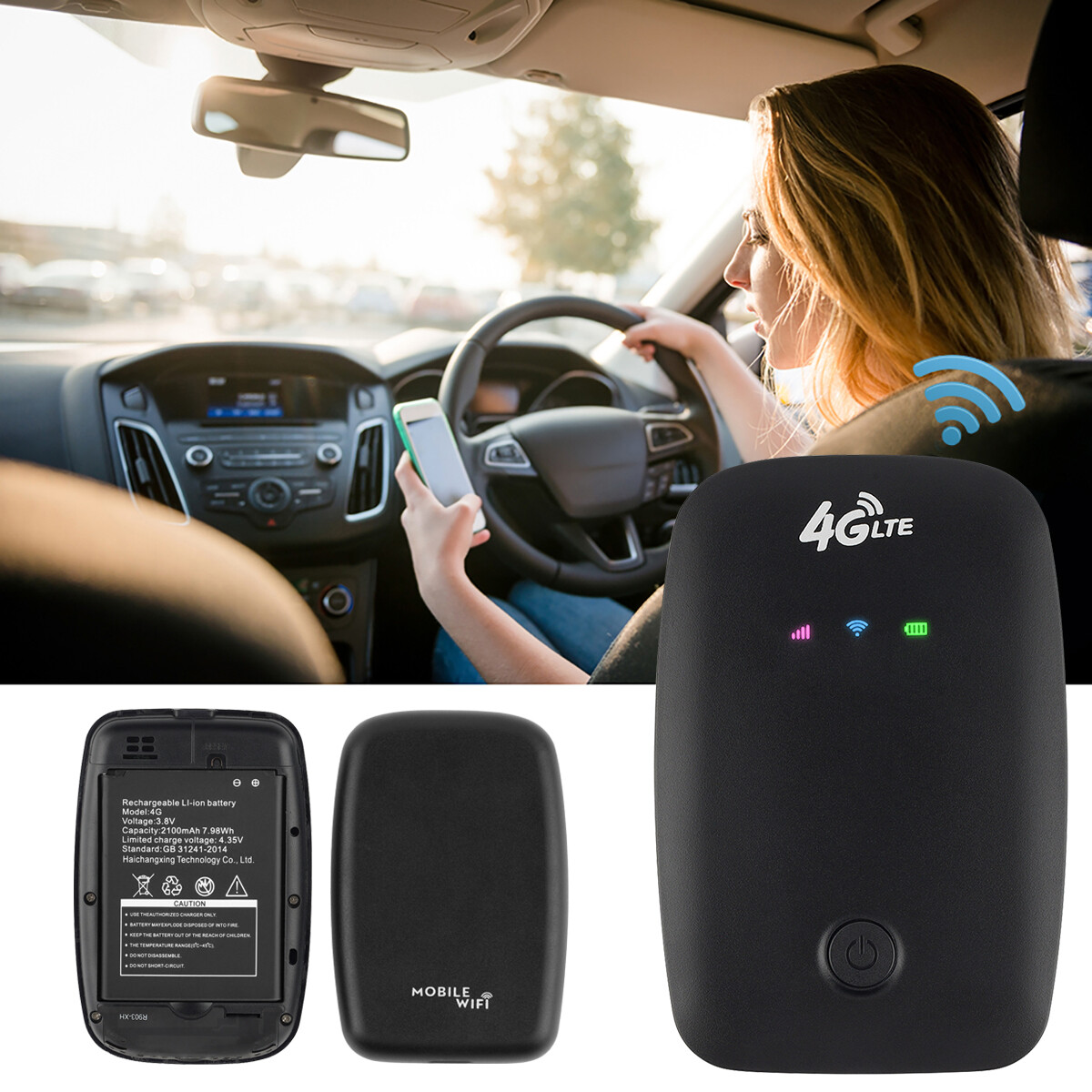

Photos from current listings. Actual item, color, and included accessories may vary.
Portable WiFi Router Buying Guide
A portable WiFi router is a battery-powered device that creates a local Wi-Fi network from a cellular (4G/5G) or wired Ethernet source. The core trade-off is between modem capability (LTE Cat4 vs Cat6+ vs 5G) and battery/routing throughput, where cheap plastic units often lack carrier aggregation and proper band support. The decision rule: buy a model with confirmed band compatibility for your carrier, a removable or ≥3000mAh battery, and at least 802.11ac Wi-Fi; skip single-band 2.4GHz units and locked-carrier modems.
Key takeaways
- Modem category determines real-world speed: LTE Cat4 caps at 150Mbps down/50Mbps up with no carrier aggregation; Cat6+ adds aggregation for 300Mbps+; 5G sub-6 delivers 1Gbps+ but costs more and drains battery faster.
- Wi-Fi generation matters more than antenna count: 802.11ac (Wi-Fi 5) dual-band handles 20+ devices; 802.11n 2.4GHz-only units choke above 8-10 clients and suffer interference in dense areas.
- Battery capacity and chemistry set untethered runtime: 3000-5000mAh Li-ion delivers 6-10 hours of active routing; sub-2000mAh plastic-body units typically die in 3-4 hours under load.
At a glance
- Category
- Network Switches, Routers & Firewalls
- Last updated
- Nov 28, 2026
Current offers
Highlights
- Modem category determines real-world speed: LTE Cat4 caps at 150Mbps down/50Mbps up with no carrier aggregation; Cat6+ adds aggregation for 300Mbps+; 5G sub-6 delivers 1Gbps+ but costs more and drains battery faster.
- Wi-Fi generation matters more than antenna count: 802.11ac (Wi-Fi 5) dual-band handles 20+ devices; 802.11n 2.4GHz-only units choke above 8-10 clients and suffer interference in dense areas.
- Battery capacity and chemistry set untethered runtime: 3000-5000mAh Li-ion delivers 6-10 hours of active routing; sub-2000mAh plastic-body units typically die in 3-4 hours under load.
- Carrier lock and band support are the top compatibility failure: unlocked modems covering LTE B1/B3/B7/B20 (Europe) or B2/B4/B5/B12/B13 (US) work across MVNOs; carrier-locked units reject third-party SIMs.
Best use cases
- Best fit: travelers using local prepaid SIMs abroad — choose a true unlocked modem with broad LTE band coverage and a SIM slot (micro/nano); avoid carrier-branded locked hotspots sold with a plan.
- Best fit: home failover or temporary office backup — select a router with Ethernet WAN/LAN ports and dual-band Wi-Fi so it can switch between wired and cellular; skip screenless USB-dongle hotspots with no wired port.
- Wrong fit: permanent whole-home coverage or heavy multi-user gaming — portable routers lack external antenna ports and QoS; use a fixed 4G/5G CPE or mesh system instead.
Buying tips
- Match LTE bands to your carrier before anything else: US carriers rely on B2/B4/B5/B12/B13/B66/B71; Europe on B1/B3/B7/B20; a modem missing your primary band will drop to 3G or no service.
- Prioritize Wi-Fi 5 (802.11ac) dual-band over 802.11n: 5GHz avoids 2.4GHz congestion in hotels and airports and sustains 50-100Mbps real throughput to multiple devices.
- Choose 3000mAh minimum, 5000mAh for all-day use: runtime scales roughly linearly; 5000mAh gives 8-12 hours, while 1500-2000mAh units need a power bank by midday.
- Demand an unlocked modem with a standard SIM slot (nano/micro): carrier-locked or eSIM-only units restrict you to one provider and block cheap local data SIMs when traveling.
Specs
| Cellular Modem | LTE Cat4 / Cat6+ / 5G sub-6 |
|---|---|
| Wi-Fi Standard | 802.11ac dual-band vs 802.11n 2.4GHz |
| Battery Runtime | 3000-5000mAh; 6-12 hr active |
| SIM & Lock | Unlocked nano/micro SIM slot |
Related searches
What to check before buying
- Verify your carrier's primary LTE bands (e.g., B2/B4/B12/B13/B66/B71 in the US) and confirm the router's spec sheet lists them — band support is model-specific, not universal.
- Check device count and Wi-Fi standard: count laptops, phones, and tablets; 802.11ac dual-band handles 15-25 devices, 2.4GHz-only units degrade beyond 8-10.
- Confirm power input: most portable routers charge via Micro-USB or USB-C at 5V/1-2A; USB-C PD units recharge faster and can run from a power bank.
- Plan for Ethernet needs: if you want wired failover or a LAN port for a desktop/NAS, pick a model with at least one RJ45 WAN/LAN port; pure hotspot pucks have none.
FAQ
Data sources: eBay / Amazon listings and product attribute feeds. Updated Nov 28, 2026.
Some links on this page are affiliate links. If you buy after clicking one, we may earn a commission at no extra cost to you. This does not change which products appear here or their order. Affiliate disclosure.