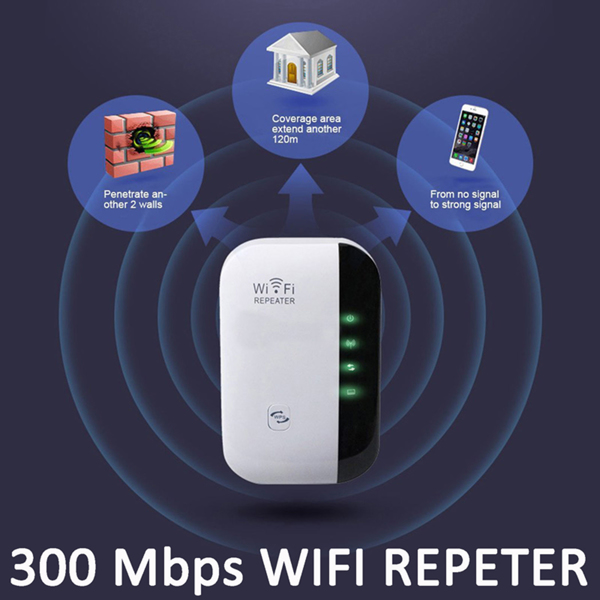

Photos from current listings. Actual item, color, and included accessories may vary.
WiFi Extender Buying Guide
A WiFi extender is a secondary radio that rebroadcasts an existing router signal to fill dead zones, and the core trade-off is between dual-band throughput with a dedicated backhaul versus single-band repeaters that halve speed. The decision rule: buy a dual-band or tri-band unit with Gigabit Ethernet and WPA3 for any connection above 100 Mbps, and only accept a 300 Mbps single-band repeater for legacy 2.4 GHz IoT coverage.
Key takeaways
- 300 Mbps repeaters are 2.4 GHz single-band only; they cut throughput in half per hop and cap real-world clients near 40-60 Mbps.
- 1200 Mbps class extenders use 300 Mbps on 2.4 GHz plus 867 Mbps on 5 GHz, requiring a Gigabit Ethernet port to avoid wired backhaul bottlenecking.
- Dedicated backhaul (tri-band or Ethernet) preserves full client speed; shared-radio repeaters lose roughly 50% of bandwidth on every hop.
At a glance
- Category
- Network Switches, Routers & Firewalls
- Last updated
- Nov 28, 2026
Current offers
Highlights
- 300 Mbps repeaters are 2.4 GHz single-band only; they cut throughput in half per hop and cap real-world clients near 40-60 Mbps.
- 1200 Mbps class extenders use 300 Mbps on 2.4 GHz plus 867 Mbps on 5 GHz, requiring a Gigabit Ethernet port to avoid wired backhaul bottlenecking.
- Dedicated backhaul (tri-band or Ethernet) preserves full client speed; shared-radio repeaters lose roughly 50% of bandwidth on every hop.
- WPA3 and 802.11k/v/r roaming support determine whether clients hand off cleanly between router and extender instead of clinging to a weak signal.
Best use cases
- Pick a 1200 Mbps dual-band extender with Gigabit Ethernet for gaming or 4K streaming in a far room; skip 300 Mbps single-band units, which add latency and halve throughput.
- For Xfinity or Verizon Fios gateways, choose an extender that supports WPA2/WPA3 and can run in access-point mode over Ethernet; skip repeaters that only clone the SSID over wireless backhaul.
- Use a 300 Mbps 2.4 GHz repeater only for smart bulbs, cameras, and IoT sensors that need range, not speed; skip it for laptops, consoles, or TVs.
- For multi-room coverage beyond two rooms, pick a mesh system with dedicated backhaul rather than chaining multiple extenders, which compounds latency and throughput loss.
Buying tips
- Match extender class to your internet tier: 1200 Mbps (AC1200) for plans up to 300 Mbps, and AX1800/AX3000 WiFi 6 for 500 Mbps+ plans to avoid becoming the bottleneck.
- Place the extender where the router signal is still at least two bars (roughly -60 dBm); halfway between router and dead zone is the correct rule.
- Require at least one Gigabit Ethernet port for wired backhaul or for connecting a console/PC; Fast Ethernet (100 Mbps) caps wired clients and defeats dual-band speed.
- Choose access-point mode support for the most stable backhaul when an Ethernet drop exists; repeater mode is only for locations with no cabling.
Specs
| WiFi Class | 300M single-band / 1200M dual-band |
|---|---|
| Backhaul Type | Wireless repeater / Ethernet AP |
| Ethernet Port | Fast Ethernet vs Gigabit |
| Security Standard | WPA2 / WPA3 |
Related searches
What to check before buying
- Measure the distance from router to dead zone and confirm a power outlet exists at the halfway point for extender placement.
- Confirm your router's band and security standard (WPA2 or WPA3) so the extender can match SSID and encryption without downgrading the network.
- Verify the extender supports the same WiFi generation as your router (WiFi 5/AC or WiFi 6/AX) to avoid negotiating a slower link.
- Check plug type and voltage (US NEMA 1-15 / 120V vs EU/UK) and whether the unit is wall-plug or desktop with external antennas for placement flexibility.
FAQ
Data sources: eBay / Amazon listings and product attribute feeds. Updated Nov 28, 2026.
Some links on this page are affiliate links. If you buy after clicking one, we may earn a commission at no extra cost to you. This does not change which products appear here or their order. Affiliate disclosure.