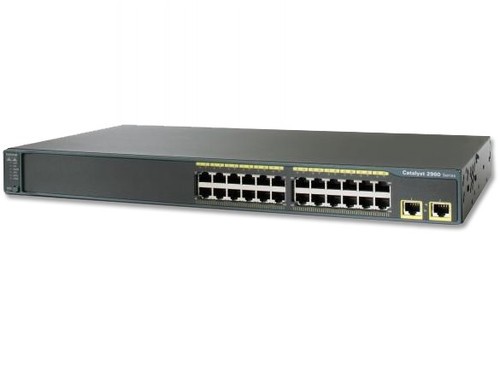

Photos from current listings. Actual item, color, and included accessories may vary.
Catalyst Switch Buying Guide
Catalyst switches are Cisco's enterprise-grade access and aggregation line, defined by managed Layer 2/3 feature sets, CLI/SNMP control, and long service life. The core trade-off is port speed and PoE budget versus power draw, noise, and licensing: Fast Ethernet models are dirt-cheap but obsolete for gigabit clients, while multi-gig and UPOE units cost more and run hotter. Buy by port speed tier, PoE class, and IOS feature set—not by chassis size alone.
Key takeaways
- 2960-24TT-L: 24 Fast Ethernet (10/100) access ports plus 2 Gigabit uplinks; LAN Lite IOS lacks static routing and advanced QoS.
- 2960-S/2960-X: Gigabit access with 2-4 SFP uplinks; 2960-X adds StackWise-80 stacking and optional PoE+ (30W/port).
- Catalyst 9200/9300: Gigabit or multigig access, PoE+ or UPOE (60W/port), DNA licensing, and IOS-XE modular architecture.
At a glance
- Category
- Network Switches, Routers & Firewalls
- Last updated
- Nov 28, 2026
Current offers
Highlights
- 2960-24TT-L: 24 Fast Ethernet (10/100) access ports plus 2 Gigabit uplinks; LAN Lite IOS lacks static routing and advanced QoS.
- 2960-S/2960-X: Gigabit access with 2-4 SFP uplinks; 2960-X adds StackWise-80 stacking and optional PoE+ (30W/port).
- Catalyst 9200/9300: Gigabit or multigig access, PoE+ or UPOE (60W/port), DNA licensing, and IOS-XE modular architecture.
- PoE tiers: 802.3af (15.4W), 802.3at/PoE+ (30W), and UPOE/802.3bt (60-90W); total budget per switch caps concurrent powered ports.
Best use cases
- Best fit: lab, legacy industrial, or printer/VoIP access where 10/100 is sufficient—pick 2960-24TT-L and skip PoE models.
- Best fit: office gigabit access with IP phones and APs—choose 2960-X or 9200 with PoE+ and verify total budget covers peak draw.
- Best fit: core/aggregation or multi-switch closets—stack 2960-X (StackWise-80) or 9300 (StackWise-480) instead of standalone units.
- Wrong fit: Wi-Fi 6/6E APs needing 2.5G or 10G uplinks—skip Fast Ethernet and 1G-only Catalyst tiers; move to multigig 9300-M or 9000 series.
Buying tips
- Count peak PoE draw: sum device class max watts (af 15.4, at 30, bt 60-90) and compare to switch budget; leave 20% headroom.
- Uplink math: 24×1G access at line rate needs 2×10G or 4×1G uplinks; SFP vs SFP+ determines 1G vs 10G fiber compatibility.
- IOS feature check: LAN Lite lacks routing, SSHv2, and advanced ACLs; LAN Base/IP Base needed for L3 and policy.
- EOL risk: 2960-24TT-L is end-of-sale/end-of-support; avoid for production and reserve for isolated lab or spare use.
Specs
| Access Speed | 10/100 vs 1G vs Multigig |
|---|---|
| PoE Standard | 802.3af / at / bt (15-90W) |
| Uplink Type | SFP 1G / SFP+ 10G / Stack |
| IOS Tier | LAN Lite / LAN Base / IOS-XE |
Related searches
What to check before buying
- Rack depth and airflow: confirm 1RU 19-inch EIA mounting, front-to-back or side-to-side airflow, and clearance for fan noise in occupied rooms.
- Power/plug: verify 100-240V AC input and the correct IEC C14/C16 cord; PoE models draw more and may need dedicated circuits.
- Cabling: Cat5e minimum for 1G, Cat6/6a for 2.5G/10G; confirm SFP/SFP+ module wavelength and reach match existing fiber.
- Companion parts: console cable (RJ45 or USB), stacking cables, SFP optics, and rack screws are often missing from used units.
FAQ
Data sources: eBay / Amazon listings and product attribute feeds. Updated Nov 28, 2026.
Some links on this page are affiliate links. If you buy after clicking one, we may earn a commission at no extra cost to you. This does not change which products appear here or their order. Affiliate disclosure.