
Photos from current listings. Actual item, color, and included accessories may vary.
Power Amplifier Buying Guide
A power amplifier is the gain stage that takes a line-level signal and drives passive loudspeakers, and the core trade-off is honest continuous power per channel versus inflated peak wattage claims. Durable amps are rated in RMS watts at a specified impedance and distortion threshold across the full 20 Hz–20 kHz band, while compromise units advertise peak or 'max' watts into a single frequency and skimp on heatsinking, transformer mass, and protection circuitry.
Median $119.45
Key takeaways
- Continuous FTC-style ratings are given as RMS watts per channel into 8 and 4 ohms at 20 Hz–20 kHz with THD under 0.1%; 'peak' or 'max' figures are momentary and not comparable across brands.
- Class AB amps use large linear transformers and heatsinks for clean low-distortion output; Class D amps use switching supplies for lighter, cooler, more efficient high-power designs.
- Multi-channel 5.1 chassis distribute a shared supply across five channels, so per-channel RMS drops sharply versus a 2-channel stereo amp of the same total rating.
At a glance
- Category
- AV Receivers & Amplifiers
- Last updated
- Nov 24, 2026
Current offers
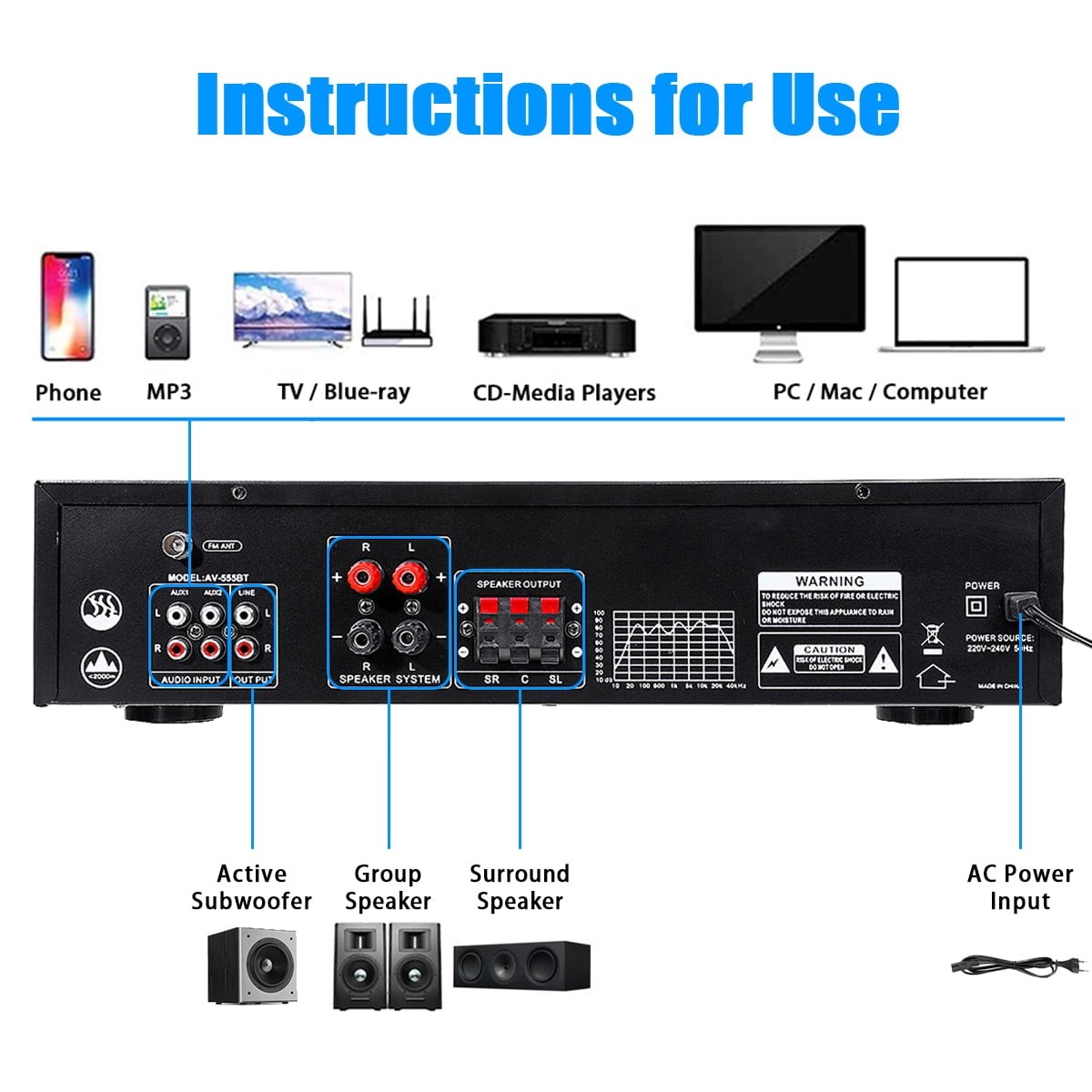 800W Surround Sound Bluetooth Audio Power Amplifier Receiver Home Theater Stereo$117.49View on eBay
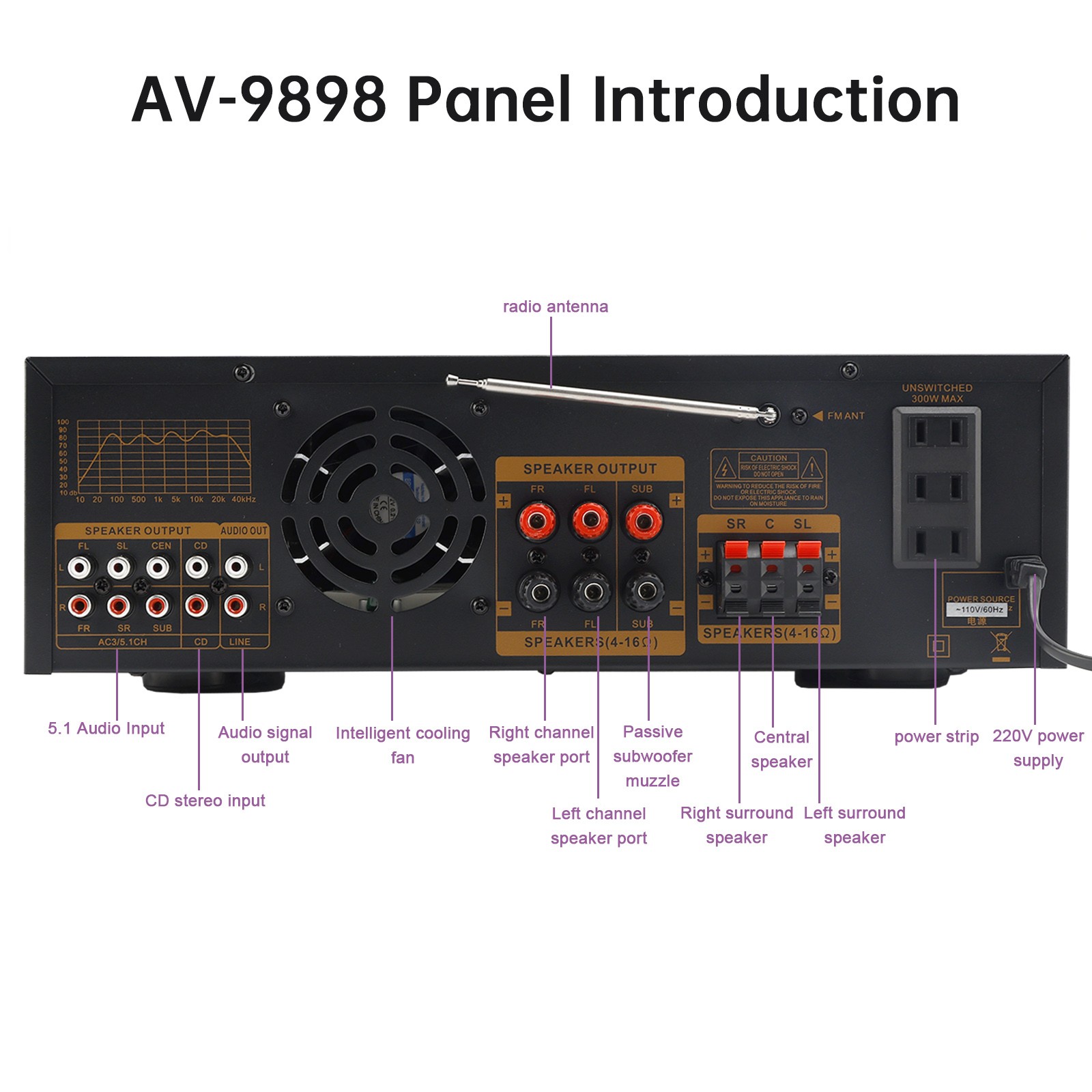 3000W Peak Stereo HiFi Power Amplifier High-Power 5.1Channel Subwoofer Amplifier$119.45View on eBay
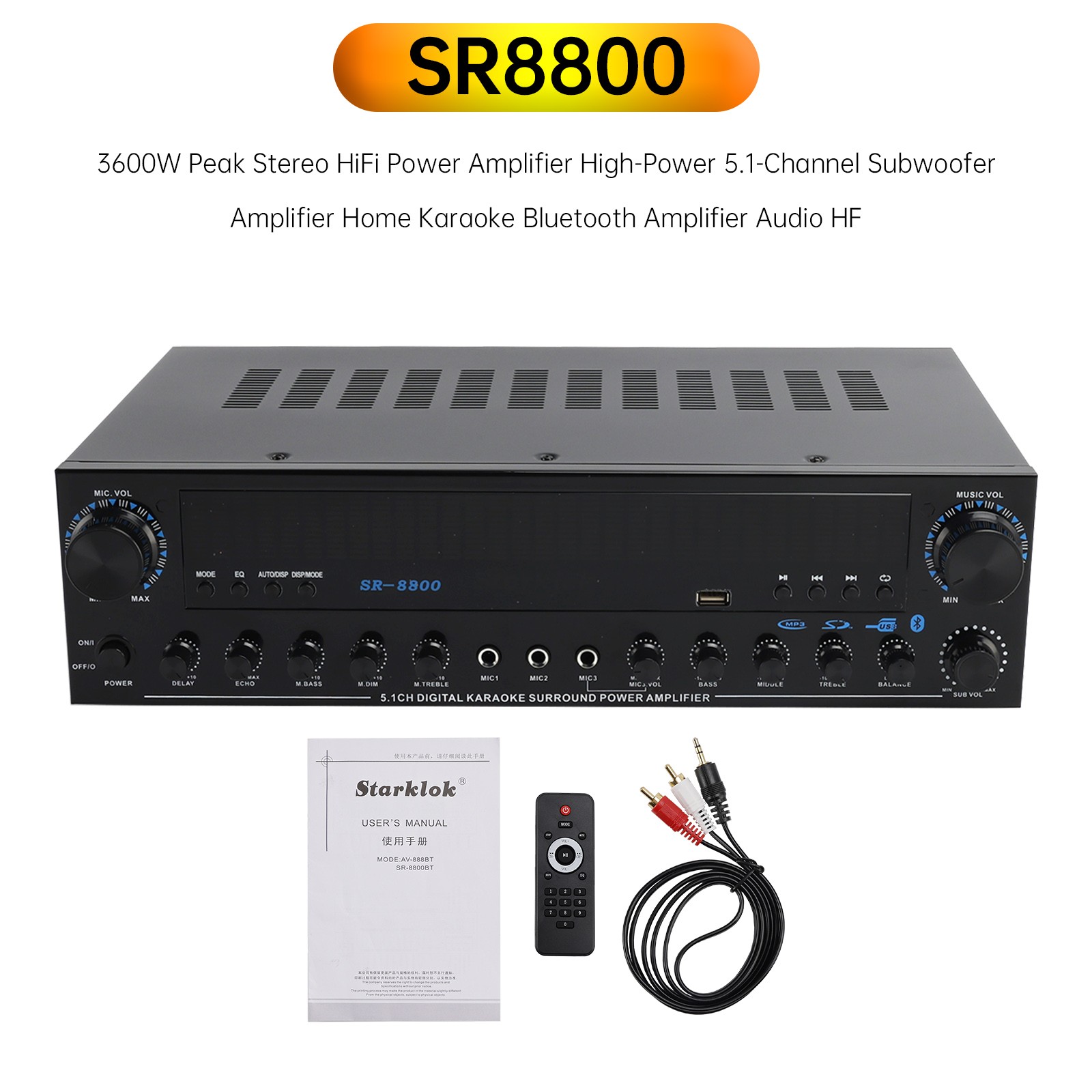 3600W Peak Stereo HiFi Power Bluetooth Amplifier High-Power 5.1 Subwoofer Home$319.55Last checked Nov 18, 2026View on eBay
Highlights
- Continuous FTC-style ratings are given as RMS watts per channel into 8 and 4 ohms at 20 Hz–20 kHz with THD under 0.1%; 'peak' or 'max' figures are momentary and not comparable across brands.
- Class AB amps use large linear transformers and heatsinks for clean low-distortion output; Class D amps use switching supplies for lighter, cooler, more efficient high-power designs.
- Multi-channel 5.1 chassis distribute a shared supply across five channels, so per-channel RMS drops sharply versus a 2-channel stereo amp of the same total rating.
- Protection and headroom are physical: transformer weight, capacitor bank size, and heatsink area determine whether an amp sustains rated power without clipping or thermal shutdown.
Best use cases
- Best fit: a 2-channel Class AB or Class D stereo amp rated 50–150 W RMS per channel into 8 ohms for driving two bookshelf or tower speakers in a music system; skip 5.1 receivers if you only need stereo.
- Best fit: a 5.1-channel amp only when you are actually wiring five passive speakers plus a powered subwoofer; choose one rated at least 60–80 W RMS per channel into 8 ohms, not a '3000 W peak' badge.
- Wrong fit: pairing a high-peak, low-RMS amp with low-sensitivity 4-ohm speakers and expecting loud clean output; you will hit clipping and thermal limiting before reaching reference levels.
- Wrong fit: buying a bare power amp for a TV or streamer without a preamp or receiver with pre-outs; a power amp has no source switching, volume control, or HDMI decoding.
Buying tips
- Match RMS power to speaker sensitivity: a 85 dB speaker needs roughly double the watts of a 88 dB speaker for the same loudness, so prioritize honest RMS ratings over peak claims.
- Confirm stable 4-ohm operation if your speakers dip below 8 ohms; an amp rated only for 8 ohms may current-limit or overheat on 4-ohm loads.
- Budget for pre-amplification: a pure power amp requires a preamp, AV receiver with pre-outs, or streamer with variable line output to control volume and switch sources.
- For multi-room or desktop use, a Class D amp with 24–48 V DC or universal AC input runs cooler and lighter; for high-current tower speakers, favor a linear-supply Class AB with substantial transformer mass.
Specs
| Amplifier Class | Class AB linear vs Class D switching |
|---|---|
| Power Rating Basis | RMS 20 Hz–20 kHz vs peak watts |
| Channel Count | 2-channel stereo vs 5.1 multi-channel |
| Impedance Support | 8 ohm / 4 ohm stable minimum |
Related searches
What to check before buying
- Measure speaker impedance and sensitivity from the spec sheet; both 4-ohm capability and 85–90 dB sensitivity determine how much real RMS power you need.
- Verify input connections: RCA line inputs are standard, but confirm XLR, balanced, or trigger inputs if integrating with a preamp or AV processor.
- Check chassis dimensions and ventilation clearance against your shelf or rack; Class AB amps need several inches of open air around heatsinks.
- Confirm mains voltage and plug type for your region (120 V/60 Hz or 230 V/50 Hz) and that the amp includes the correct IEC or captive power cord.
FAQ
Data sources: eBay / Amazon listings and product attribute feeds. Updated Nov 24, 2026.
Some links on this page are affiliate links. If you buy after clicking one, we may earn a commission at no extra cost to you. This does not change which products appear here or their order. Affiliate disclosure.