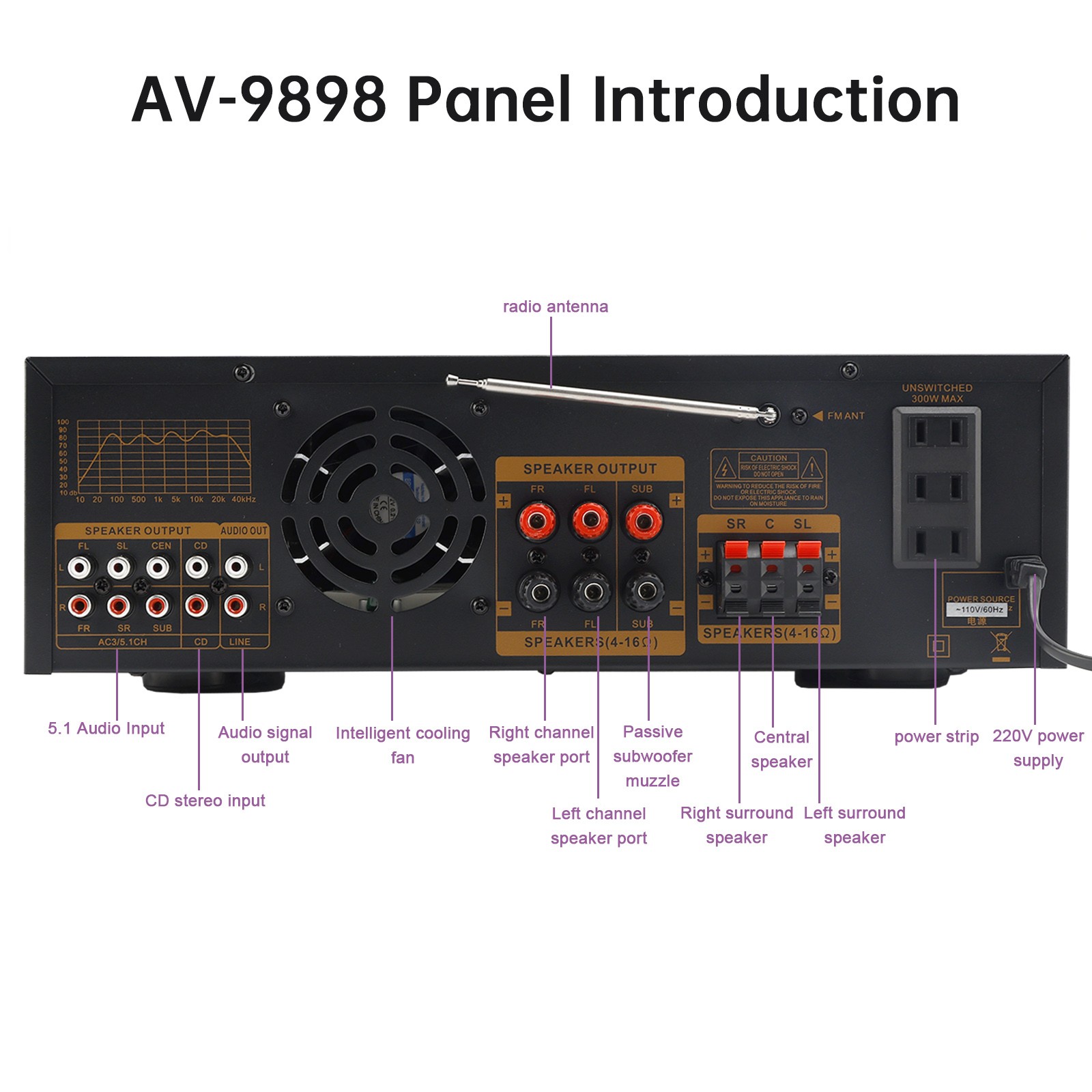

Photos from current listings. Actual item, color, and included accessories may vary.
Av Power Amplifier Buying Guide
An AV power amplifier is a dedicated multichannel amp that boosts line-level preamp signals to speaker-level output, bypassing the tuner and video switching of a full receiver. The core trade-off is Class AB linear power versus Class D switching efficiency—AB delivers robust low-impedance drive and heat tolerance, Class D offers compact size and high efficiency but demands clean SMPS design. The decision rule: buy by continuous FTC-rated watts at your actual speaker impedance and channel count, not peak or 'dynamic' marketing numbers.
Key takeaways
- FTC continuous power (20Hz–20kHz, 0.1% THD, 8Ω/4Ω) is the only legally binding spec; ignore 'peak' or 'dynamic' watts that inflate numbers 2–3x.
- Class AB amps double power into 4Ω if the transformer and heatsink are sized for it; Class D amps deliver near-constant power across 4–8Ω but clip early at 2Ω.
- Balanced XLR inputs reject ground-loop hum over long preamp-to-amp runs; RCA-only amps are limited to short cable runs near the source.
At a glance
- Category
- AV Receivers & Amplifiers
- Last updated
- Nov 24, 2026
Current offers
Highlights
- FTC continuous power (20Hz–20kHz, 0.1% THD, 8Ω/4Ω) is the only legally binding spec; ignore 'peak' or 'dynamic' watts that inflate numbers 2–3x.
- Class AB amps double power into 4Ω if the transformer and heatsink are sized for it; Class D amps deliver near-constant power across 4–8Ω but clip early at 2Ω.
- Balanced XLR inputs reject ground-loop hum over long preamp-to-amp runs; RCA-only amps are limited to short cable runs near the source.
- Multichannel amps (5–7 ch) share one power supply, so all-channel-driven power drops 20–40% versus two-channel ratings—check the 'all channels driven' figure.
Best use cases
- Home theater 5.1.4 Atmos: pick a 7–9 channel Class AB amp rated at 100W+ all-channels-driven into 8Ω if your LCR are 4Ω towers; skip compact Class D unless it publishes 4Ω continuous ratings.
- Stereo music with high-efficiency speakers (90dB+): a 2-channel 50–80W Class D amp is sufficient and runs cool; skip 200W monoblocks that waste headroom and add fan noise.
- Multi-zone distributed audio (4–8 pairs): choose a 70V/100V constant-voltage amp with per-zone volume, not a home-theater multichannel amp; skip 4Ω-only amps for long wire runs.
- Powering passive subwoofers from an AVR pre-out: use a dedicated Class D sub amp with DSP and 4Ω stability; skip full-range multichannel amps that lack a low-pass filter.
Buying tips
- Match continuous watts to speaker sensitivity: 85dB speakers need ~2x the power of 88dB speakers for the same SPL; add 3dB headroom for movies.
- For 4Ω speakers, confirm the amp's 4Ω FTC rating equals or exceeds its 8Ω rating—transformers that don't double current will sag and clip.
- Count preamp outputs: a 7-channel amp needs 7 RCA or XLR inputs; AVRs with only 5.1 pre-outs cannot feed a 7-channel power amp without a splitter.
- Leave 3–4 inches of clearance above Class AB amps—they dissipate 40–60% of input power as heat; Class D needs only 1–2 inches but still requires airflow.
Specs
| Amplifier Class | Class AB vs Class D switching |
|---|---|
| Continuous Power | FTC 20Hz–20kHz, 8Ω/4Ω @ 0.1% THD |
| Channel Count | 2 / 5 / 7 / 9 ch (all-ch driven) |
| Input Type | RCA unbalanced vs XLR balanced |
Related searches
What to check before buying
- Measure rack or shelf depth: Class AB multichannel amps run 16–20 inches deep and weigh 30–60 lbs; confirm shelf load rating and rear-panel clearance for binding posts.
- Verify AVR pre-out voltage: most output 1–2V; amps needing 2V+ for full output may require a preamp with higher gain or a line driver.
- Confirm speaker impedance dip: speakers rated 8Ω nominal often dip to 4–6Ω; check the minimum impedance spec and ensure the amp is rated for it.
- Check AC circuit: a 7-channel 200W Class AB amp can draw 10–12A at full output; a dedicated 15A circuit is recommended over shared outlets.
FAQ
Data sources: eBay / Amazon listings and product attribute feeds. Updated Nov 24, 2026.
Some links on this page are affiliate links. If you buy after clicking one, we may earn a commission at no extra cost to you. This does not change which products appear here or their order. Affiliate disclosure.