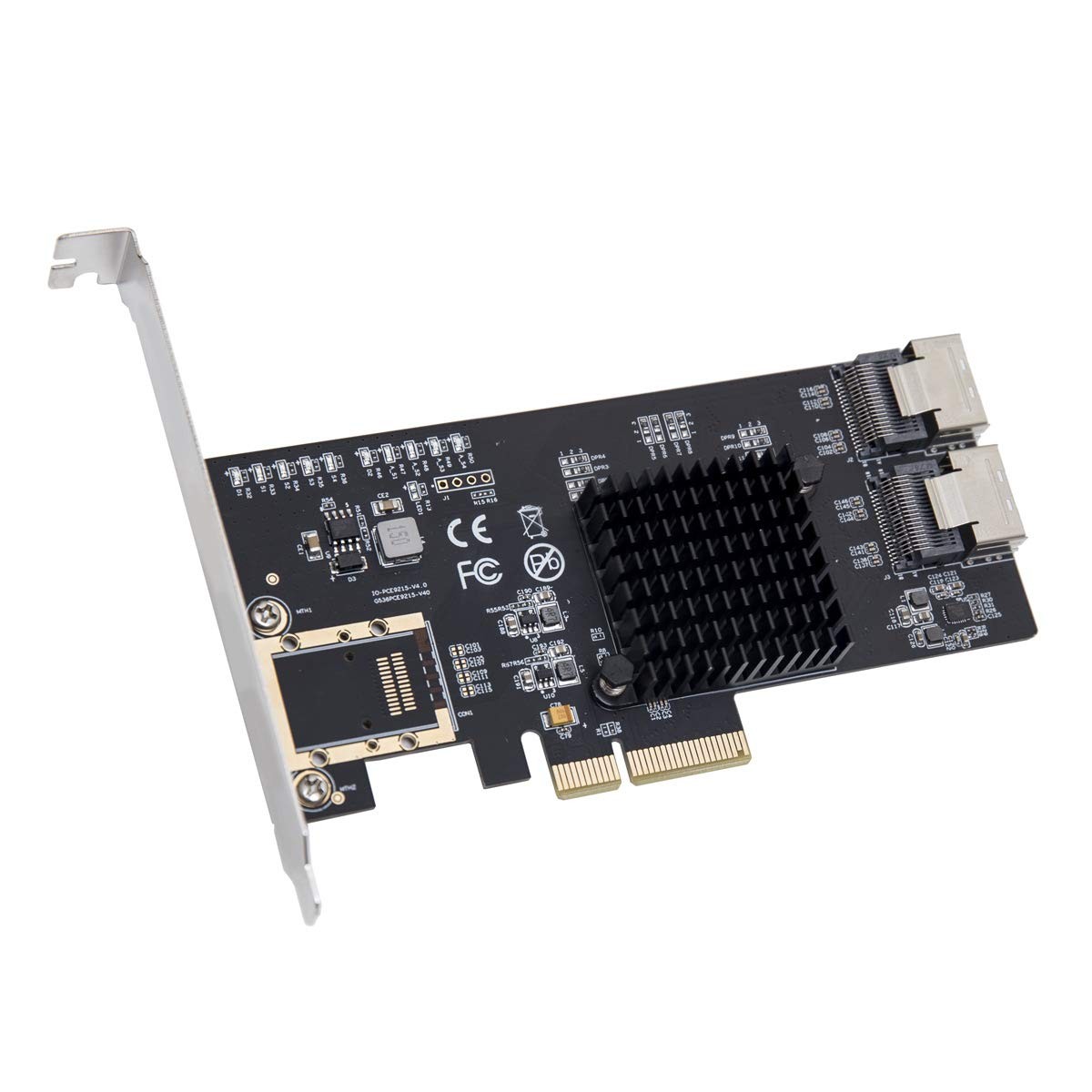

Photos from current listings. Actual item, color, and included accessories may vary.
SATA Raid Controller Card Buying Guide
A SATA RAID controller card adds dedicated SATA ports and hardware or software RAID to a desktop, server, or NAS, bypassing chipset port limits. The core trade-off is host-bus architecture: PCIe 3.0 x2/x4 cards with a true HBA/RAID-on-chip deliver full bandwidth across all drives, while x1 bridge cards share a single lane and bottleneck multi-drive arrays. Buy a lane-sufficient card with RAID or HBA firmware matching your OS, and skip x1 port multipliers for any parity or multi-SSD workload.
Key takeaways
- PCIe 3.0 x1 caps total throughput near 985 MB/s, so 8-port x1 cards starve SATA III SSDs; x4 cards provide ~3.9 GB/s aggregate for full-speed arrays.
- Hardware RAID cards (e.g., LSI/Broadcom 92xx/93xx, Marvell 88SE92xx) offload parity to an onboard ROC; software RAID (mdadm, Storage Spaces, ZFS) uses plain HBA/JBOD mode instead.
- Port multipliers and bridge chips share one upstream lane across all drives; native HBA controllers give each port independent bandwidth and better NCQ queue depth.
At a glance
- Category
- PC Storage Upgrades
- Last updated
- Nov 28, 2026
Current offers
Highlights
- PCIe 3.0 x1 caps total throughput near 985 MB/s, so 8-port x1 cards starve SATA III SSDs; x4 cards provide ~3.9 GB/s aggregate for full-speed arrays.
- Hardware RAID cards (e.g., LSI/Broadcom 92xx/93xx, Marvell 88SE92xx) offload parity to an onboard ROC; software RAID (mdadm, Storage Spaces, ZFS) uses plain HBA/JBOD mode instead.
- Port multipliers and bridge chips share one upstream lane across all drives; native HBA controllers give each port independent bandwidth and better NCQ queue depth.
- RAID levels differ by minimum drives: RAID 0 needs 2, RAID 1 needs 2, RAID 5 needs 3, RAID 6 needs 4, RAID 10 needs 4 — confirm the card's firmware supports your target level and drive count.
Best use cases
- Best fit: a FreeNAS/TrueNAS or ZFS build needing more SATA ports — pick a non-RAID HBA in IT/JBOD mode (e.g., SI-PEX40137 class) and let ZFS handle redundancy.
- Best fit: a Windows/Linux workstation wanting bootable hardware RAID 1 or RAID 5 — choose a card with onboard ROC, battery/flash backup option, and OS driver support.
- Wrong fit: adding 5+ SATA SSDs to a PCIe x1 slot — the shared lane throttles all drives; use an x4 HBA instead.
- Wrong fit: expecting a cheap port-multiplier card to run RAID 5 reliably — parity rebuilds over a shared bridge lane risk timeouts and array drops.
Buying tips
- Match lanes to drives: budget ~600 MB/s per SATA SSD and ~200 MB/s per HDD; an x4 PCIe 3.0 card covers 6-8 mixed drives, x1 covers only 1-2 HDDs.
- For ZFS/Unraid/TrueNAS, buy an HBA in IT/JBOD mode, not a RAID card — hardware RAID masks drives from the OS and breaks pool management.
- Check RAID level support and drive minimums on the controller firmware: RAID 5 needs 3 drives, RAID 6 and RAID 10 need 4, and some budget cards omit RAID 6 entirely.
- Prefer PCIe 3.0 x4 (or x8) cards with native SATA III (6 Gb/s) ports; avoid PCIe bridge chips on x1 slots for any parity RAID or SSD array.
Specs
| Host Interface | PCIe 3.0 x4 vs x1 bridge |
|---|---|
| Controller Mode | Hardware RAID vs HBA/JBOD |
| Port Count | 2-4 / 6-8 / 12-16 ports |
| RAID Levels | 0/1/5/6/10 (check minimums) |
Related searches
What to check before buying
- Confirm a free PCIe slot with at least x4 electrical lanes (x4, x8, or x16 physical) — x1 slots bottleneck multi-drive arrays.
- Measure case clearance and airflow: full-height RAID cards with heatsinks or battery units need ~6-7 inches of card length and adjacent fan airflow.
- Verify OS driver support for the exact controller chipset (e.g., LSI 9211-8i IT mode, Marvell 88SE9230) before purchase; older cards may lack Windows 11 or ESXi drivers.
- Count SATA power connectors and data cables needed — controller cards ship without cables; budget one SATA data cable per drive plus PSU power leads.
FAQ
Data sources: eBay / Amazon listings and product attribute feeds. Updated Nov 28, 2026.
Some links on this page are affiliate links. If you buy after clicking one, we may earn a commission at no extra cost to you. This does not change which products appear here or their order. Affiliate disclosure.