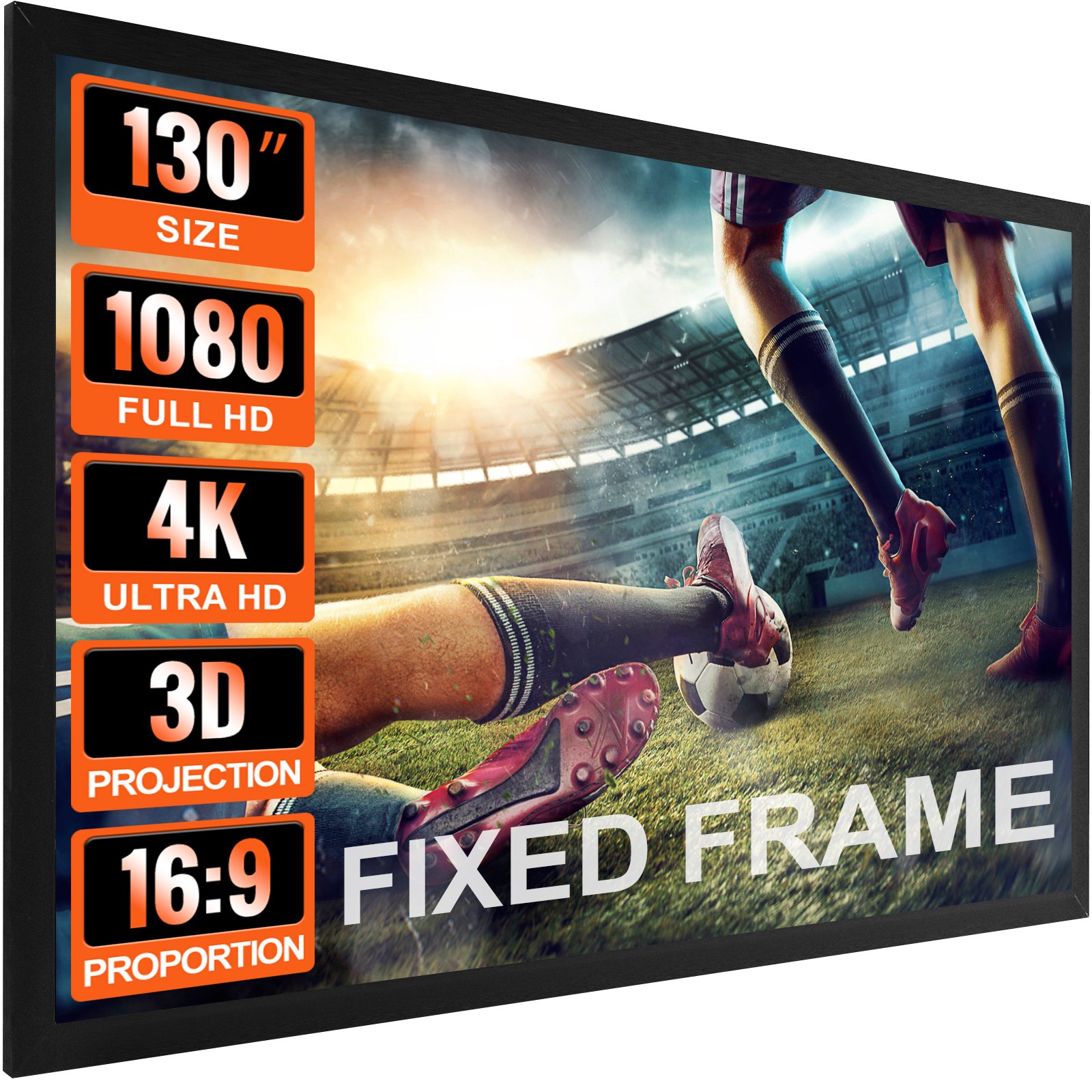

Photos from current listings. Actual item, color, and included accessories may vary.
Wall Projector Screen Buying Guide
A wall projector screen is a fixed or pull-down fabric surface that replaces a bare wall to control gain, viewing angle, and ambient-light rejection. The primary trade-off is between fixed-frame tensioned screens that maximize flatness and contrast versus portable pull-down or roll-up options that trade rigidity for placement flexibility. Choose a fixed aluminum-frame screen for a dedicated theater or media room, and a tensioned pull-down only when the wall cannot host a permanent frame.
Median $200.49
Key takeaways
- Fixed-frame screens use a tensioned PVC or woven fabric stretched over an aluminum extrusion, eliminating edge curl and wrinkles that degrade focus and geometry.
- Screen gain determines brightness: matte white at 1.0 gain preserves color accuracy and wide viewing angles, while gray or ALR surfaces at 0.6-0.9 gain reject ambient light but narrow the sweet spot.
- Aspect ratio must match the projector's native output: 16:9 suits most 4K DLP and LCD home projectors, while 2.35:1 requires an anamorphic lens or digital scaling.
At a glance
- Category
- Projectors & Screens
- Last updated
- Nov 28, 2026
Current offers
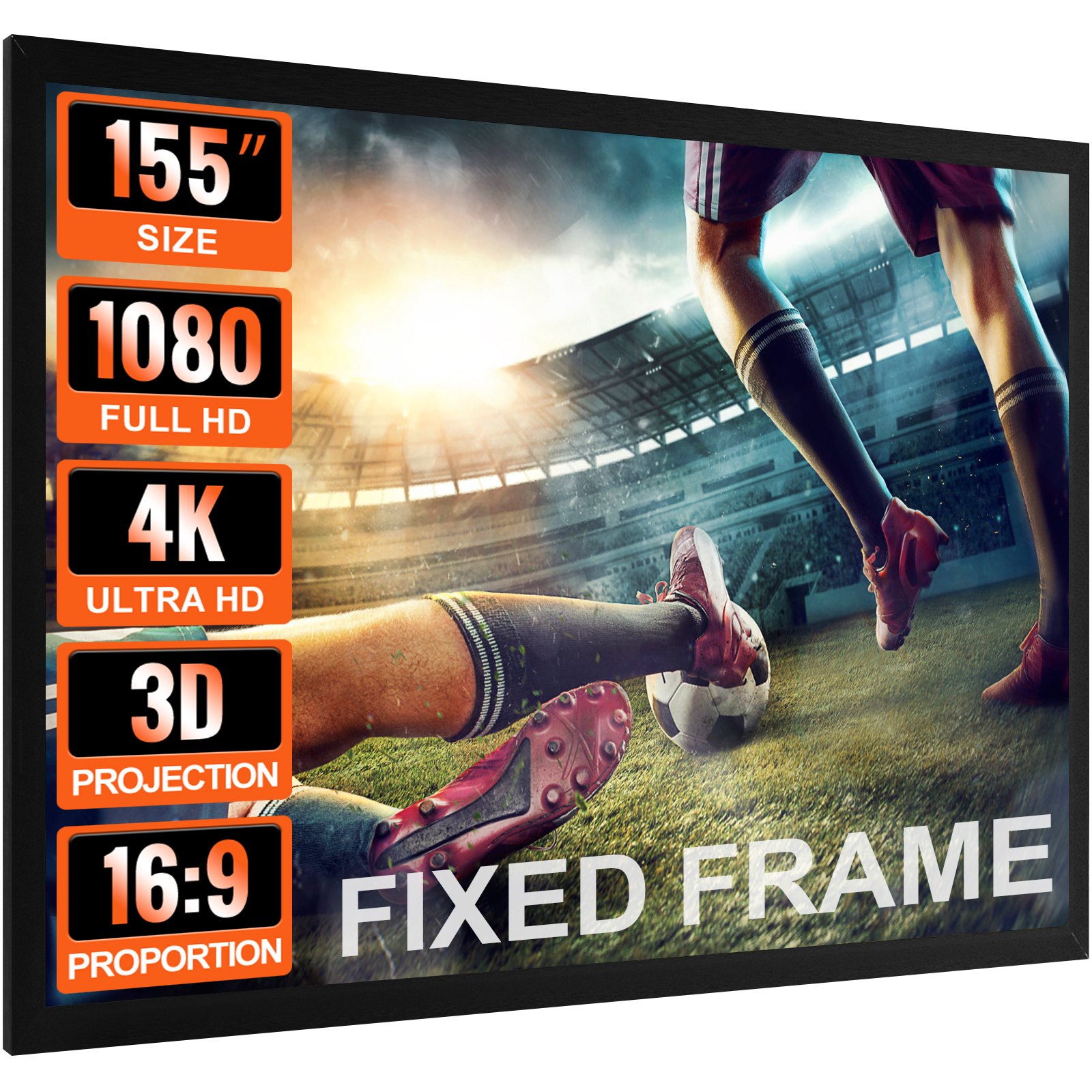
Highlights
- Fixed-frame screens use a tensioned PVC or woven fabric stretched over an aluminum extrusion, eliminating edge curl and wrinkles that degrade focus and geometry.
- Screen gain determines brightness: matte white at 1.0 gain preserves color accuracy and wide viewing angles, while gray or ALR surfaces at 0.6-0.9 gain reject ambient light but narrow the sweet spot.
- Aspect ratio must match the projector's native output: 16:9 suits most 4K DLP and LCD home projectors, while 2.35:1 requires an anamorphic lens or digital scaling.
- Diagonal size is not width: a 130-inch 16:9 screen is roughly 113 inches wide by 64 inches tall; a 155-inch 16:9 screen is about 135 inches wide by 76 inches tall.
Best use cases
- Best fit: dedicated dark media room — choose a fixed-frame matte-white 16:9 screen at 1.0 gain for accurate color and maximum viewing angle.
- Best fit: bright living room with daytime viewing — choose a gray or ALR fixed-frame screen at 0.6-0.8 gain to preserve black levels under ambient light.
- Wrong fit: rental or multipurpose room — skip the fixed frame; a tensioned pull-down or portable roll-up screen avoids permanent wall drilling.
- Wrong fit: ultra-short-throw projector — a standard matte-white screen will wash out; select an ALR screen engineered specifically for UST geometry.
Buying tips
- Size the screen to your seating distance: for 4K, sit at 1.0-1.5x screen height; a 130-inch 16:9 screen is about 64 inches tall, so seating should be roughly 5.3-8 feet back.
- Measure wall width before ordering: a 155-inch 16:9 screen needs at least 135 inches of clear wall width plus frame border, typically 1-2 inches per side.
- Match screen gain to projector lumens: below 2,000 lumens use 1.0-1.3 gain in dark rooms; above 3,000 lumens in ambient light use 0.6-0.8 gain ALR.
- Confirm the frame depth and mounting: fixed frames protrude 1-2 inches from the wall and require stud or anchor mounting rated for the screen's weight.
Specs
| Screen Type | Fixed-frame / Pull-down / Portable |
|---|---|
| Aspect Ratio | 16:9 native / 2.35:1 cinemascope |
| Screen Gain | Matte white 1.0 / ALR 0.6-0.8 |
| Frame Material | Aluminum extrusion / Velvet border |
Related searches
What to check before buying
- Measure the exact clear wall width and height where the screen will mount, including space for the frame border and any ceiling or shelf clearance.
- Verify the wall substrate is drywall over studs, concrete, or brick, and confirm you can anchor into studs or use rated masonry fasteners.
- Check projector throw ratio and lens shift: the screen width must fall within the projector's throw distance range at your mounting position.
- Confirm room light control and wall color: dark matte walls and ceiling reduce bounce light; ALR screens require precise projector alignment.
FAQ
Data sources: eBay / Amazon listings and product attribute feeds. Updated Nov 28, 2026.
Some links on this page are affiliate links. If you buy after clicking one, we may earn a commission at no extra cost to you. This does not change which products appear here or their order. Affiliate disclosure.