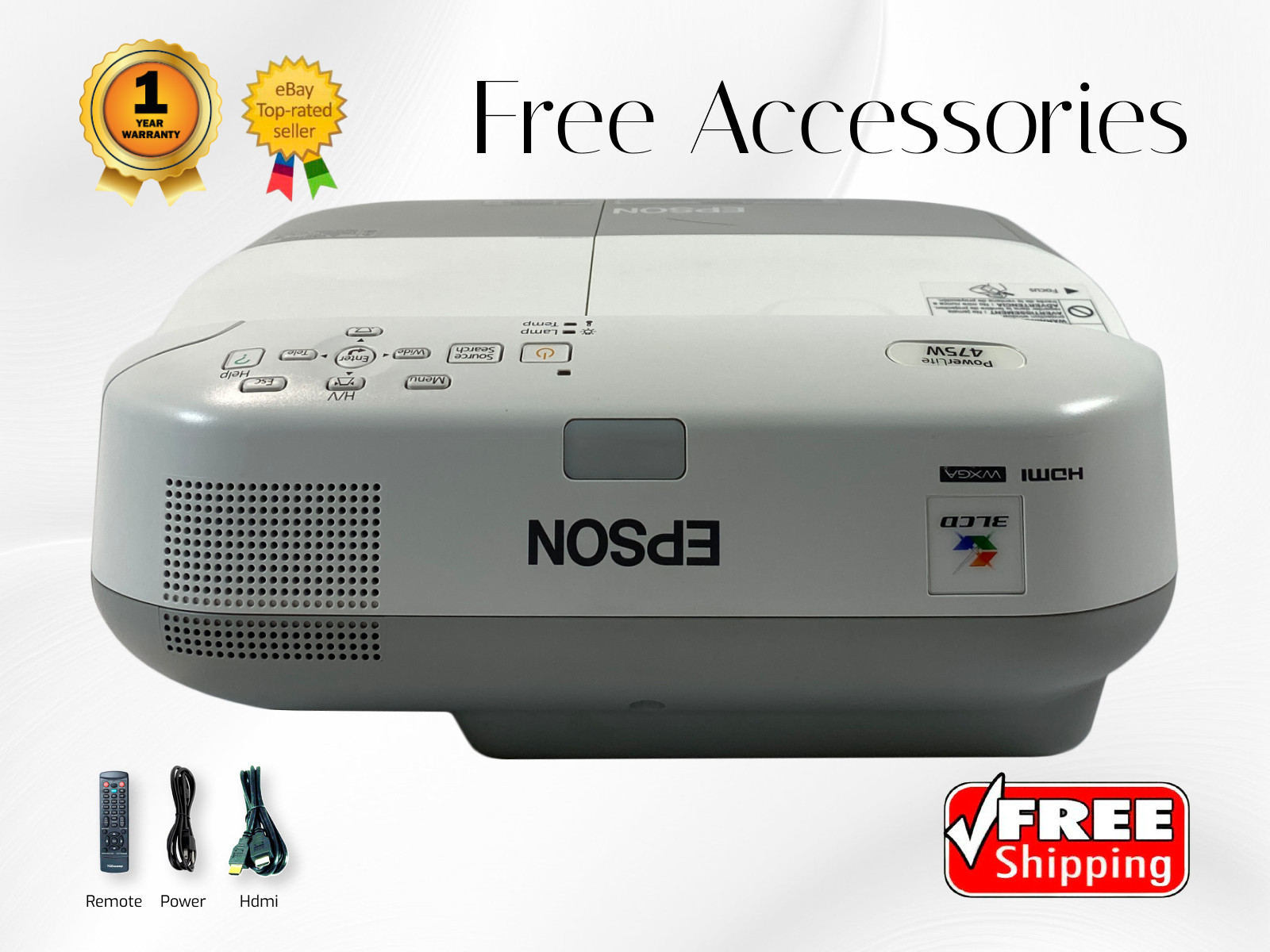

Photos from current listings. Actual item, color, and included accessories may vary.
Short Throw 4K Projector Buying Guide
Short throw 4K projectors place a large, high-resolution image inches from the wall, trading the long-room flexibility of standard projectors for space-saving placement and reduced shadowing. The core trade-off is between true 4K (or pixel-shifted 4K) resolution and light output: ultra-short-throw (UST) models need high lumens to fight ambient light, while standard short-throw models are dimmer but far cheaper. Decide by throw ratio first—0.2–0.4:1 is UST for wall-side placement, 0.4–0.8:1 is short throw for shelf or ceiling placement—then match lumens to your room's light control.
Key takeaways
- Throw ratio defines placement: 0.2–0.4:1 UST sits inches from the wall; 0.4–0.8:1 short throw needs several feet for a 100-inch image.
- 4K comes in two forms: native 4K panels (rare, premium) vs pixel-shifting DLP/3LCD that flashes 1080p to 4K—sharp but softer on fine text.
- Laser phosphor light sources rate 20,000+ hours and hold brightness better than lamp-based UST models, which dim and need replacement.
At a glance
- Category
- Projectors & Screens
- Last updated
- Nov 28, 2026
Current offers
Highlights
- Throw ratio defines placement: 0.2–0.4:1 UST sits inches from the wall; 0.4–0.8:1 short throw needs several feet for a 100-inch image.
- 4K comes in two forms: native 4K panels (rare, premium) vs pixel-shifting DLP/3LCD that flashes 1080p to 4K—sharp but softer on fine text.
- Laser phosphor light sources rate 20,000+ hours and hold brightness better than lamp-based UST models, which dim and need replacement.
- 3LCD (Epson) and DLP (BenQ, Optoma) differ in color brightness and pixel grid; 3LCD avoids rainbow artifacts, DLP offers sharper single-chip contrast.
Best use cases
- Living room with ambient light: pick a 3,000+ lumen laser UST with an ALR screen—skip dim 2,000-lumen lamp models that wash out in daylight.
- Dedicated dark theater: a 2,000–2,600 lumen short-throw 4K projector is sufficient and saves budget over UST laser units.
- Gaming: require low input lag (under 30 ms) and 60 Hz+ HDMI 2.0; skip business/education UST models like the Epson PowerLite series, which prioritize brightness over lag.
- Small apartment or rental: UST on a sideboard avoids ceiling mounts and long cable runs—skip standard short throw if you lack 4–6 feet of wall clearance.
Buying tips
- Calculate throw distance: for a 100-inch (2.2 m wide) image, a 0.25:1 UST needs ~55 cm from lens to wall; a 0.5:1 short throw needs ~1.1 m.
- Require at least 2,500 ANSI lumens for UST in a room with windows; 3,000+ for daytime sports or bright living rooms.
- Confirm HDMI 2.0 with HDCP 2.2 for 4K 60 Hz streaming and consoles; HDMI 1.4 caps 4K at 30 Hz and breaks 4K HDR.
- Budget for an ALR (ambient light rejecting) screen with UST—a standard white screen causes hot-spotting and washes out; the screen can cost as much as the projector.
Specs
| Throw Ratio | UST 0.2–0.4:1 / Short 0.4–0.8:1 |
|---|---|
| 4K Method | Native 4K vs Pixel-shift DLP/3LCD |
| Light Source | Laser 20,000+ hr vs Lamp 4,000 hr |
| Brightness | 2,000–5,000 ANSI lumens |
Related searches
What to check before buying
- Measure wall width available for the screen and the distance from wall to your shelf or ceiling mount; use the projector's throw ratio to confirm a 100–120 inch image fits.
- Check ceiling height and furniture: UST units sit below the screen and need a level, unobstructed surface; standard short throw needs a ceiling mount clear of seating.
- Verify room light: count windows and fixtures—if you cannot darken the room, prioritize 3,000+ lumens and an ALR screen.
- Confirm voltage (120V US vs 220–240V) and plug type, plus whether the model includes a streaming stick or requires an external HDMI source.
FAQ
Data sources: eBay / Amazon listings and product attribute feeds. Updated Nov 28, 2026.
Some links on this page are affiliate links. If you buy after clicking one, we may earn a commission at no extra cost to you. This does not change which products appear here or their order. Affiliate disclosure.