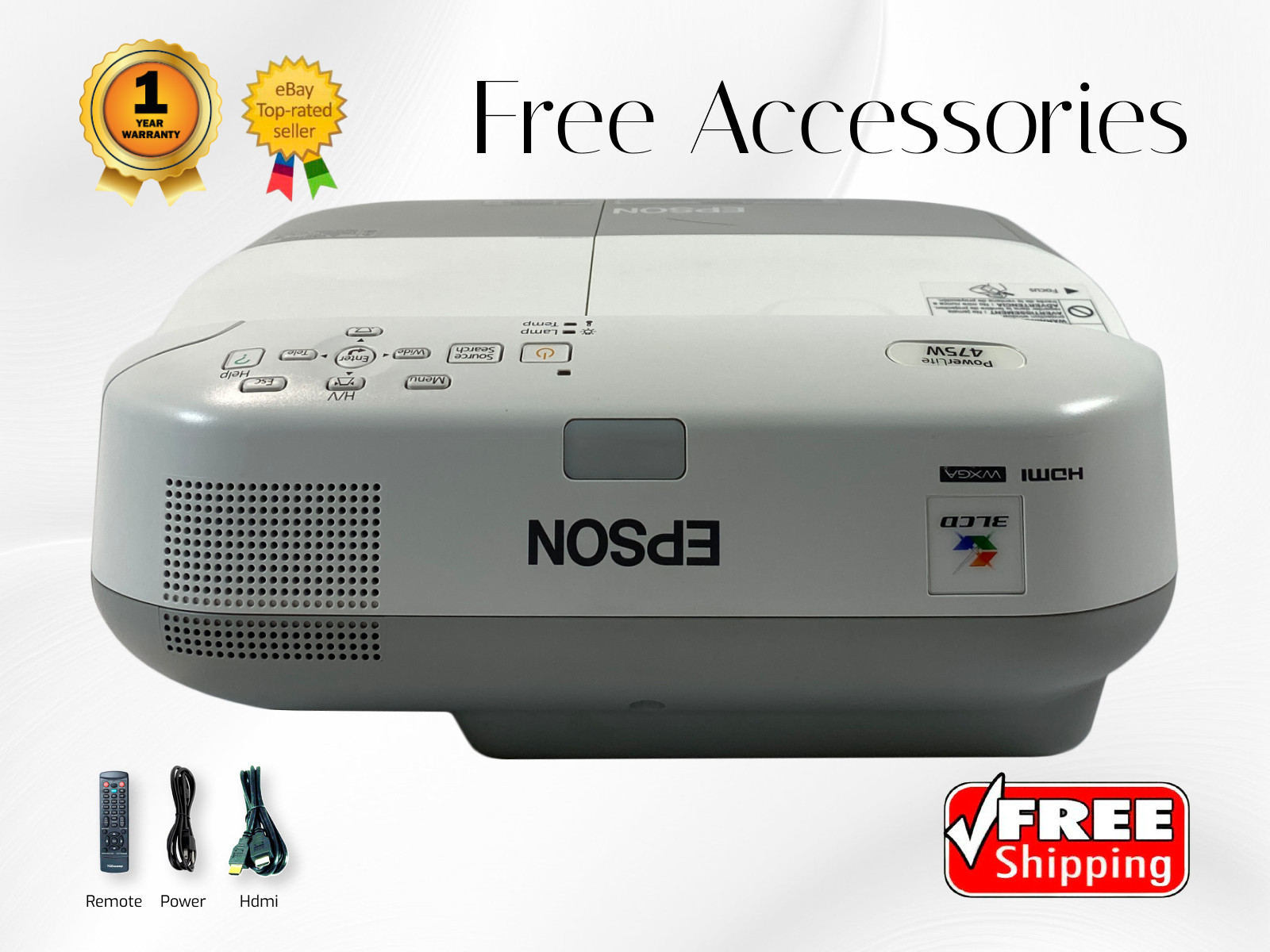

Photos from current listings. Actual item, color, and included accessories may vary.
Epson 3lcd Projector Buying Guide
Epson 3LCD projectors use a three-chip LCD light engine that delivers equal white and color brightness, unlike single-chip DLP designs that often sacrifice color lumens. The primary trade-off is panel durability and brightness consistency versus pixel-fill sharpness and compactness. Choose a 3LCD model when color accuracy and long-term brightness matter; skip it only if you need a tiny portable unit or the deepest possible blacks.
Key takeaways
- 3LCD engines project red, green and blue simultaneously through three LCD panels, so color brightness equals white brightness—typically 1:1—while DLP color brightness often measures 50-70% of white.
- Epson's mainstream lines split into PowerLite (business/education, higher lumens, often XGA/WXGA), Home Cinema (1080p/4K enhancement, high contrast), and Pro Cinema (UB variable aperture, wider color gamut).
- Ultra-short-throw (UST) models like the PowerLite 475W cast a 100-inch image from roughly 2 feet, requiring a rigid wall or UST-specific screen to avoid keystone distortion.
At a glance
- Category
- Projectors & Screens
- Last updated
- Nov 28, 2026
Current offers
Highlights
- 3LCD engines project red, green and blue simultaneously through three LCD panels, so color brightness equals white brightness—typically 1:1—while DLP color brightness often measures 50-70% of white.
- Epson's mainstream lines split into PowerLite (business/education, higher lumens, often XGA/WXGA), Home Cinema (1080p/4K enhancement, high contrast), and Pro Cinema (UB variable aperture, wider color gamut).
- Ultra-short-throw (UST) models like the PowerLite 475W cast a 100-inch image from roughly 2 feet, requiring a rigid wall or UST-specific screen to avoid keystone distortion.
- 4K PRO-UHD models use pixel-shifting on a 1080p LCD panel, delivering 8.3 million on-screen pixels but not native 4K panels; native 4K 3LCD exists only in high-end Pro Cinema tiers.
Best use cases
- Pick a PowerLite WXGA/XGA model for classrooms or conference rooms where ambient light is high and color-coded charts must stay legible; skip it for dark-room movie watching.
- Choose a Home Cinema 1080p or 4K PRO-UHD model for living-room film and gaming with low input lag; skip ultra-short-throw unless the room has a dedicated rigid screen wall.
- Select a UST PowerLite 475W-class unit only when ceiling mounting is impossible and the wall is flat and dedicated; skip it for portable outdoor use where throw distance flexibility matters.
Buying tips
- Match throw ratio to room depth: standard throw needs about 1.5x screen width distance, short throw about 1x, and UST about 0.2-0.4x—measure wall-to-seat before choosing.
- For a 100-inch 16:9 image, a 1.5 throw ratio projector sits roughly 11 feet back; a 0.3 UST unit sits about 2 feet from the wall—confirm lens-to-screen math, not room length.
- Require at least 2,500 lumens for rooms with uncontrolled daylight and 1,500-2,000 lumens for light-controlled home theater; 3LCD keeps color brightness at spec, so lumen ratings are comparable.
- Choose models with HDMI 2.0 and HDCP 2.2 for 4K HDR streaming and gaming; older HDMI 1.4 units cap at 1080p/30Hz for protected content.
Specs
| Light Engine | 3LCD (3-panel) vs DLP (1-chip) |
|---|---|
| Color Brightness | 1:1 white:color (3LCD) |
| Resolution Tier | 1080p / 4K PRO-UHD pixel-shift |
| Throw Ratio | Standard 1.5 / Short 1.0 / UST 0.3 |
Related searches
What to check before buying
- Measure throw distance from lens front to screen surface and compare against the model's throw ratio range for your target image size.
- Confirm screen type: UST models need a flat, rigid UST screen or painted wall without texture; standard throw works with pull-down or fixed-frame screens.
- Check ceiling-mount weight and vent clearance—most 3LCD business units run 7-10 lbs and need 4-6 inches of side/rear airflow.
- Verify voltage and plug standard for your region (100-240V models ship with regional cords) and confirm lamp or laser light-source replacement access.
FAQ
Data sources: eBay / Amazon listings and product attribute feeds. Updated Nov 28, 2026.
Some links on this page are affiliate links. If you buy after clicking one, we may earn a commission at no extra cost to you. This does not change which products appear here or their order. Affiliate disclosure.