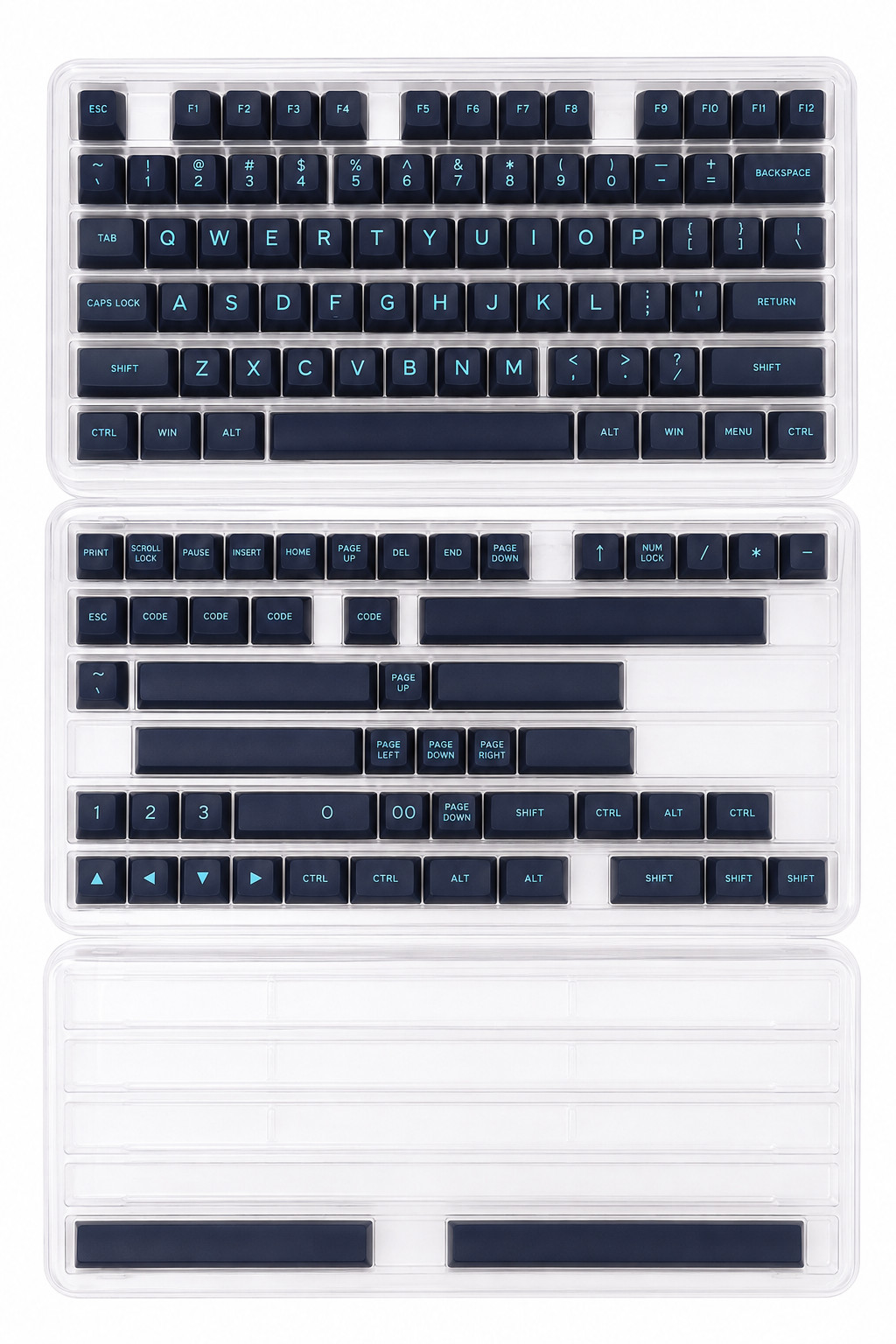

Photos from current listings. Actual item, color, and included accessories may vary.
Blue Keycap Set Buying Guide
A blue keycap set is a full replacement or accent kit that changes a keyboard's switch-top plastic to a blue colorway while preserving or improving typing feel and durability. The core trade-off is profile and material: molded PBT in Cherry/OEM/CYL profiles resists shine and warping, while cheap pad-printed ABS in low-tier OEM profile shines quickly and can fade. The decision rule: buy ANSI- or ISO-labeled double-shot or dye-sub PBT sets with explicit profile and layout compatibility, and skip any listing that omits profile, material, and layout coverage.
Key takeaways
- Double-shot PBT legend construction is the durability benchmark: legends are molded through the cap rather than printed, so they resist wear and solvents; dye-sub PBT is the next tier and is permanent but cannot produce light legends on dark caps.
- Profile determines typing geometry and fit: Cherry and OEM are sculpted rows with different heights, CYL is a taller cylindrical sculpt, and uniform profiles like XDA/DSA are row-agnostic — mixing profiles across a board causes uneven feel and collisions.
- Layout coverage is a hard compatibility metric: an ANSI base kit covers 60%–TKL–full-size, while ISO, 65%, 75%, Alice, and split-space boards require extra key sizes and stabilizer placements that base kits often omit.
At a glance
- Category
- Keycaps & Artisan Keycaps
- Last updated
- Nov 23, 2026
Current offers
Highlights
- Double-shot PBT legend construction is the durability benchmark: legends are molded through the cap rather than printed, so they resist wear and solvents; dye-sub PBT is the next tier and is permanent but cannot produce light legends on dark caps.
- Profile determines typing geometry and fit: Cherry and OEM are sculpted rows with different heights, CYL is a taller cylindrical sculpt, and uniform profiles like XDA/DSA are row-agnostic — mixing profiles across a board causes uneven feel and collisions.
- Layout coverage is a hard compatibility metric: an ANSI base kit covers 60%–TKL–full-size, while ISO, 65%, 75%, Alice, and split-space boards require extra key sizes and stabilizer placements that base kits often omit.
- Stabilizer and stem compatibility decide install success: MX-style stems fit Cherry MX, Gateron, Kailh, and most clones, but Topre, Alps, and low-profile Choc switches need dedicated caps; spacebar and modifier widths must match the PCB's stabilizer spacing.
Best use cases
- Best fit: a 60% or TKL ANSI hot-swap board in Cherry MX or Gateron — choose a double-shot PBT Cherry-profile blue set with base-kit coverage and standard 1.25u/1.5u/1.75u/2u/2.25u/2.75u/6.25u modifiers.
- Best fit: a full-size or 1800-compact board — pick an extended kit that explicitly lists 104/108-key coverage and 6.25u or 6.5u spacebar options, otherwise the bottom row and numpad will not match.
- Wrong fit: a 65%/75%/Alice or split-space board — skip base-only sets and buy a blue kit with explicit 1.75u right shift, 1u/1.5u bottom-row, and split-spacebar support, or the layout will be incomplete.
- Wrong fit: a Topre, Alps, or low-profile Choc keyboard — skip MX-style blue sets entirely; these switches require proprietary stem mounts that MX keycaps cannot grip.
Buying tips
- Match the profile before color: OEM and Cherry are the safest for most prebuilt boards; CYL suits tall sculpt lovers; XDA/DSA uniform sets simplify row placement but change typing angle and sound.
- Prioritize double-shot PBT over pad-printed ABS for any daily-use board; PBT's higher melting point and density resist shine and warping, while thin ABS develops glossy wear patches within months of heavy typing.
- Count your modifier widths before ordering: standard ANSI bottom rows use 1.25u mods with a 6.25u spacebar, but many 65% and 75% boards use 1.5u/1.75u right-side keys and 6.25u or 7u spacebars that base kits may not include.
- For backlit boards, choose shine-through or translucent blue caps only if the listing states the legend is transparent; solid double-shot PBT blocks RGB almost entirely, so an opaque blue set kills per-key lighting.
Specs
| Material | Double-shot PBT vs dye-sub PBT vs ABS |
|---|---|
| Profile | Cherry / OEM / CYL / XDA / DSA |
| Layout Coverage | ANSI / ISO / 60%–full-size / Alice |
| Stem Mount | MX-style; Topre/Alps/Choc need dedicated |
Related searches
What to check before buying
- Measure your spacebar center-to-center stabilizer distance (6.25u ≈ 100 mm, 7u ≈ 112 mm) and confirm the kit lists that spacebar size.
- Identify your layout class (ANSI, ISO, 65%, 75%, Alice) and verify the kit explicitly names that layout or lists the required extra key sizes.
- Confirm your switch stem type is MX-style; Topre, Alps, and low-profile Choc need dedicated keycap mounts and will not accept standard MX blue sets.
- Check whether you need shine-through legends for a backlit board, and verify the blue kit states translucent or transparent legend construction.
FAQ
Data sources: eBay / Amazon listings and product attribute feeds. Updated Nov 23, 2026.
Some links on this page are affiliate links. If you buy after clicking one, we may earn a commission at no extra cost to you. This does not change which products appear here or their order. Affiliate disclosure.