
Photos from current listings. Actual item, color, and included accessories may vary.
VHF Antenna Tuner Buying Guide
A VHF antenna tuner matches a transmitter's 50-ohm output to an antenna system's complex impedance across the 30-300 MHz band, reducing SWR and protecting solid-state finals. The core trade-off is insertion loss versus matching range: relay-switched L/C networks handle wider impedance swings but add loss, while simple fixed-tuned designs are efficient only near resonance. Buy a tuner rated at or above your transmit power with a VHF-specific matching range; skip HF-only tuners and CB "mobile" units that specify coverage above 30 MHz as an afterthought.
Key takeaways
- VHF tuners use either relay-switched discrete L/C components or a motorized roller inductor; relay models tune faster but have coarser resolution and higher minimum SWR.
- Power rating must exceed your radio's PEP output with margin—typical VHF tuners handle 100-200 W SSB, while 50 W FM-only rigs can use lighter 100 W-rated tuners safely.
- Insertion loss at 144 MHz is typically 0.3-0.8 dB for well-matched loads and rises sharply above 1.5 dB when compensating for reactance beyond the tuner's rated range.
At a glance
- Category
- Antenna Tuners & SWR Meters
- Last updated
- Nov 23, 2026
Current offers
Highlights
- VHF tuners use either relay-switched discrete L/C components or a motorized roller inductor; relay models tune faster but have coarser resolution and higher minimum SWR.
- Power rating must exceed your radio's PEP output with margin—typical VHF tuners handle 100-200 W SSB, while 50 W FM-only rigs can use lighter 100 W-rated tuners safely.
- Insertion loss at 144 MHz is typically 0.3-0.8 dB for well-matched loads and rises sharply above 1.5 dB when compensating for reactance beyond the tuner's rated range.
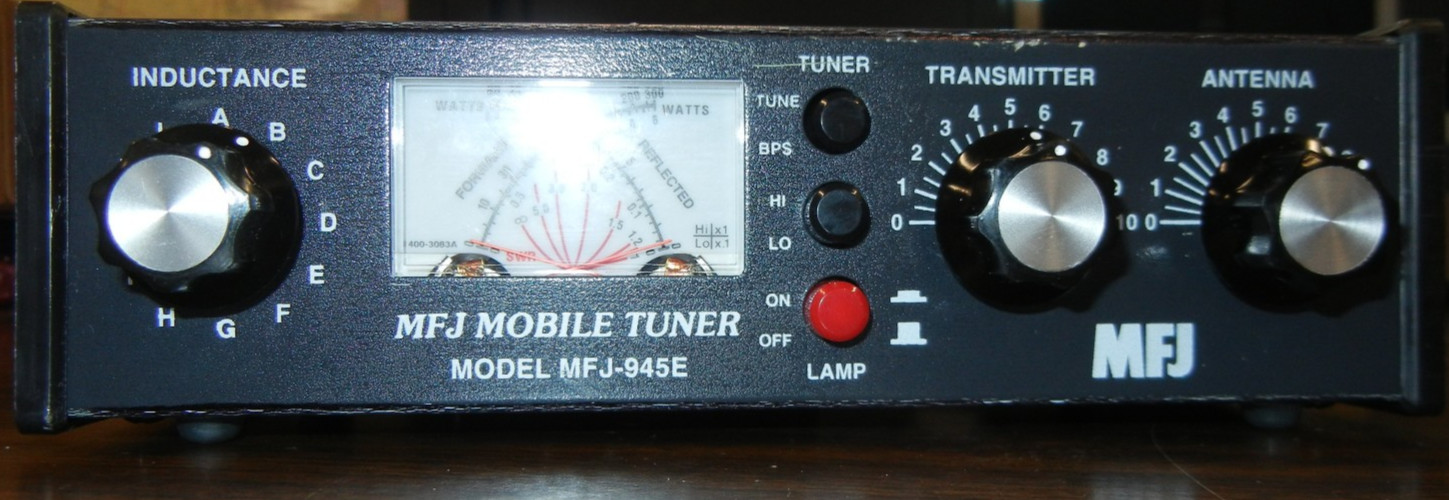
- MFJ-945E and similar compact "mobile" tuners are primarily HF/6 m designs; their VHF coverage is limited to 6 m (50-54 MHz) and they do not tune 2 m or 70 cm bands.
Best use cases
- Best fit: tuning a slightly off-resonance 2 m or 70 cm vertical or beam (SWR 1.5-3:1) at 50-100 W—choose a relay-switched VHF tuner rated 200 W PEP with a 1.5-10:1 matching range.
- Choose a 6 m-capable HF tuner like an MFJ-945E only if you operate 50-54 MHz as a secondary band and accept no 2 m/70 cm coverage.
- Wrong fit: attempting to tune a random-length wire or severely detuned antenna on 2 m—VHF tuners cannot compensate for high reactance and losses exceed 3 dB; fix the antenna instead.
- Skip any tuner marketed for CB/11 m if your primary need is 144-148 MHz; those units lack the VHF matching range and power handling for 2 m operation.
Buying tips
- Match tuner power rating to at least 1.5x your radio's PEP output: a 100 W VHF rig needs a 150-200 W tuner to avoid arcing in the L/C network.
- Confirm the tuner's specified frequency coverage includes 144-148 MHz and 430-450 MHz—not just "HF/VHF" with 6 m only.
- Prefer relay-switched tuners with 0.5 dB or lower insertion loss at 146 MHz; motorized roller-inductor tuners are smoother but slower and heavier for mobile use.
- Check connector type: SO-239 (UHF) is standard on most VHF tuners; N-type is preferred above 100 W at 2 m for lower loss and better 50-ohm match.
Specs
| Frequency Coverage | 6 m / 2 m / 70 cm band-specific |
|---|---|
| Power Rating | 100-200 W PEP typical VHF |
| Matching Range | Up to 10:1 (relay-switched) |
| Insertion Loss | 0.3-0.8 dB at 144 MHz tuned |
Related searches
What to check before buying
- Measure your antenna's SWR at the operating frequency with a VHF SWR meter first; if above 3:1 across the band, a tuner will not fix efficiency.
- Verify your coax run: RG-8X or LMR-240 is adequate under 100 W at 2 m; LMR-400 is preferred for runs over 15 m to keep loss below 1.5 dB.
- Confirm your radio's output connector and power level—50 W FM handhelds and 100 W mobile rigs need different tuner power tiers.
- Plan for a bypass switch: most VHF tuners add 0.3-0.5 dB insertion loss even when tuned, so a true bypass keeps weak-signal receive clean.
FAQ
Data sources: eBay / Amazon listings and product attribute feeds. Updated Nov 23, 2026.
Some links on this page are affiliate links. If you buy after clicking one, we may earn a commission at no extra cost to you. This does not change which products appear here or their order. Affiliate disclosure.