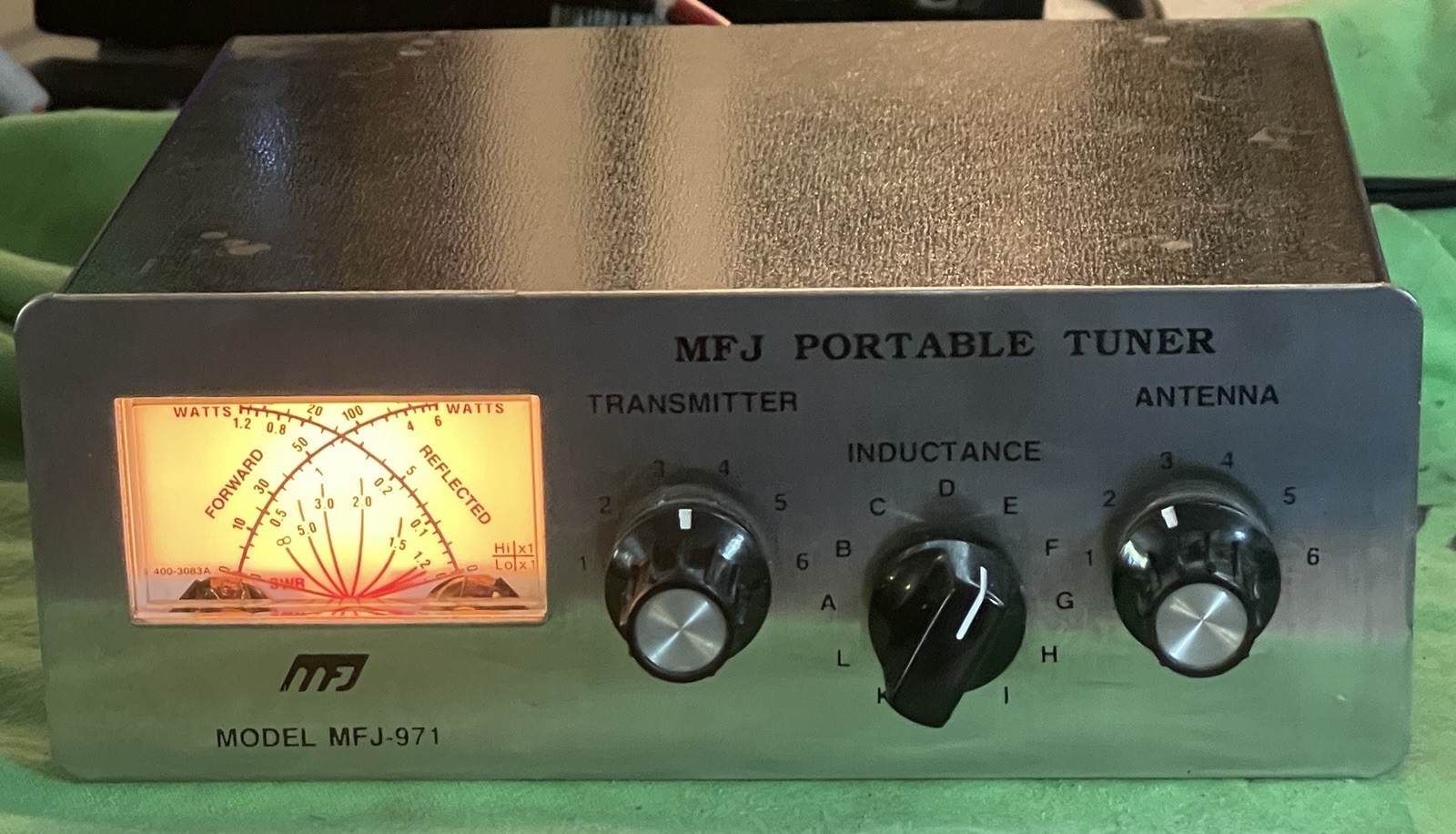

Photos from current listings. Actual item, color, and included accessories may vary.
Mfj 969 Antenna Tuner Buying Guide
The MFJ-969 is a classic 300 W roll-inductor antenna tuner covering 1.8–30 MHz, prized for its wide matching range and analog cross-needle SWR/wattmeter. The core trade-off is mechanical durability and band coverage versus modern auto-tuners' convenience that sacrifice matching range and serviceability. Buy the MFJ-969 if you need a manual, repairable, high-range tuner for wire antennas and QRP-to-100 W rigs; skip it for legal-limit power or hands-off auto-tuning.
Median $149.99
Key takeaways
- Roller inductor with silver-plated 6:1 vernier drive matches 6–1600 ohm loads, far wider than switched-L auto-tuners (typically 6–1000 ohm).
- Cross-needle meter reads forward/reflected power simultaneously; 300 W SSB/CW, 200 W PEP on 1.8–30 MHz continuous coverage.
- Built-in 4:1 balun, 2-position antenna switch, and 10-position ceramic switch bank; all serviceable with standard RF parts.
At a glance
- Category
- Antenna Tuners & SWR Meters
- Last updated
- Nov 23, 2026
Current offers
Highlights
- Roller inductor with silver-plated 6:1 vernier drive matches 6–1600 ohm loads, far wider than switched-L auto-tuners (typically 6–1000 ohm).
- Cross-needle meter reads forward/reflected power simultaneously; 300 W SSB/CW, 200 W PEP on 1.8–30 MHz continuous coverage.
- Built-in 4:1 balun, 2-position antenna switch, and 10-position ceramic switch bank; all serviceable with standard RF parts.
- Current production uses PTFE wiring and heavier switch wafers; older units need contact cleaning and roller-inductor inspection.
Best use cases
- Best fit: Wire, dipole, or end-fed antennas on 160–10 m with 100 W rigs — choose the MFJ-969 for its 6–1600 ohm range and manual roll inductor.
- Wrong fit: Legal-limit amplifiers (1500 W) — skip; use a 3 kW tuner like Palstar AT2K or MFJ-998RT instead.
- Best fit: Portable/field or vintage stations needing repairable analog metering and no firmware — pick the MFJ-969 over auto-tuners.
- Wrong fit: Hands-off multi-band operation with Icom/Yaesu rigs — choose an auto-tuner (LDG, MFJ-929) if you want one-button tuning.
Buying tips
- Match power tier: 300 W PEP SSB/CW; derate to 200 W on 160 m and 6 m for safety margin.
- Verify frequency coverage: 1.8–30 MHz continuous; 6 m only on later revisions — check rear label for '6M' or serial above 2000.
- Inspect roller inductor: silver-plated coil should be smooth and free of arcing pits; a pitted roller means high-contact loss.
- Choose 4:1 balun for balanced lines; for coax-fed dipoles use the direct coax input and bypass the balun.
Specs
| Tuner Type | Manual roll-inductor L-network |
|---|---|
| Power Rating | 300 W SSB/CW; 200 W on 160/6 m |
| Frequency Coverage | 1.8–30 MHz continuous |
| Impedance Range | 6–1600 ohm unbalanced |
Related searches
What to check before buying
- Measure your antenna feedpoint impedance range; if below 6 or above 1600 ohm, add a 4:1 or 9:1 transformer before the tuner.
- Confirm your rig's maximum output; stay at or below 300 W SSB/CW (200 W on 160/6 m).
- Check bench space: MFJ-969 is approximately 13 × 4 × 10 in; allow clearance for rear SO-239 connectors and balun terminals.
- Verify you have a 12 VDC source if using the optional meter lamp; the tuner itself needs no power.
FAQ
Data sources: eBay / Amazon listings and product attribute feeds. Updated Nov 23, 2026.
Some links on this page are affiliate links. If you buy after clicking one, we may earn a commission at no extra cost to you. This does not change which products appear here or their order. Affiliate disclosure.