
Photos from current listings. Actual item, color, and included accessories may vary.
Hf Antenna Tuner Buying Guide
An HF antenna tuner matches a transceiver's 50-ohm output to an antenna's actual feedpoint impedance, letting you operate across 160–6 m bands on one wire or vertical. The core trade-off is manual vs automatic tuning and power ceiling: roller-inductor manuals tolerate high SWR and high power, while auto-tuners add convenience but cap at lower wattage. Buy by continuous carrier power rating and true impedance-matching range first; anything rated only for SSB peak power is a compromise for digital or AM modes.
Key takeaways
- Manual tuners use tapped or roller inductors plus switched capacitors; roller types like the MFJ-986 cover 1.8–30 MHz continuously and handle 3 kW PEP with no band-switch contacts to arc.
- Automatic tuners such as the mAT-180H and ATU-130C use relay-switched L/C networks and typically cap at 120–250 W, requiring a tune carrier and a control cable or RF-sense to trigger.
- Power ratings are mode-dependent: a 300 W PEP tuner is generally safe for ~150 W continuous carrier (FT8, AM, RTTY), so derate by roughly 50% for digital and AM operation.
At a glance
- Category
- Antenna Tuners & SWR Meters
- Last updated
- Nov 23, 2026
Current offers
Highlights
- Manual tuners use tapped or roller inductors plus switched capacitors; roller types like the MFJ-986 cover 1.8–30 MHz continuously and handle 3 kW PEP with no band-switch contacts to arc.
- Automatic tuners such as the mAT-180H and ATU-130C use relay-switched L/C networks and typically cap at 120–250 W, requiring a tune carrier and a control cable or RF-sense to trigger.
- Power ratings are mode-dependent: a 300 W PEP tuner is generally safe for ~150 W continuous carrier (FT8, AM, RTTY), so derate by roughly 50% for digital and AM operation.
- Built-in SWR/wattmeter cross-needle meters (MFJ-941E, 949E, B&W VS300A) let you read forward/reflected power directly without a separate meter; auto-tuners typically have no meter and rely on the radio's display.
Best use cases
- Best fit: a 100 W HF transceiver with a multiband doublet or end-fed wire — choose an automatic tuner (mAT-180H, ATU-130C) for band-hopping; skip it if you run an amplifier.
- Best fit: legal-limit or QRO operation (1–1.5 kW) with a vertical or long wire — choose a roller-inductor manual like the MFJ-986 rated 3 kW PEP; skip 300 W PEP tuners entirely.
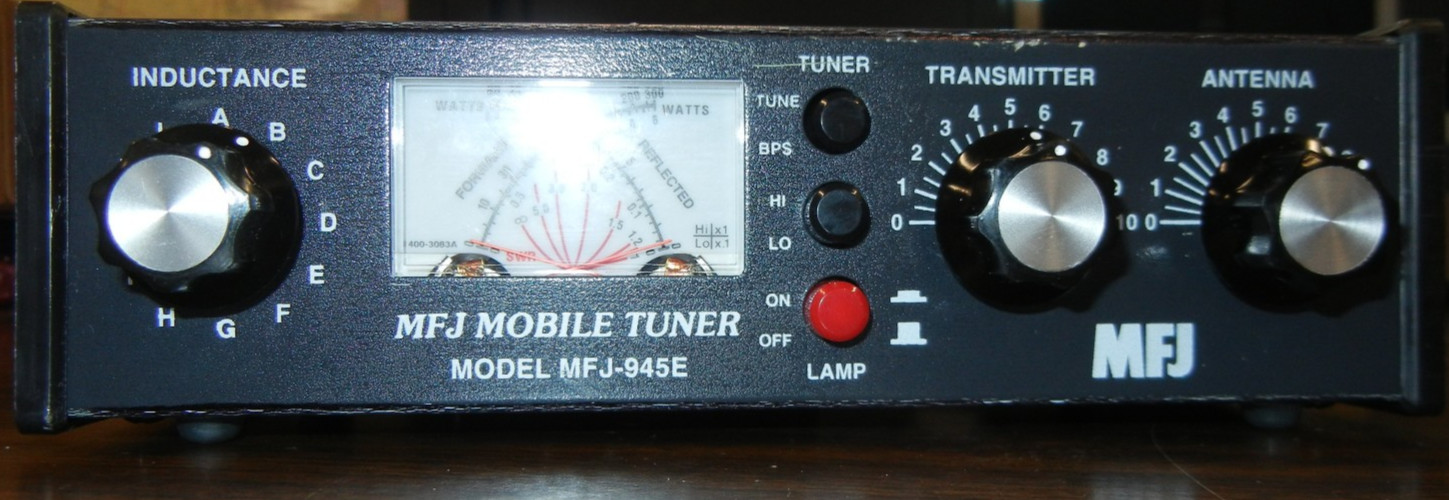
- Best fit: portable or mobile HF (FT-857, IC-706) — choose a compact manual mobile tuner such as the MFJ-945E; skip heavy roller tuners and AC-powered auto-tuners.
- Wrong fit: using a 200 W tuner (Kenwood AT-230, Yaesu FC-757AT) behind a 500 W amplifier or on 60 m digital modes — the L/C network and relays will arc or fail.
Buying tips
- Match tuner continuous rating to your carrier power, not peak: for 100 W FT8 use a tuner rated at least 200 W PEP; for a 1.5 kW amplifier use a 3 kW PEP roller tuner.
- Confirm the tuning range covers the impedance you actually present: a 10:1 SWR match is typical for manuals, while auto-tuners often spec 3:1 to 10:1 — a short random wire needs the wider range.
- Check band coverage explicitly: 1.8–30 MHz covers 160–10 m, but 6 m (50 MHz) and 60 m channels require a tuner whose spec sheet lists them; older AT-230/FC-757AT units stop at 30 MHz.
- For auto-tuners, confirm the radio interface: Yaesu and Icom sell tuners keyed to their own control protocol (FC-757AT is Yaesu-only, mAT-180H is Icom-oriented); generic RF-sense tuners work with any rig.
Specs
| Tuning Type | Manual roller/tapped vs Automatic relay |
|---|---|
| Power Rating | 120-250 W auto / 300 W-3 kW manual |
| Frequency Coverage | 1.8-30 MHz HF; 6 m on select models |
| Impedance Match Range | 3:1 to 10:1 SWR typical |
Related searches
What to check before buying
- Measure your antenna feedpoint impedance or expected SWR range across the bands you will use; pick a tuner whose matching range exceeds it.
- Record your transmitter's maximum carrier and PEP output, then select a tuner rated at least twice the carrier for digital/AM modes.
- Verify band coverage against your operating plan — 160 m through 10 m, plus 6 m/60 m if needed — and confirm the tuner's frequency spec.
- For auto-tuners, confirm the control interface (Yaesu/icom proprietary vs RF-sense) and that you have the required interface cable or DC power source.
FAQ
Data sources: eBay / Amazon listings and product attribute feeds. Updated Nov 23, 2026.
Some links on this page are affiliate links. If you buy after clicking one, we may earn a commission at no extra cost to you. This does not change which products appear here or their order. Affiliate disclosure.