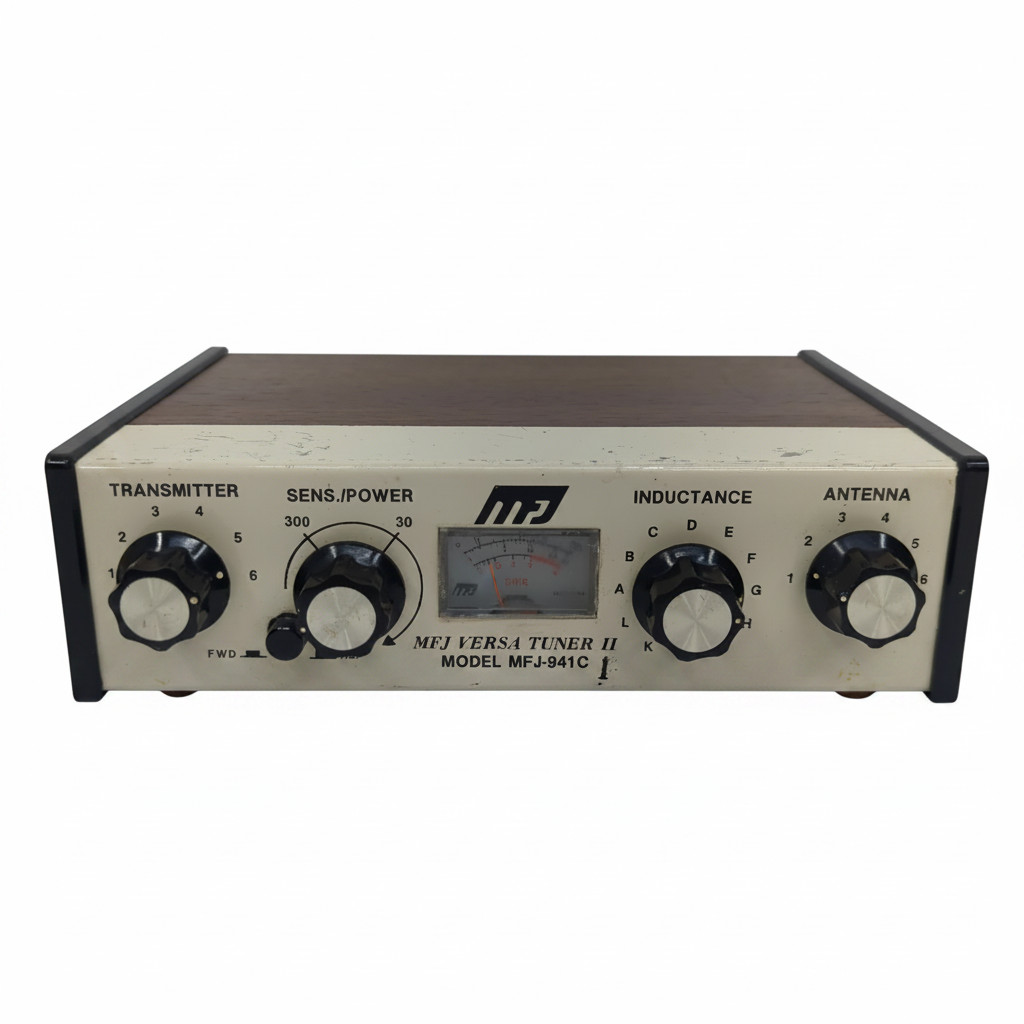

Photos from current listings. Actual item, color, and included accessories may vary.
Ham Radio Swr Buying Guide
Ham radio SWR meters and antenna tuners are the impedance-matching and measurement tools that keep your transmitter safe and your signal strong. The core trade-off is between passive analog cross-needle meters (rugged, no power, less precise) and active digital meters or auto-tuners (precise, feature-rich, require power). Choose based on whether you need a standalone field meter, a bench tuner, or an integrated transceiver function—skip any unit that cannot handle your radio's PEP power and frequency range.
Key takeaways
- Cross-needle analog meters read forward power, reflected power, and SWR simultaneously without switching, using dual taut-band movements.
- Manual tuners use a T-network or pi-L network with roller inductor or tapped coil; auto-tuners use switched L/C relays and need 12V DC.
- SWR meter power ranges are rated in PEP watts and frequency bands—HF-only (1.8–30 MHz) versus VHF/UHF coverage changes the directional coupler design.
At a glance
- Category
- Antenna Tuners & SWR Meters
- Last updated
- Nov 23, 2026
Current offers
Highlights
- Cross-needle analog meters read forward power, reflected power, and SWR simultaneously without switching, using dual taut-band movements.
- Manual tuners use a T-network or pi-L network with roller inductor or tapped coil; auto-tuners use switched L/C relays and need 12V DC.
- SWR meter power ranges are rated in PEP watts and frequency bands—HF-only (1.8–30 MHz) versus VHF/UHF coverage changes the directional coupler design.
- Tuner power ratings are conservative: a 300W PEP tuner handles 150W continuous carrier, while 3kW PEP tuners use ceramic insulators and heavy-gauge inductors.
Best use cases
- Best fit: a 100W HF transceiver with a wire dipole or random wire—pick a 300W PEP manual tuner with built-in cross-needle SWR meter; skip 3kW tuners and auto-tuners that cost more than the radio.
- Best fit: QRP field operation (5–10W)—choose a compact analog SWR meter or a low-power manual tuner with a 1.8–30 MHz range; skip high-power roller inductors that add weight.
- Best fit: multi-band operation with a solid-state amplifier—select a 1.5–3kW PEP tuner with a roller inductor and ceramic switch; skip 300W tuners that will arc at amplifier power.
- Wrong fit: using an auto-tuner as a permanent SWR meter—auto-tuners need transmit RF to tune and add insertion loss; use a dedicated cross-needle meter for continuous monitoring.
Buying tips
- Match tuner PEP rating to at least 1.5× your radio's maximum output: a 100W radio needs a 150W+ tuner, but a 300W PEP tuner gives safe headroom for SSB peaks.
- Check frequency coverage: HF-only tuners (1.8–30 MHz) are smaller and cheaper; if you operate 6m or VHF, choose a tuner rated to 54 MHz or a separate VHF SWR meter.
- For analog SWR meters, verify the meter scale reads 1:1 to ∞ and has a sensitivity control—fixed-scale meters are hard to read below 1.5:1 SWR.
- Manual tuners with a roller inductor handle a wider impedance range (up to 10:1 SWR) than tapped-coil designs; pick roller inductor for random wires and long dipoles.
Specs
| Meter Type | Cross-needle analog vs digital LCD |
|---|---|
| Tuner Power Rating | 300W PEP vs 3kW PEP roller inductor |
| Frequency Coverage | HF 1.8–30 MHz vs HF+VHF 1.8–500 MHz |
| Tuner Network | T-network vs pi-L vs auto-relay L/C |
Related searches
What to check before buying
- Measure your operating position: manual tuners with roller inductors are deep (8–12 inches) and heavy (5–10 lbs)—confirm shelf or desk space and cable routing.
- Verify your transceiver's antenna connector: most HF radios use SO-239 (UHF) female; tuners with PL-259 male pigtails require a barrel adapter.
- Check power source for auto-tuners: they need 12V DC at 1–2A—confirm a fused accessory outlet or power supply port is available.
- Confirm your antenna feedline impedance: all ham tuners and SWR meters are designed for 50-ohm coax; 75-ohm or open-wire feeders need a balun or dedicated tuner.
FAQ
Data sources: eBay / Amazon listings and product attribute feeds. Updated Nov 23, 2026.
Some links on this page are affiliate links. If you buy after clicking one, we may earn a commission at no extra cost to you. This does not change which products appear here or their order. Affiliate disclosure.