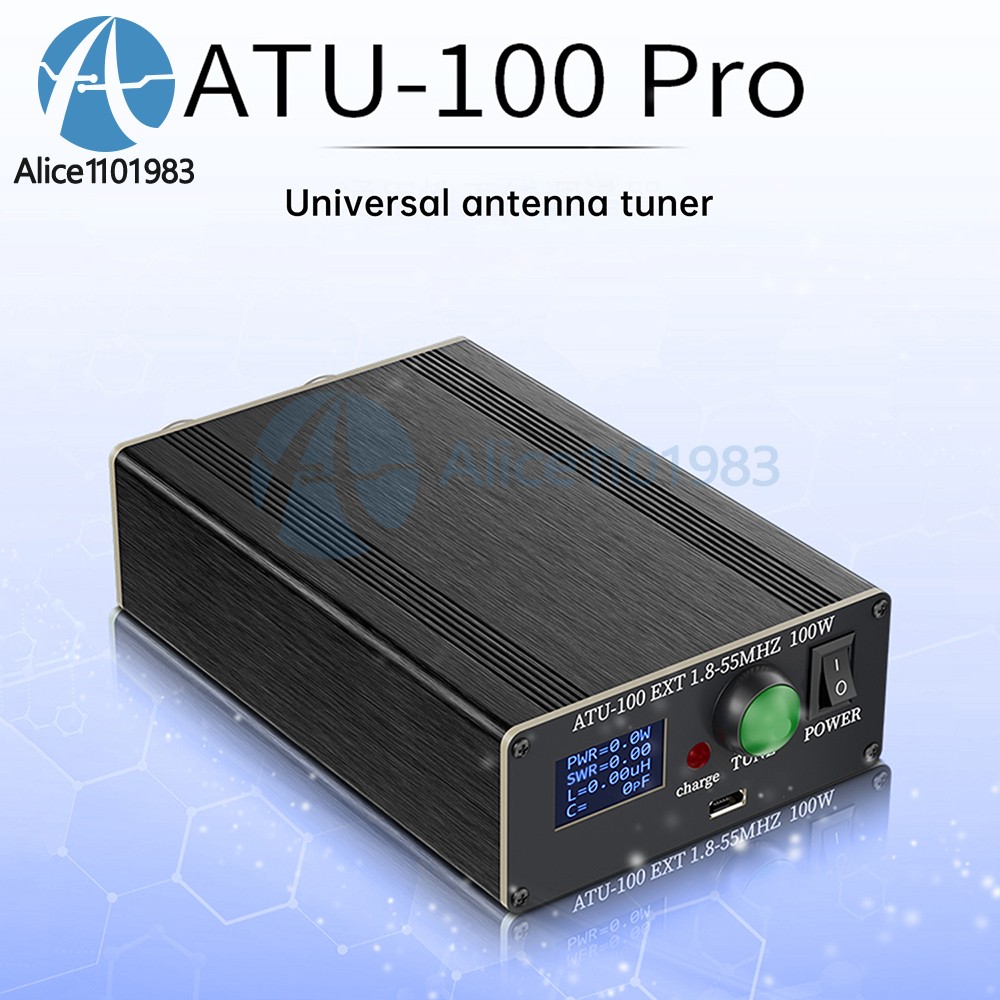

Photos from current listings. Actual item, color, and included accessories may vary.
Auto Antenna Tuner Buying Guide
Auto antenna tuners are microprocessor-controlled impedance-matching networks that automatically minimize SWR across HF/VHF bands, letting transceivers run at full power into mismatched wire, vertical, or mobile antennas. The core trade-off is power handling versus matching range and tuning speed: relay-switched L-networks with large air-core inductors and vacuum or ceramic capacitors handle legal-limit power, while compact SMD/relay tuners with limited inductor banks suit QRP and 100W-class radios. The decision rule: match the tuner's continuous power rating and tuning range to your transceiver's output and antenna's worst-case impedance; any tuner that requires throttling below your radio's rated power or cannot match your antenna on every band is a compromise.
Key takeaways
- Legal-limit tuners use large air-core or roller inductors plus vacuum-variable or ceramic doorknob capacitors; 100W-class tuners use relay-switched toroids and smaller capacitors, capping continuous power and matching range.
- Internal tuners (e.g., ICOM AH-series, Yaesu FC-series) are band-limited and model-specific; external auto tuners like the ATU-100, mAT-180H, and Palstar HF-AUTO cover broader impedance ranges via SO-239 inputs.
- Remote-head designs (e.g., Palstar HF-AUTO-R) separate the control head from the tuner via RS-232 or proprietary cabling, allowing the matching network to sit at the antenna feedpoint to reduce coax loss.
At a glance
- Category
- Antenna Tuners & SWR Meters
- Last updated
- Nov 23, 2026
Current offers
Highlights
- Legal-limit tuners use large air-core or roller inductors plus vacuum-variable or ceramic doorknob capacitors; 100W-class tuners use relay-switched toroids and smaller capacitors, capping continuous power and matching range.
- Internal tuners (e.g., ICOM AH-series, Yaesu FC-series) are band-limited and model-specific; external auto tuners like the ATU-100, mAT-180H, and Palstar HF-AUTO cover broader impedance ranges via SO-239 inputs.
- Remote-head designs (e.g., Palstar HF-AUTO-R) separate the control head from the tuner via RS-232 or proprietary cabling, allowing the matching network to sit at the antenna feedpoint to reduce coax loss.
- Tuning range is defined by the impedance transformation ratio (often 10:1 or 16:1) and frequency coverage; 1.8–55 MHz continuous coverage requires wide-range relay banks, while 160–6m coverage with narrower ranges may still cover resonant antennas.
Best use cases
- Best fit: base-station HF operators running 100W transceivers into multiband wire or vertical antennas should pick a 100–200W external auto tuner with 1.8–30 MHz coverage and SO-239 inputs; skip legal-limit tuners unless upgrading to an amplifier.
- Best fit: legal-limit or amplifier users (1–1.5 kW) must choose a tuner rated for continuous carrier at that power, with vacuum or ceramic capacitors and air-core inductors; skip compact relay tuners that overheat or arc at high power.
- Best fit: mobile or portable operators needing automatic matching at the antenna feedpoint should select a remote-head tuner (control head in cabin, tuner at base) to minimize coax loss; skip internal tuners that cannot be mounted remotely.
- Wrong fit: operators with antennas already below 1.5:1 SWR across all bands do not need an auto tuner; a manual tuner or no tuner is sufficient and more economical.
Buying tips
- Match continuous power rating to your transceiver's PEP output with a 20–30% margin: a 100W radio needs a tuner rated at least 120–150W continuous, especially for digital modes with high duty cycle.
- Confirm impedance matching range (e.g., 10:1 or 16:1) covers your antenna's worst-case SWR; a 10:1 tuner can match up to 5:1 SWR at 100W, but 16:1 extends to 8:1 SWR for end-fed wires.
- Check frequency coverage: 1.8–30 MHz covers HF amateur bands; 1.8–55 MHz adds 6m and low-VHF; ensure coverage includes all bands you operate, including WARC bands.
- For remote-head tuners, verify the control cable length and interface (RS-232, proprietary) matches your station layout, and that the tuner accepts SO-239 or N-type connectors for your coax.
Specs
| Power Rating | 100W / 200W / 1.5kW continuous |
|---|---|
| Frequency Coverage | 1.8–30 MHz / 1.8–55 MHz |
| Impedance Match Range | 10:1 to 16:1 SWR |
| Tuner Type | Internal / External / Remote-head |
Related searches
What to check before buying
- Measure your antenna's worst-case SWR on each band with an SWR meter; if any band exceeds the tuner's matching range, choose a wider-range model or adjust antenna length.
- Verify your transceiver's maximum output power and duty cycle; select a tuner with continuous rating at least 20% above PEP for digital/AM modes.
- Confirm interface compatibility: internal tuners require a specific radio model; external tuners need a control cable (RS-232, USB, or proprietary) and may need a radio-specific interface box.
- Check connector types (SO-239, N-type, PL-259) and coax impedance (50 ohms); ensure tuner inputs/outputs match your station's connectors and that the tuner can be grounded to a station ground bus.
FAQ
Data sources: eBay / Amazon listings and product attribute feeds. Updated Nov 23, 2026.
Some links on this page are affiliate links. If you buy after clicking one, we may earn a commission at no extra cost to you. This does not change which products appear here or their order. Affiliate disclosure.