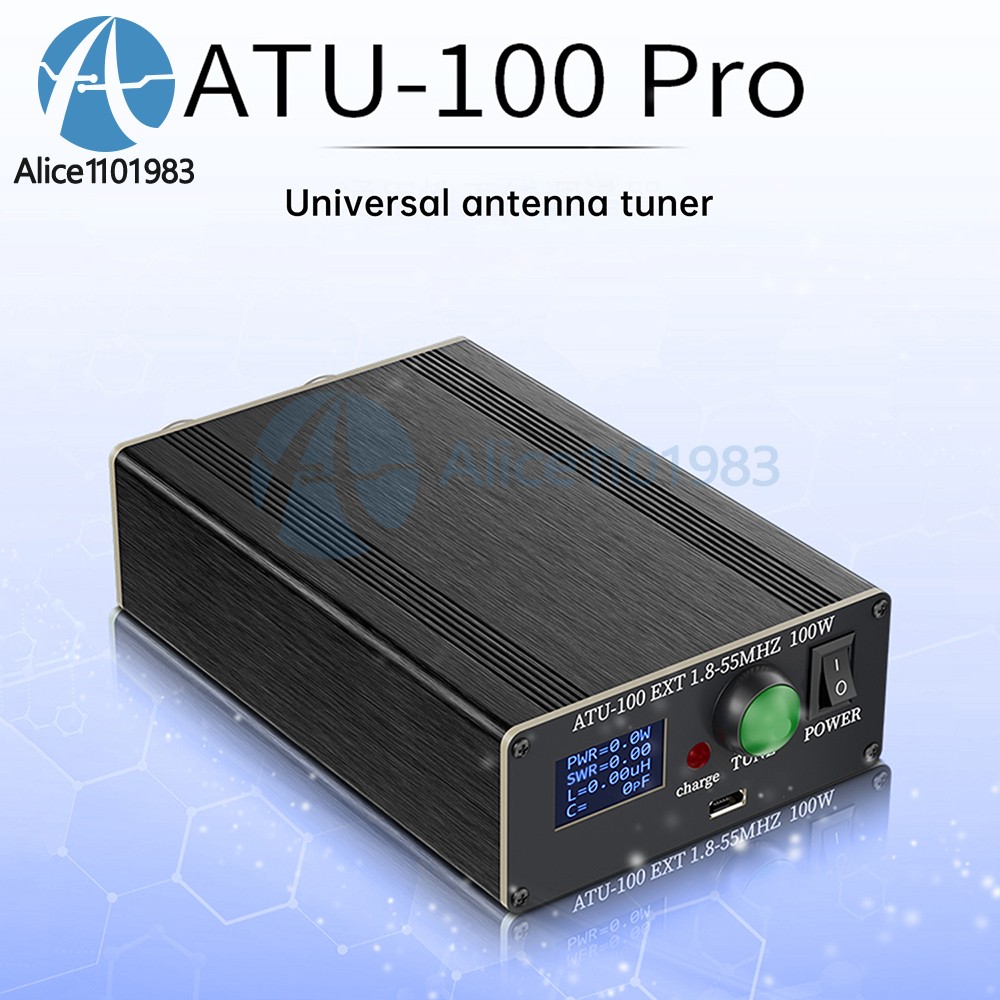

Photos from current listings. Actual item, color, and included accessories may vary.
Atu 100 Antenna Tuner Buying Guide
The ATU-100 is an open-source, relay-switched automatic antenna tuner design for HF ham radio, commonly sold as a compact 100W-class kit or assembled board. The defining trade-off is relay quality versus cost: quality latching relays and proper toroid winding yield a tuner that matches 1.8–55 MHz antennas reliably, while cheap non-latching relays and thin PCB traces cause arcing, hot-switching failures, and poor SWR resolution. Buyers should treat the ATU-100 as a 100W PEP SSB / 30–50W digital-mode tuner, not a continuous-carrier 100W unit, and choose firmware with a proper SWR bridge calibration.
Median $64.60
Key takeaways
- Relay-switched L-network with 7 inductors and 7 capacitors gives 128 steps; resolution depends on relay count and toroid winding accuracy.
- Genuine design target is 100W PEP SSB; continuous carrier (FT8, RTTY, FM) should stay at 30–50W to avoid relay contact and core saturation failures.
- Latching relays hold state without coil current and reduce heat; non-latching relay clones draw current continuously and fail faster under thermal cycling.
At a glance
- Category
- Antenna Tuners & SWR Meters
- Last updated
- Nov 23, 2026
Current offers
Highlights
- Relay-switched L-network with 7 inductors and 7 capacitors gives 128 steps; resolution depends on relay count and toroid winding accuracy.
- Genuine design target is 100W PEP SSB; continuous carrier (FT8, RTTY, FM) should stay at 30–50W to avoid relay contact and core saturation failures.
- Latching relays hold state without coil current and reduce heat; non-latching relay clones draw current continuously and fail faster under thermal cycling.
- Frequency coverage of 1.8–55 MHz covers 160m through 6m; tuning accuracy above 30 MHz degrades without calibrated firmware and proper SWR bridge.
Best use cases
- Best fit: portable QRP-to-100W SSB operators using random-wire or end-fed antennas on 160–6m who want automatic matching in a small enclosure.
- Best fit: kit builders and experimenters who want an open-source ATU with accessible firmware, schematics, and relay-level serviceability.
- Wrong fit: operators running 100W FT8, RTTY, or FM continuously — choose a 200W+ tuner with higher-rated relays and larger cores.
- Wrong fit: users needing balanced-line or ladder-line matching — the ATU-100 is an unbalanced 50-ohm coax tuner only.
Buying tips
- Confirm relay type before buying: latching relays (e.g., 5V latching DPDT) are preferable to non-latching clones for heat and current efficiency.
- Check whether the unit ships assembled and tested or as a bare PCB kit; assembled units with calibrated SWR bridge save hours of troubleshooting.
- Match power rating to mode: derate to 50W for digital/continuous modes and 100W PEP for SSB/CW; never exceed 100W into a high-SWR load.
- Verify firmware variant: open-source ATU-100 firmware with OLED support and manual tune buttons differs from locked vendor firmware; prefer flashable units.
Specs
| Tuner Architecture | Relay-switched L-network, 7L/7C |
|---|---|
| Frequency Coverage | 1.8–55 MHz (160m–6m) |
| Power Rating | 100W PEP SSB / 30–50W digital |
| Relay Type | Latching vs non-latching DPDT |
Related searches
What to check before buying
- Confirm your transceiver output does not exceed 100W PEP and that you can reduce power to 30–50W for digital modes.
- Measure your antenna feedpoint SWR and impedance range; the ATU-100 matches roughly 10:1 SWR but struggles beyond that on some bands.
- Check enclosure and connector type: most units use SO-239 or BNC; confirm your coax jumpers match before installation.
- Verify power input: ATU-100 boards typically require 12V DC at 0.5–1A; confirm your station supply can spare the current.
FAQ
Data sources: eBay / Amazon listings and product attribute feeds. Updated Nov 23, 2026.
Some links on this page are affiliate links. If you buy after clicking one, we may earn a commission at no extra cost to you. This does not change which products appear here or their order. Affiliate disclosure.