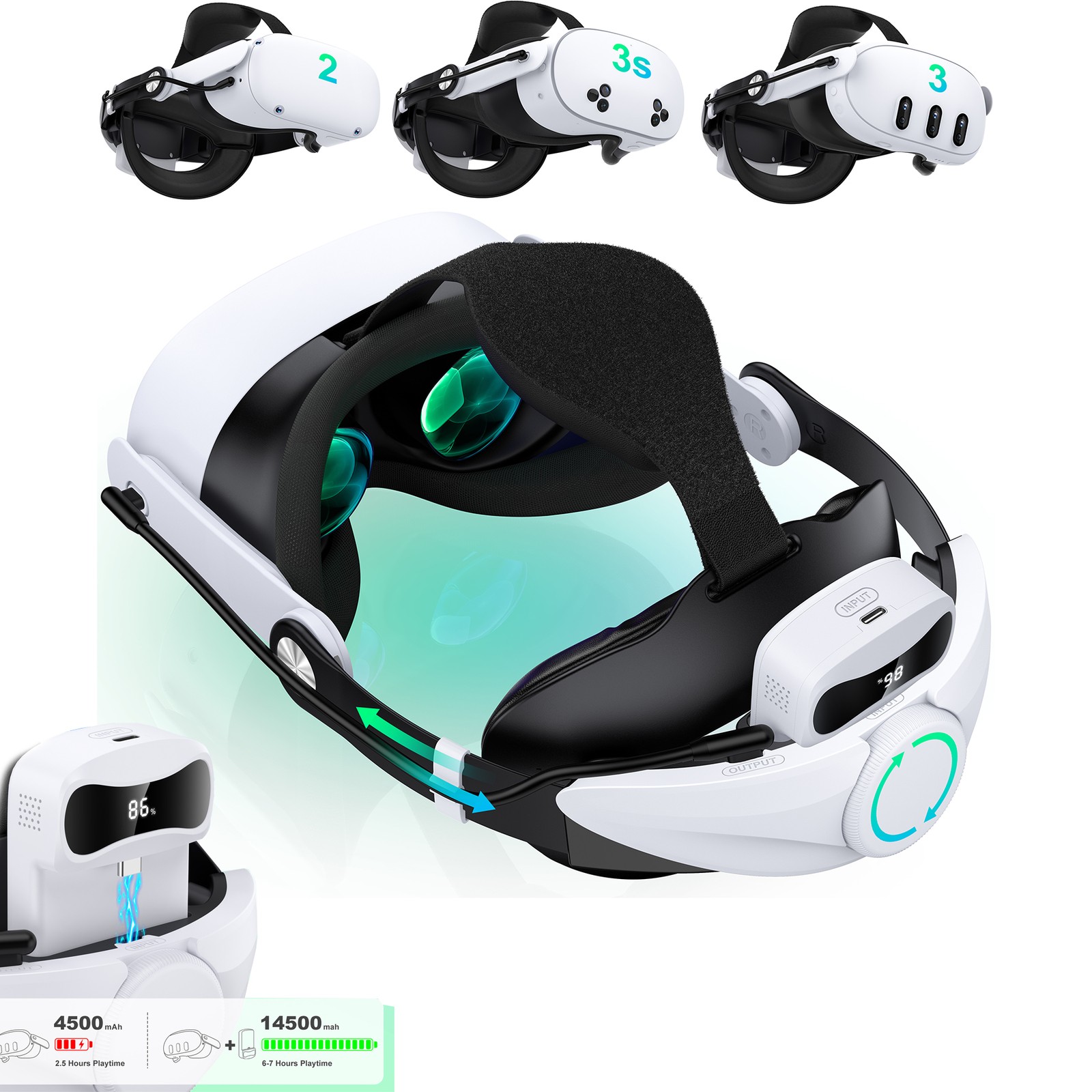

Photos from current listings. Actual item, color, and included accessories may vary.
Oculus Head Strap Buying Guide
An Oculus head strap is the structural harness that replaces the stock soft strap on Meta Quest headsets, and the primary trade-off is between a simple rigid frame (balance and fit) and an integrated battery version (counterweight and runtime at the cost of added mass). The clear decision rule: buy a rigid strap with a rear counterweight dial for comfort, and only choose a battery strap if you routinely play longer than the headset's internal battery allows and accept the extra rear weight.
Key takeaways
- Rigid halo-style straps with a rear fitment dial distribute pressure across the occipital bone instead of the face gasket, eliminating the stock strap's front-heavy torque.
- Battery straps typically carry 5000-10000mAh cells in the rear cradle; the mass acts as a counterweight but adds 150-300g to the head, shifting the center of gravity backward.
- Quest 3 and Quest 2 use different strap-mount geometries; a Quest 2 strap will not click into a Quest 3 stock arm socket, so model-specific mounting clips are mandatory.
At a glance
- Category
- VR Gaming Hardware & Accessories
- Last updated
- Nov 28, 2026
Current offers
Highlights
- Rigid halo-style straps with a rear fitment dial distribute pressure across the occipital bone instead of the face gasket, eliminating the stock strap's front-heavy torque.
- Battery straps typically carry 5000-10000mAh cells in the rear cradle; the mass acts as a counterweight but adds 150-300g to the head, shifting the center of gravity backward.
- Quest 3 and Quest 2 use different strap-mount geometries; a Quest 2 strap will not click into a Quest 3 stock arm socket, so model-specific mounting clips are mandatory.
- Elite-style straps use hard polymer arms that snap into the headset rails; halo straps use a padded forehead ring plus a rear ratchet, offering different pressure profiles.
Best use cases
- Pick a rigid non-battery halo strap if you play 30-60 minute sessions and want the lightest possible balanced fit without charging another device.
- Pick a 5000-10000mAh battery head strap if you routinely play 2+ hours and want the rear battery to double as a counterweight; skip it if you mostly play seated and can charge between sessions.
- Pick an Elite-style rigid strap for active room-scale play where you need a tight, low-profile lock; skip halo rings if you wear over-ear headphones that clash with a wide forehead pad.
- Skip any strap marketed as universal for Quest 2/3/3S without model-specific clips; the mounting interfaces and stock arm lengths differ and a loose clip causes tracking wobble.
Buying tips
- Match the strap to the exact headset: Quest 2, Quest 3, and Quest 3S each have distinct side-rail clip geometry, so verify the model designation in the product title rather than assuming cross-compatibility.
- For battery straps, target 5000-10000mAh capacity and USB-C pass-through charging; below 5000mAh the added weight rarely justifies the runtime gain.
- Choose a strap with a tool-free rear fitment dial and a padded occipital cradle; ratchet systems with metal internals survive repeated adjustment better than all-plastic detents.
- Check the strap's rear cradle depth if you use a elite-style battery: deep cradles can press the headset's rear cushion and reduce the effective fit range for smaller head circumferences.
Specs
| Strap Type | Rigid halo vs Elite-style clamp |
|---|---|
| Battery Capacity | None / 5000-10000mAh rear cell |
| Headset Compatibility | Quest 2 / Quest 3 / Quest 3S specific |
| Fitment Range | Approx. 52-62cm circumference |
Related searches
What to check before buying
- Measure your head circumference and confirm the strap's fitment range covers it; most rigid straps adjust roughly 52-62cm, and battery cradles can reduce the minimum by several centimeters.
- Confirm the headset model (Quest 2 vs Quest 3 vs Quest 3S) and that the strap ships with the correct side-rail clips for that model.
- For battery straps, verify USB-C input/output and that pass-through charging supports the headset's power draw during play.
- Check whether you use over-ear headphones or the stock speakers; wide halo forehead pads and bulky rear battery cradles can interfere with headphone bands.
FAQ
Data sources: eBay / Amazon listings and product attribute feeds. Updated Nov 28, 2026.
Some links on this page are affiliate links. If you buy after clicking one, we may earn a commission at no extra cost to you. This does not change which products appear here or their order. Affiliate disclosure.