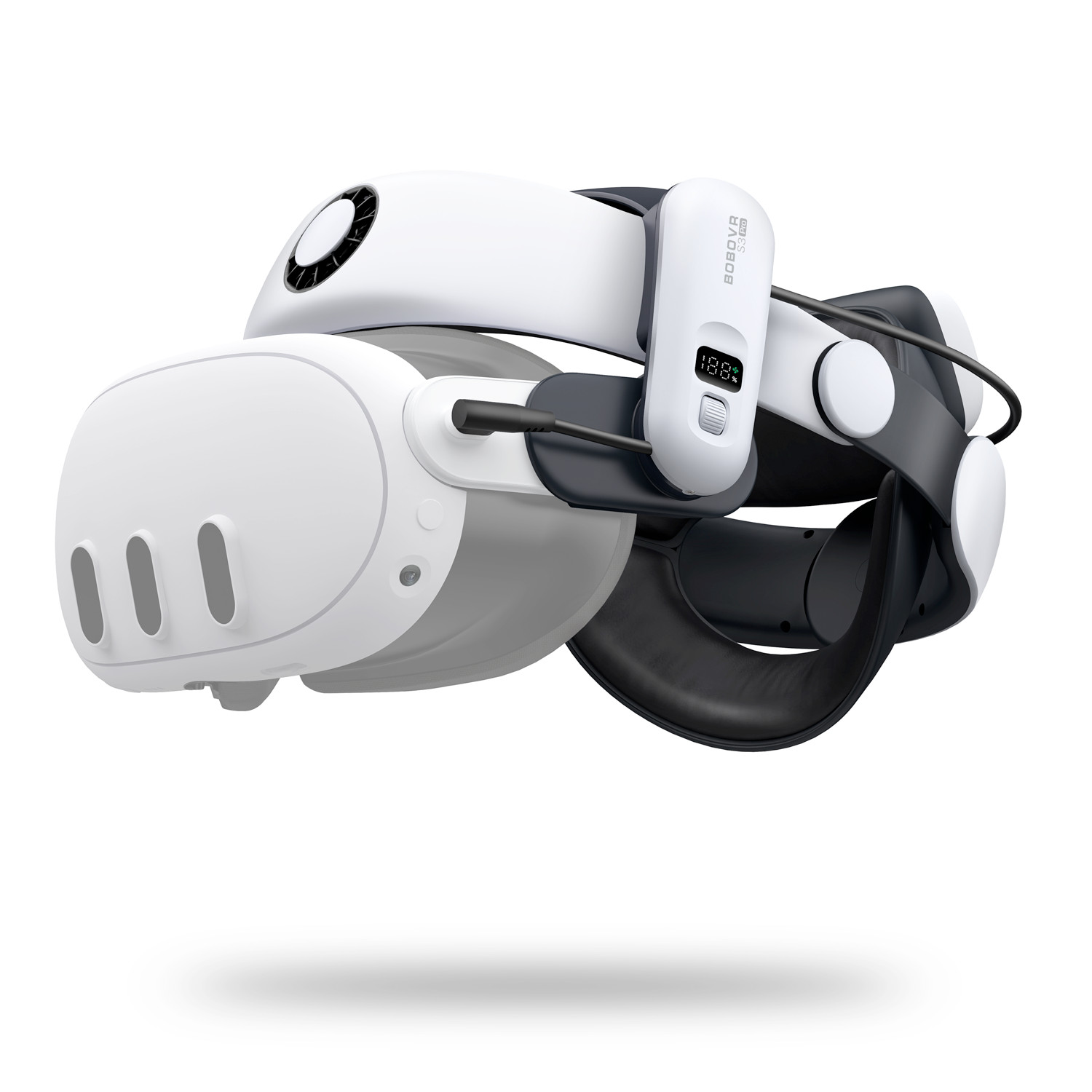

Photos from current listings. Actual item, color, and included accessories may vary.
Bobovr Head Strap Buying Guide
A BOBOVR head strap is a third-party ergonomic replacement for the stock soft strap on Meta Quest 2, Quest 3, and Quest 3S, using a halo-style rigid frame with a rear counterweight battery. The core trade-off is added rear weight and bulk versus dramatically better front-to-back balance, longer play sessions, and built-in hot-swap power. Buy the battery-integrated Pro or S3 tier for active VR and marathon sessions; skip it if you need maximum portability or wear a tight-fitting over-ear headset.
Key takeaways
- Halo-style rigid frame replaces the stock soft strap, moving clamp pressure from the face gasket to the forehead and rear skull for reduced face fatigue.
- Battery-integrated tiers (M2 Pro, M3 Pro, S3 Pro) add a rear counterweight that offsets the Quest's front-heavy center of gravity and hot-swap magnetic power.
- S3 Pro adds an active air-circulation module and a higher-capacity battery versus the passive M-series, trading extra bulk for cooling and runtime.
At a glance
- Category
- VR Gaming Hardware & Accessories
- Last updated
- Nov 28, 2026
Current offers
Highlights
- Halo-style rigid frame replaces the stock soft strap, moving clamp pressure from the face gasket to the forehead and rear skull for reduced face fatigue.
- Battery-integrated tiers (M2 Pro, M3 Pro, S3 Pro) add a rear counterweight that offsets the Quest's front-heavy center of gravity and hot-swap magnetic power.
- S3 Pro adds an active air-circulation module and a higher-capacity battery versus the passive M-series, trading extra bulk for cooling and runtime.
- Quest 3 and Quest 3S use different side-arm mounting geometry, so the strap must match the headset generation; Quest 2 straps are not cross-compatible.
Best use cases
- Best fit: Quest 3/3S owners doing 1-hour-plus sessions who want balanced weight and swappable battery power — pick the S3 Pro or M3 Pro with the correct Quest 3/3S mount.
- Best fit: Quest 2 owners seeking a cheaper comfort upgrade — choose the M2 Pro rather than paying for Quest 3-only features.
- Wrong fit: buyers who prioritize pocketability or travel-light packing — the rigid halo and rear battery add bulk that defeats a compact case.
- Wrong fit: users with very large over-ear headphones or tight headgear — the rear battery pod competes for space behind the head.
Buying tips
- Match the mount to the headset generation: Quest 2, Quest 3, and Quest 3S each need their specific side-arm clips; a Quest 2 strap will not lock onto Quest 3 arms.
- Choose battery capacity by session length: standard M-series packs suit short sessions, while Pro/S3 tiers with larger hot-swap cells support multi-hour play.
- Prefer magnetic hot-swap battery designs over fixed internal cells so you can rotate packs without removing the strap.
- Check the rear pad shape: wider, contoured rear cushions distribute counterweight better than narrow pads on halo frames.
Specs
| Headset Fit | Quest 2 / Quest 3 / Quest 3S mounts |
|---|---|
| Frame Style | Halo rigid frame vs stock soft strap |
| Battery Tier | Non-battery / M-Pro / S3 Pro hot-swap |
| Cooling | Passive pad vs S3 active airflow |
Related searches
What to check before buying
- Confirm your exact headset model (Quest 2 vs Quest 3 vs Quest 3S) before choosing a mount variant.
- Measure your head circumference and check the strap's adjustable range against the stock strap fit.
- Verify the strap's rear battery pod clears your usual over-ear headphones and any glasses arms.
- Check that your VR carry case has internal clearance for a halo frame plus rear battery.
FAQ
Data sources: eBay / Amazon listings and product attribute feeds. Updated Nov 28, 2026.
Some links on this page are affiliate links. If you buy after clicking one, we may earn a commission at no extra cost to you. This does not change which products appear here or their order. Affiliate disclosure.