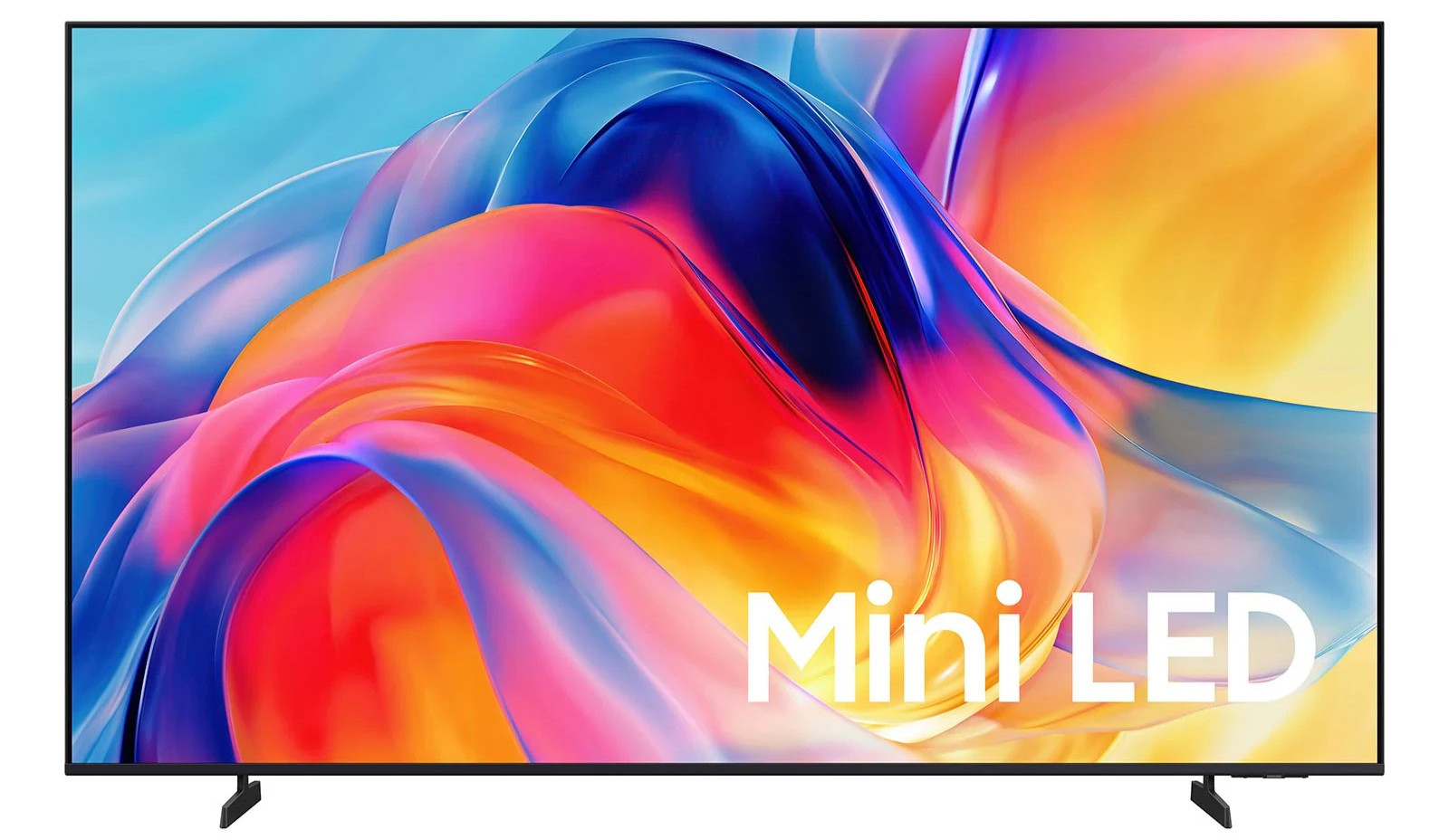

Photos from current listings. Actual item, color, and included accessories may vary.
Samsung TV Buying Guide
Samsung's TV lineup spans three distinct panel architectures—edge-lit Crystal UHD, full-array Mini LED/QLED, and self-emissive OLED—with the biggest trade-offs being peak brightness versus per-pixel contrast and 60Hz versus 120Hz gaming support. The model-year code (F=2025, D=2024, C=2023) and HDMI tier are the fastest ways to separate current, future-proof sets from clearance compromises. The decision rule is simple: buy 120Hz HDMI 2.1 with full-array or OLED if you game or watch HDR in a bright room; accept 60Hz edge-lit only for secondary or dim-room viewing.
Key takeaways
- Panel hierarchy: Crystal UHD uses edge-lit LED with 60Hz; QLED adds quantum-dot full-array local dimming; Mini LED increases dimming zones; OLED delivers per-pixel contrast with no backlight.
- HDMI tier decides gaming: 60Hz sets carry HDMI 2.0 (4K/60), while 120Hz sets add HDMI 2.1 for 4K/120, VRR, and ALLM—required for current-gen console performance modes.
- HDR support is HDR10+ and HLG only; Samsung does not license Dolby Vision, so Dolby Vision discs and streams fall back to HDR10 base layer.
At a glance
- Category
- TVs & Display Panels
- Last updated
- Nov 24, 2026
Current offers
Highlights
- Panel hierarchy: Crystal UHD uses edge-lit LED with 60Hz; QLED adds quantum-dot full-array local dimming; Mini LED increases dimming zones; OLED delivers per-pixel contrast with no backlight.
- HDMI tier decides gaming: 60Hz sets carry HDMI 2.0 (4K/60), while 120Hz sets add HDMI 2.1 for 4K/120, VRR, and ALLM—required for current-gen console performance modes.
- HDR support is HDR10+ and HLG only; Samsung does not license Dolby Vision, so Dolby Vision discs and streams fall back to HDR10 base layer.
- Model-year letter in the code (F=2025, D=2024, C=2023) marks panel generation and processor; older letters mean clearance stock with prior-year dimming and upscaling.
Best use cases
- Bright living room with sports and HDR movies: pick QLED or Mini LED with full-array local dimming (QN**D/QN**F tiers); skip edge-lit Crystal UHD, which washes out under window light.
- Dark dedicated theater or bedroom: pick OLED (S90F/S95F class) for per-pixel blacks and wide viewing angles; skip Mini LED if you sit off-axis or demand zero blooming.
- Next-gen console gaming: pick a 120Hz HDMI 2.1 set with VRR and ALLM (QN**C/D/F or S90F); skip any 60Hz HDMI 2.0 Crystal UHD, which caps 4K at 60fps with no VRR.
- Secondary room or outdoor patio: pick the smallest 43–50" Crystal UHD at 60Hz; skip 120Hz and OLED tiers, which add cost and brightness limits without benefit at short viewing distance.
Buying tips
- For 4K, seat distance should be about 1.0–1.5× screen diagonal: a 65" set suits 6.5–8 ft; below that, 4K detail is lost and 8K adds nothing.
- Match HDMI count to devices: 120Hz sets typically provide four inputs with one or two HDMI 2.1 ports—reserve the 2.1 port for the console or PC and route legacy gear to 2.0.
- Check the model letter before buying: F (2025) and D (2024) carry current processors and dimming; C (2023) and older are clearance and may lack newer anti-glare coatings.
- Confirm VRR support in the spec sheet—only 120Hz HDMI 2.1 models list FreeSync Premium or VRR—since 60Hz sets cannot smooth frame pacing for consoles or PC.
Specs
| Panel Type | Crystal UHD / QLED / Mini LED / OLED |
|---|---|
| Refresh & HDMI | 60Hz HDMI 2.0 vs 120Hz HDMI 2.1 |
| Model Year Code | F=2025, D=2024, C=2023 |
| HDR Formats | HDR10+ / HLG (no Dolby Vision) |
Related searches
What to check before buying
- Measure the wall or stand width and the viewing distance; a 65" 4K set needs roughly 6.5–8 ft, and the stand footprint must fit your furniture depth.
- Check room light: south- or west-facing windows demand Mini LED/QLED peak brightness; a dark room lets OLED deliver contrast without brightness concerns.
- Confirm voltage and plug: Samsung TVs are 110–120V North American or 220–240V export; buy the regional model with the correct plug and tuner.
- Verify companion parts: a 120Hz set needs an HDMI 2.1 certified cable for 4K/120, and wall mounting requires a VESA bracket matching the set's pattern and weight.
FAQ
Data sources: eBay / Amazon listings and product attribute feeds. Updated Nov 24, 2026.
Some links on this page are affiliate links. If you buy after clicking one, we may earn a commission at no extra cost to you. This does not change which products appear here or their order. Affiliate disclosure.