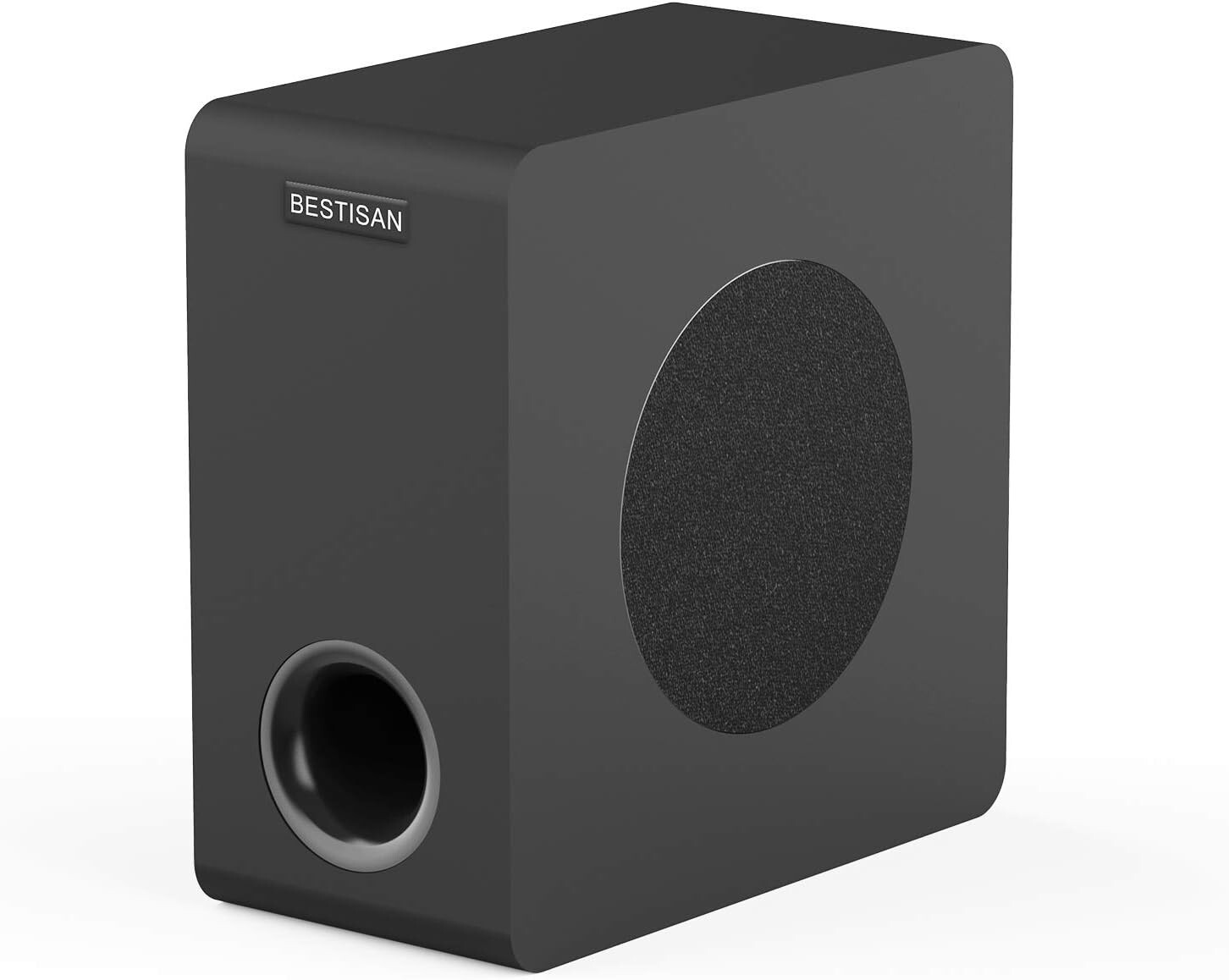

Photos from current listings. Actual item, color, and included accessories may vary.
Bestisan SW65D Buying Guide
The Bestisan SW65D is a 6.5-inch powered subwoofer intended to add low-frequency impact to a stereo or home-theater setup at a budget price. The core trade-off is driver size and cabinet volume versus amplifier quality and low-end extension: a 6.5-inch woofer in a compact box delivers mid-bass punch but rolls off early below roughly 40-45 Hz. Buy it only if you need an affordable bass fill for a small-to-medium room and can accept the physical limits of a single 6.5-inch driver; skip it if you want true sub-30 Hz home-theater rumble or calibrated room correction.
Key takeaways
- 6.5-inch front-firing paper or poly cone woofer in a bass-reflex cabinet with rear port — the port tuning sets the usable low-frequency limit, typically around 40-45 Hz.
- Class AB or Class D amplifier integrated into the cabinet, usually rated in the 60-100 W RMS class — power claims on budget subs are often peak, not continuous.
- Line-level LFE and stereo RCA inputs plus a variable crossover and gain knob — no high-level speaker inputs on most SW65D units, so an AVR with a sub-out or pre-out is required.
At a glance
- Category
- Home Theater Speakers & Subwoofers
- Status
- Listings available
- Last updated
- Nov 27, 2026
Current offers
Highlights
- 6.5-inch front-firing paper or poly cone woofer in a bass-reflex cabinet with rear port — the port tuning sets the usable low-frequency limit, typically around 40-45 Hz.
- Class AB or Class D amplifier integrated into the cabinet, usually rated in the 60-100 W RMS class — power claims on budget subs are often peak, not continuous.
- Line-level LFE and stereo RCA inputs plus a variable crossover and gain knob — no high-level speaker inputs on most SW65D units, so an AVR with a sub-out or pre-out is required.
- Single-driver, single-ported design with no EQ or room-correction DSP — placement and the AVR's bass management do all the integration work.
Best use cases
- Best fit: a 2.1 desktop, bedroom, or small living-room system with a stereo amp or AVR that has a dedicated subwoofer pre-out — set the crossover at 80 Hz and place the sub near a wall for boundary gain.
- Best fit: adding low-end weight to bookshelf speakers or a soundbar with a sub-out in a room under roughly 150-200 sq ft where a 6.5-inch driver can pressurize the space.
- Wrong fit: a large open-plan room or a dedicated home-theater wanting sub-30 Hz effects — a single 6.5-inch ported sub will run out of excursion and output; step up to a 10- or 12-inch driver.
- Wrong fit: a stereo receiver or integrated amp with no subwoofer/LFE output — the SW65D lacks speaker-level inputs, so you cannot tap signal from the speaker terminals without an external line-level converter.
Buying tips
- Match the sub to your amplifier's bass-management output: confirm your AVR or stereo preamp has an RCA sub-out or LFE jack, because the SW65D has no high-level speaker inputs.
- Size by room volume, not by wattage: a 6.5-inch ported sub suits rooms up to about 150-200 sq ft; above that, move to a 10-inch or dual-sub configuration for adequate output.
- Set the crossover to 80 Hz when pairing with speakers whose woofers are 5.25 inches or smaller, and let the AVR handle bass management rather than the sub's own knob.
- Expect usable output to roughly 40-45 Hz from a 6.5-inch ported cabinet — if your content depends on 20-35 Hz LFE (action films, pipe organ, electronic sub-bass), this driver class will not deliver it.
Specs
| Driver Size | 6.5 in single woofer |
|---|---|
| Amplifier Type | Built-in Class AB/D powered |
| Inputs | RCA line-level / LFE only |
| Low-Freq Extension | ~40-45 Hz usable in-room |
Alternatives to compare
Related searches
What to check before buying
- Measure the intended placement footprint and clearance: the SW65D is a compact bookshelf-style box, so confirm at least a few inches behind the rear port and around the cabinet for airflow.
- Verify your receiver or amplifier has a line-level subwoofer pre-out (RCA) — the SW65D does not accept speaker-level input from bare speaker wires.
- Check the room's floor and wall construction: a rear-ported sub couples strongly with a nearby wall, so plan for corner or near-wall placement to reinforce bass, or expect thinner output in free space.
- Confirm mains voltage and plug type for your region — powered subs are region-specific, and a 120 V unit will not run correctly on a 230 V supply without a step-down transformer.
FAQ
Data sources: eBay / Amazon listings and product attribute feeds. Updated Nov 27, 2026.
Some links on this page are affiliate links. If you buy after clicking one, we may earn a commission at no extra cost to you. This does not change which products appear here or their order. Affiliate disclosure.