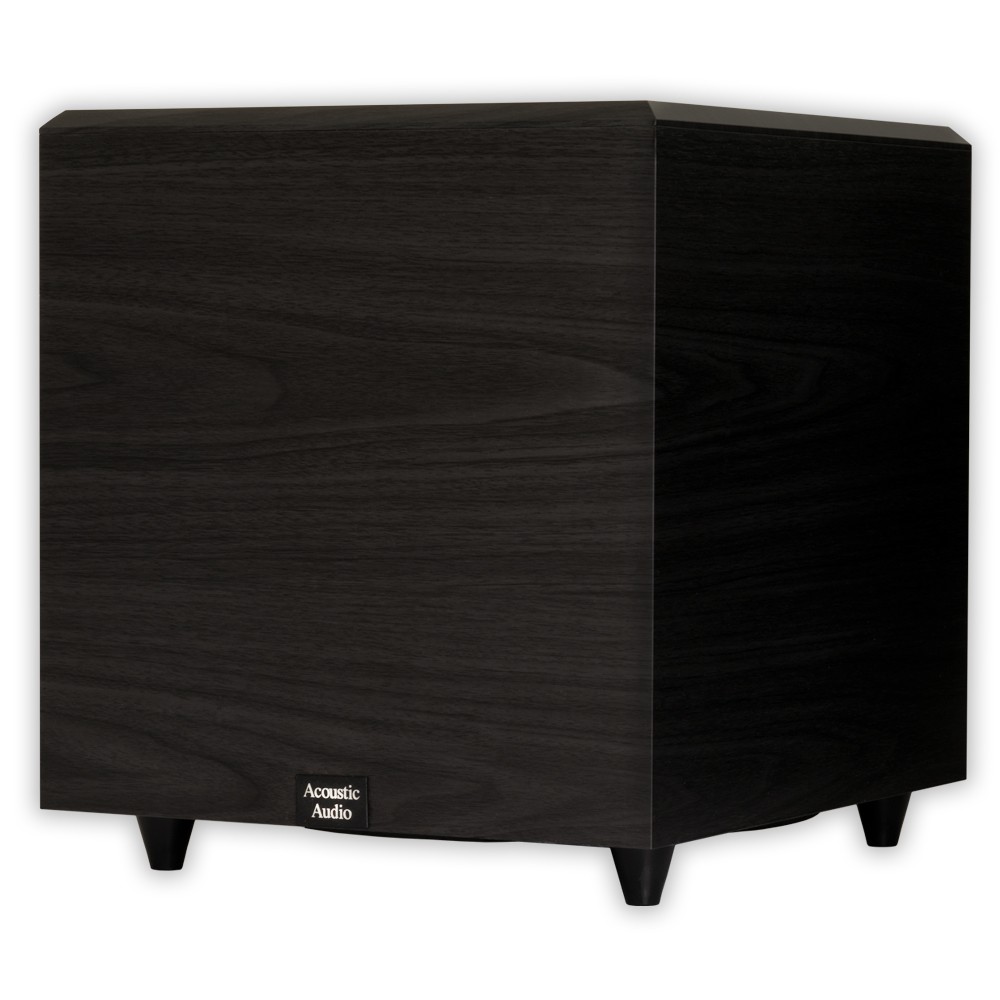

Photos from current listings. Actual item, color, and included accessories may vary.
Acoustic Audio PSW-12 Buying Guide
The Acoustic Audio PSW-12 is a powered 12-inch home theater subwoofer built around a high-excursion driver and a 500-watt peak Class-D amplifier, sold as a budget-oriented bass upgrade. The core trade-off is peak wattage marketing versus real-world continuous output and cabinet rigidity: the PSW-12 delivers usable low-end for modest rooms, but it cannot match the DSP, extension, and build tolerances of enthusiast-tier subs. The decision rule is simple—buy it for a small-to-medium sealed or ported setup where 35–40 Hz output is enough; skip it if you need sub-30 Hz home-theater rumble or calibrated room correction.
Key takeaways
- 12-inch high-excursion driver with a 500-watt peak Class-D amplifier—expect roughly 150–200 watts RMS of usable continuous power.
- Ported (bass-reflex) cabinet tuned near 35–40 Hz; output rolls off steeply below that, so it is not a true sub-30 Hz cinema sub.
- Rear-panel controls are typically limited to volume, phase (0/180), and a variable low-pass filter—no onboard DSP or parametric EQ.
At a glance
- Category
- Home Theater Speakers & Subwoofers
- Status
- Listings available
- Last updated
- Nov 27, 2026
Current offers
Highlights
- 12-inch high-excursion driver with a 500-watt peak Class-D amplifier—expect roughly 150–200 watts RMS of usable continuous power.
- Ported (bass-reflex) cabinet tuned near 35–40 Hz; output rolls off steeply below that, so it is not a true sub-30 Hz cinema sub.
- Rear-panel controls are typically limited to volume, phase (0/180), and a variable low-pass filter—no onboard DSP or parametric EQ.
- Line-level LFE and speaker-level high-level inputs allow connection to both modern AVRs and older stereo receivers without a sub out.
Best use cases
- Best fit: a 12x14 ft to 16x20 ft living room paired with bookshelf or tower speakers for movies and music—pick this tier when 35 Hz extension is acceptable.
- Best fit: a second sub in a dual-sub budget setup, or a first sub for a bedroom/secondary theater where footprint and cost matter more than deep extension.
- Wrong fit: large open-plan rooms above roughly 3,000 cubic feet—skip this and choose a 15-inch or dual-12 ported sub with real RMS power above 500 watts.
- Wrong fit: dedicated Dolby Atmos cinemas demanding 20–25 Hz tactile response—skip the PSW-12 and buy a sub with DSP, sub-25 Hz tuning, and certified continuous output.
Buying tips
- Ignore the 500-watt peak rating and size the sub by RMS: match continuous amplifier power to room volume, roughly 1 watt RMS per cubic foot as a minimum starting point.
- Confirm the low-pass filter tops out at 120–160 Hz so it blends with satellites crossed at 80–120 Hz; a fixed 80 Hz filter limits pairing flexibility.
- Check the driver impedance and amplifier inputs: line-level LFE is required for AVRs, while high-level speaker inputs are needed only for receivers lacking a subwoofer pre-out.
- Verify cabinet construction—look for at least 3/4-inch MDF and internal bracing; thin 5/8-inch walls resonate audibly at high excursion.
Specs
| Driver Size | 12-inch high-excursion woofer |
|---|---|
| Amplifier Power | 500W peak Class-D (~150-200W RMS) |
| Cabinet Type | Ported bass-reflex, ~35-40 Hz tune |
| Inputs | LFE line-level + speaker-level high-level |
Alternatives to compare
Related searches
What to check before buying
- Measure your room and listening distance: a single 12-inch ported sub is appropriate up to roughly 2,500–3,000 cubic feet of room volume.
- Confirm your AV receiver or amplifier has a subwoofer pre-out (LFE) or that you will use the speaker-level inputs—no sub out means relying on high-level connections.
- Plan placement: the PSW-12 needs a few inches of rear clearance for the port and amplifier heat sink; corner loading boosts output but can muddy bass.
- Check voltage and plug standard for your region (120V North America vs 230V export) and confirm the sub ships with the correct power cord.
FAQ
Data sources: eBay / Amazon listings and product attribute feeds. Updated Nov 27, 2026.
Some links on this page are affiliate links. If you buy after clicking one, we may earn a commission at no extra cost to you. This does not change which products appear here or their order. Affiliate disclosure.