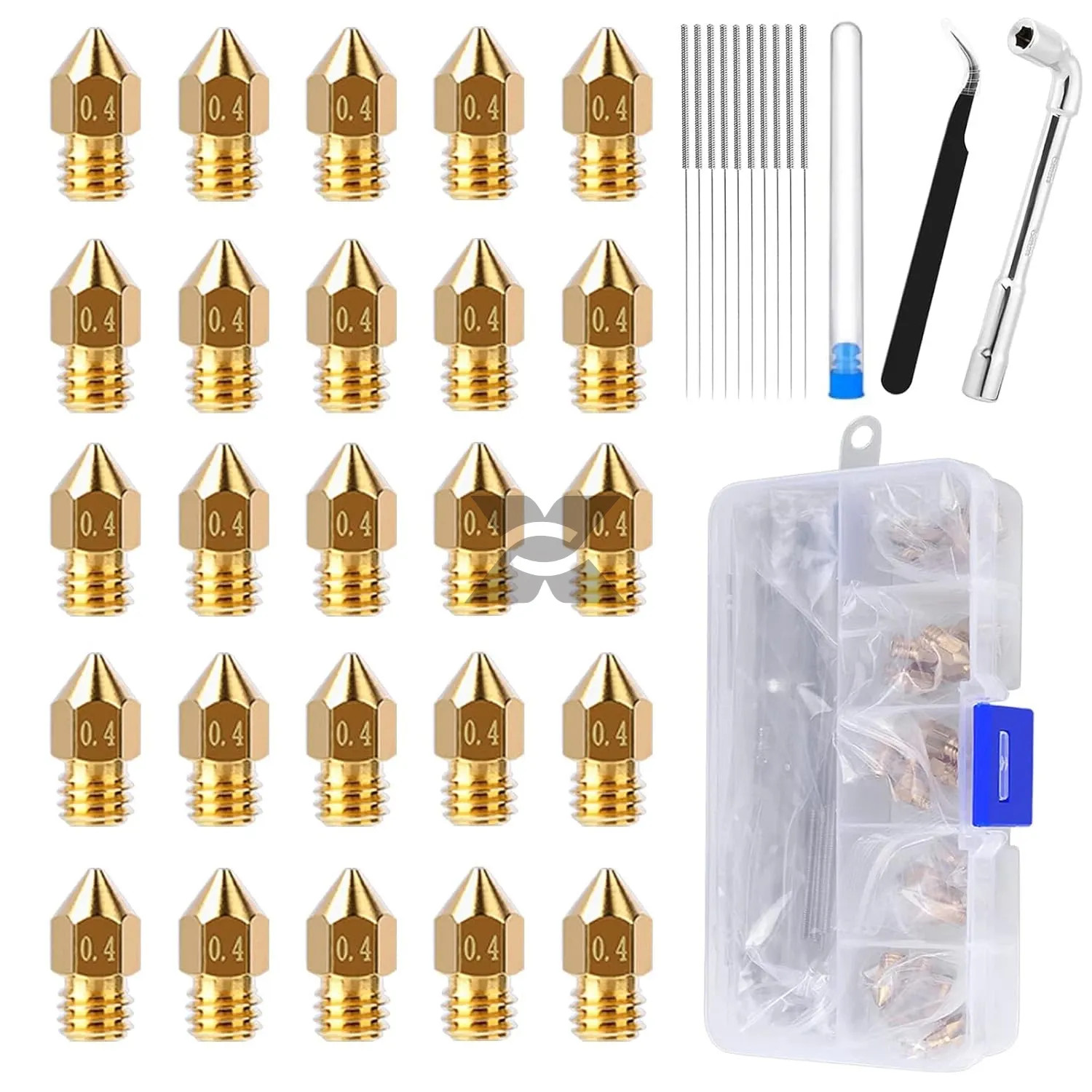

Photos from current listings. Actual item, color, and included accessories may vary.
Nozzle Buying Guide
3D printer nozzles are the final extrusion orifice that controls flow rate, layer resolution, and abrasive-filament longevity. The primary trade-off is between brass (excellent thermal conductivity, low wear) and hardened steel or tungsten carbide (high wear resistance, slightly lower conductivity). Buy brass for standard PLA/PETG printing and step up to hardened steel or carbide once you print abrasive filaments like carbon-fiber or glow-in-the-dark—brass nozzles wear out in hours on abrasives.
Key takeaways
- Brass nozzles offer the highest thermal conductivity but wear rapidly with abrasive filaments; hardened steel lasts many times longer at a small thermal penalty.
- MK8 nozzles use an M6 thread with a 7mm hex and are the standard for Creality Ender 3 series and many clone hotends; V6 nozzles are shorter and fit E3D-style hotends.
- Nozzle orifice diameter sets layer height and flow: 0.4mm is the all-round default, 0.2mm for fine detail, 0.6–0.8mm for fast functional parts, and 1.0mm for large prints with low detail.
At a glance
- Category
- Nozzles, Hotends & Build Plates
- Last updated
- Nov 28, 2026
Current offers
Highlights
- Brass nozzles offer the highest thermal conductivity but wear rapidly with abrasive filaments; hardened steel lasts many times longer at a small thermal penalty.
- MK8 nozzles use an M6 thread with a 7mm hex and are the standard for Creality Ender 3 series and many clone hotends; V6 nozzles are shorter and fit E3D-style hotends.
- Nozzle orifice diameter sets layer height and flow: 0.4mm is the all-round default, 0.2mm for fine detail, 0.6–0.8mm for fast functional parts, and 1.0mm for large prints with low detail.
- Hardened steel nozzles are required for carbon-fiber, glass-fiber, metal-fill, and glow-in-the-dark filaments; brass will erode and distort the orifice within a few spools.
Best use cases
- Best fit: standard PLA, PETG, TPU, and wood-fill on an Ender 3 or MK8 hotend — buy a brass assortment (0.2/0.4/0.6/0.8/1.0mm) to cover detail and draft prints; skip hardened steel unless you print abrasives.
- Best fit: abrasive filaments including CF-PETG, CF-Nylon, glow-in-the-dark, and metal-fill — buy hardened steel 0.4mm nozzles in a multi-pack; skip brass entirely for these materials.
- Best fit: high-volume functional part printing with large layer heights — buy 0.6mm or 0.8mm nozzles in hardened steel; skip 0.2mm nozzles unless you need miniature detail.
- Wrong fit: buying a single nozzle diameter for all tasks — you need at least 0.4mm and one wider (0.6/0.8mm) to balance detail and speed; a 0.2mm-only kit is a niche purchase.
Buying tips
- Match the nozzle thread to your hotend: MK8 (M6 thread, 7mm hex, ~13mm overall length) fits Ender 3 and many MK8 hotends; V6 (M6 thread, shorter) fits E3D V6 and clones — they are not interchangeable.
- Choose orifice by layer-height math: 0.2mm nozzle for 0.05–0.15mm layers, 0.4mm for 0.1–0.3mm, 0.6mm for 0.2–0.4mm, 0.8mm for 0.3–0.5mm; never exceed 80% of nozzle diameter as layer height.
- Buy brass for standard filaments and hardened steel for abrasives; tungsten carbide is the premium option for maximum wear life but costs more and is rarely needed unless you print abrasives constantly.
- Prefer nozzles with a smooth, deburred orifice and consistent hex flats; cheap multi-packs often have off-center holes that cause uneven extrusion — inspect the first nozzle before installing the rest.
Specs
| Nozzle Material | Brass / Hardened Steel / Carbide |
|---|---|
| Thread & Fit | MK8 (7mm hex) vs V6 (shorter) |
| Orifice Range | 0.2 / 0.4 / 0.6 / 0.8 / 1.0 mm |
| Abrasive Rating | Brass: no / Steel & Carbide: yes |
Related searches
What to check before buying
- Confirm your hotend thread standard (MK8 vs V6 vs proprietary) and nozzle length before ordering; MK8 and V6 nozzles are not cross-compatible.
- Measure your hotend's heater block and sock clearance — wider hex nozzles may not fit inside silicone socks or part-cooling ducts.
- Check your printer's maximum nozzle temperature rating: all-metal hotends handle 300°C+, while PTFE-lined hotends should stay below 240–250°C regardless of nozzle material.
- Verify you have the correct wrench or socket (typically 7mm for MK8, 6mm for V6) and a nozzle-cleaning needle matching your orifice size.
FAQ
Data sources: eBay / Amazon listings and product attribute feeds. Updated Nov 28, 2026.
Some links on this page are affiliate links. If you buy after clicking one, we may earn a commission at no extra cost to you. This does not change which products appear here or their order. Affiliate disclosure.