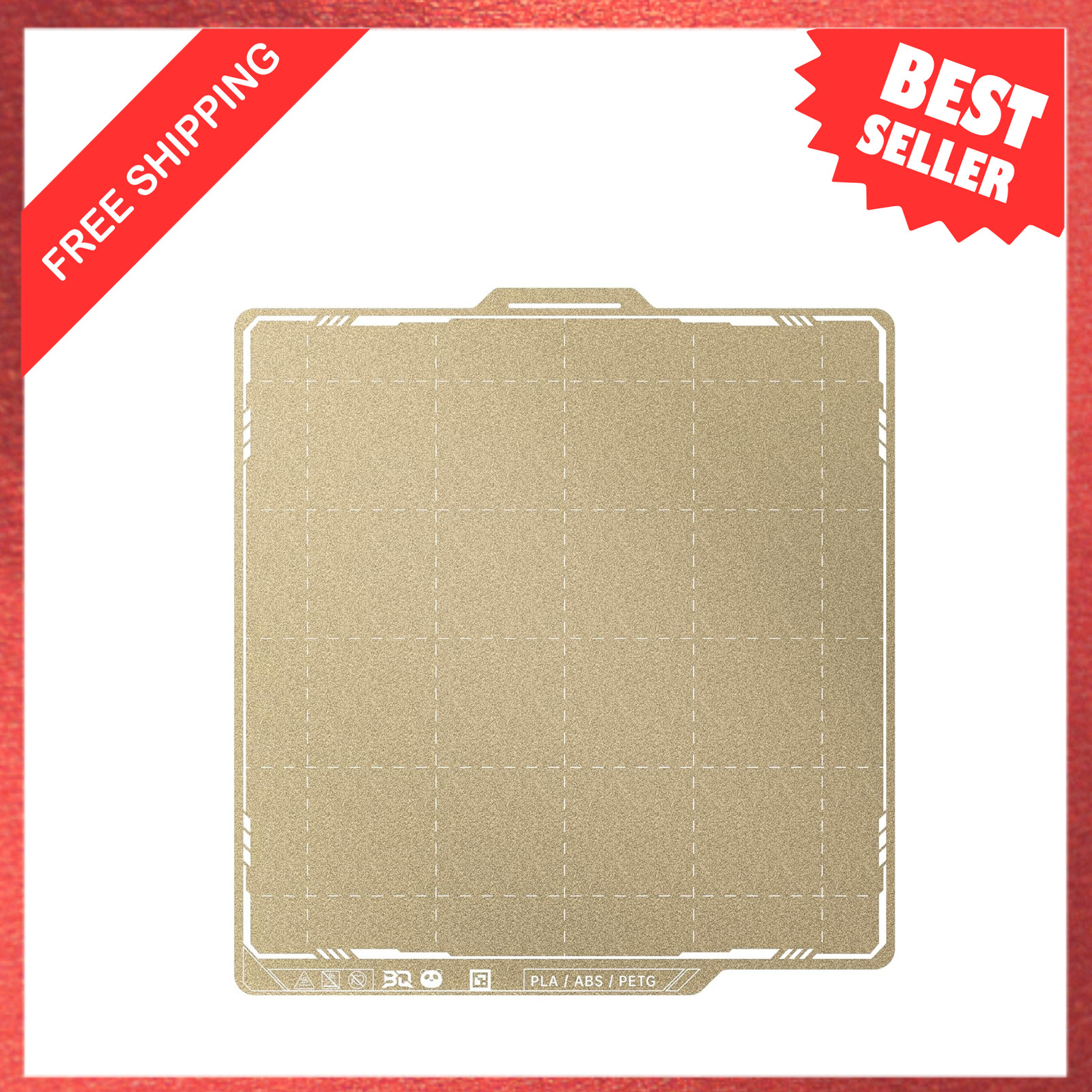

Photos from current listings. Actual item, color, and included accessories may vary.
Pei Build Plate Buying Guide
A PEI build plate is a spring-steel sheet coated with polyetherimide that provides adhesion for 3D printing and releases parts when flexed. The key trade-off is surface finish versus grip: smooth PEI gives a glossy bottom and works for PLA/PETG, while textured PEI hides first-layer flaws and handles higher-temp materials but can transfer a matte grain. Buy the plate sized to your printer's bed and coated on both sides for longevity, or skip generic sheets with unverified coating thickness.
Key takeaways
- Spring-steel core thickness of 0.4–0.5 mm flexes enough to pop parts yet stays flat; thinner 0.25 mm sheets warp and lose adhesion over time.
- PEI coating types: smooth (glossy finish, best for PLA/PETG), textured (matte, hides layer lines, works for ABS/ASA), and satin (middle ground).
- Double-sided plates extend life: rotate or flip when one side wears; single-sided PEI is false economy for frequent printers.
At a glance
- Category
- Nozzles, Hotends & Build Plates
- Last updated
- Nov 28, 2026
Current offers
Highlights
- Spring-steel core thickness of 0.4–0.5 mm flexes enough to pop parts yet stays flat; thinner 0.25 mm sheets warp and lose adhesion over time.
- PEI coating types: smooth (glossy finish, best for PLA/PETG), textured (matte, hides layer lines, works for ABS/ASA), and satin (middle ground).
- Double-sided plates extend life: rotate or flip when one side wears; single-sided PEI is false economy for frequent printers.
- Magnetic base required: a flexible PEI sheet needs a ferromagnetic base or magnetic sticker rated to at least 120°C to hold flat during heated prints.
Best use cases
- Best fit: You print PLA, PETG, or TPU daily and want tool-free part removal — pick a double-sided textured PEI plate sized exactly to your bed (e.g., 235×235 mm for Ender-3, 257×257 mm for Bambu/Prusa MK4 class).
- Best fit: You print ABS/ASA or high-temp materials — choose a textured PEI plate rated to 120°C+ with a 0.5 mm steel core and a high-temp magnetic base; skip smooth PEI if your bed exceeds 100°C routinely.
- Wrong fit: You need a mirror-gloss first layer for display models — a smooth PEI sheet is better than textured, but if you also print PETG at high temp, use a release agent or glue stick to prevent bonding too strong.
- Wrong fit: Your printer lacks a magnetic base or uses a glass bed — a bare PEI sheet won't stay flat; buy a complete kit with magnetic base or a PEI-coated glass plate instead.
Buying tips
- Match the sheet to your bed dimensions exactly: 220×220 mm for Ender-3/CR-10 mini, 235×235 mm for Ender-3 V2/S1, 257×257 mm for Bambu X1/P1 and Prusa MK4; a 1–2 mm overhang is fine, but a smaller sheet leaves unprinted zones.
- Check coating thickness specs: quality PEI coatings are 20–40 µm thick; sub-10 µm coatings wear through in weeks under frequent flexing and scraping.
- For printers with auto bed leveling, confirm the plate thickness matches your stock plate (typically 0.4–0.5 mm steel plus coating) so the probe offset stays accurate.
- Prefer plates with a pull-tab or corner cutout: thin steel sheets are hard to lift without a tab, and prying at the edge delaminates the coating.
Specs
| Surface Type | Smooth / Textured / Satin PEI |
|---|---|
| Steel Core | 0.4–0.5 mm spring steel |
| Max Temp | 120°C+ (standard PEI) |
| Compatibility | Magnetic base required (120°C+) |
Related searches
What to check before buying
- Measure your print bed and current plate thickness (calipers) — the new PEI sheet plus magnetic base must keep the total within your printer's Z-offset adjustment range.
- Confirm your printer has a magnetic base or buy a kit with a high-temperature magnetic sticker rated 120°C+; glass beds need a full replacement plate.
- Check your hotend's max temperature: standard PEI is fine to 120°C, but for PEEK/PEI filament above 150°C you need a specialty high-temp plate.
- Verify the plate ships with protective film on both sides — textured PEI arrives with a blue or clear film that must be peeled before first use.
FAQ
Data sources: eBay / Amazon listings and product attribute feeds. Updated Nov 28, 2026.
Some links on this page are affiliate links. If you buy after clicking one, we may earn a commission at no extra cost to you. This does not change which products appear here or their order. Affiliate disclosure.